
Simple Interest All Competence Aptitude

Question 91
A man loses 55.50 yearly when the annual rate of interest falls from 11.5% to 10%. His capital (in rupees) is ?
Let's denote the capital as \( C \).
Given:
- The man loses Rs. 55.50 yearly when the annual rate of interest falls from 11.5% to 10%.
When the interest rate is 11.5%, the interest earned is \( \dfrac{11.5}{100} \times C \), and when the interest rate is 10%, the interest earned is \( \dfrac{10}{100} \times C \).
The difference in yearly interest due to the change in interest rate is \( \dfrac{11.5}{100}C - \dfrac{10}{100}C = \dfrac{11.5C - 10C}{100} = \dfrac{1.5C}{100} \).
Given that this difference is Rs. 55.50, we can set up the equation:
\[ \dfrac{1.5C}{100} = 55.50 \]
Now, let's solve for \( C \):
\[ C = \dfrac{55.50 \times 100}{1.5} = 3700 \]
So, the man's capital is Rs. 3700.
Therefore, the correct answer is \(\boxed{3700}\).
Not clear enough?
Question 92
The effective annual rate of interest, corresponding to a nominal rate of 6% per annum payable half yearly, is ?
To calculate the effective annual rate of interest, we use the formula for compound interest.
Given:
- Nominal rate of interest \( R \) = 6% per annum
- Compounded semi-annually, meaning \( n = 2 \) times per year
- We know that the nominal rate is half-yearly compounded, so the time period (\( n \)) is also multiplied by 2.
Using the formula for compound interest:
\[ A = P \times \left(1 + \dfrac{r}{n}\right)^{nt} \]
Where:
- \( A \) is the amount after \( t \) years
- \( P \) is the principal amount
- \( r \) is the nominal rate of interest (in decimal form)
- \( n \) is the number of times interest is compounded per year
- \( t \) is the time in years
Let's denote the effective annual rate of interest as \( R_{\text{eff}} \).
Given \( R = 6\% = 0.06 \), we'll find the effective annual rate.
\[ R_{\text{eff}} = \left(1 + \dfrac{0.06}{2}\right)^{2} - 1 \]
\[ R_{\text{eff}} = \left(1 + 0.03\right)^{2} - 1 \]
\[ R_{\text{eff}} = (1.03)^{2} - 1 \]
\[ R_{\text{eff}} = 1.0609 - 1 \]
\[ R_{\text{eff}} = 0.0609 \]
Converting \( 0.0609 \) to a percentage gives \( 6.09\% \).
Therefore, the effective annual rate of interest, corresponding to a nominal rate of 6% per annum payable half-yearly, is \( \boxed{6.09\%} \).
Not clear enough?
Question 93
Nitin borrowed some money at the rate of 6% p.a. for the first three years, 9% p.a. for the next five years and 13% p.a. for the period beyond eight years. If the total interest paid by him at the end of eleven years is 8,160, the money borrowed by him (in) was ?
Let's denote the money borrowed by Nitin as \( P \).
Given:
- Rate of interest for the first three years = 6% per annum
- Rate of interest for the next five years = 9% per annum
- Rate of interest for the period beyond eight years = 13% per annum
- Total interest paid after eleven years = Rs. 8,160
To find the total interest paid, we'll calculate the interest for each period and then sum them up.
For the first three years:\[ \text{Interest}_1 = \dfrac{P \times 6 \times 3}{100} = \dfrac{18P}{100} \]
For the next five years:\[ \text{Interest}_2 = \dfrac{P \times 9 \times 5}{100} = \dfrac{45P}{100} \]
For the period beyond eight years (which is the remaining three years):\[ \text{Interest}_3 = \dfrac{P \times 13 \times 3}{100} = \dfrac{39P}{100} \]
Now, let's sum up the interests:\[ \text{Total Interest} = \dfrac{18P}{100} + \dfrac{45P}{100} + \dfrac{39P}{100} \]
\[ 8160 = \dfrac{18P + 45P + 39P}{100} \]
\[ 8160 = \dfrac{102P}{100} \]
\[ 8160 \times \dfrac{100}{102} = P \]
\[ P = 8000 \]
So, the money borrowed by Nitin was Rs. 8,000.
Therefore, the correct answer is \(\boxed{8,000}\).
Not clear enough?
Question 94
A man buys a TV priced at Rs. 16000. He pays Rs. 4000 at once and the rest after 15 months on which he is charged a simple interest at the rate of 12% per year. The total amount he pays for the TV is ?
Given Information
- Total price of the TV = Rs. 16000
- Initial payment made by the man = Rs. 4000
- Remaining amount to be paid = Rs. 12000
- Rate of interest = 12% per annum
- Time = 15 months
Calculation of Simple Interest (S.I.) for the Remaining Amount
- Using the formula for simple interest:
- Substituting the given values:
Total Amount to be Paid for the Remaining Amount (Principal
- Adding the interest to the principal amount:
Total Amount Paid by the Man for the TV
- Adding the initial payment to the total amount for the remaining amount:
So, the detailed solution shows that the total amount paid by the man for the TV is Rs. 17,800.
Therefore, the correct answer is .
Not clear enough?
Question 95
A sum of money was lent at simple interest at a certain rate for 3 years. Had it been lent at 2.5% per annum higher rate, it would have fetched 540 more. The money lent was ?
Let's denote the principal amount as \( P \) and the original rate of interest as \( R \).
Given:
- Time (\( T \)) = 3 years
- If the rate were 2.5% higher, the interest would be Rs. 540 more.
We'll first calculate the interest earned at the original rate, then at the higher rate, and set up an equation based on the given condition.
1. Interest earned at the original rate:\[ \text{Interest}_1 = \dfrac{P \times R \times T}{100} \]
2. Interest earned at the higher rate (2.5% more than the original rate):\[ \text{Interest}_2 = \dfrac{P \times (R + 2.5) \times T}{100} \]
According to the given condition, the difference in interest is Rs. 540:\[ \text{Interest}_2 - \text{Interest}_1 = 540 \]
Substituting the expressions for the interests:\[ \dfrac{P \times (R + 2.5) \times T}{100} - \dfrac{P \times R \times T}{100} = 540 \]
\[ \dfrac{P \times (R + 2.5) \times 3}{100} - \dfrac{P \times R \times 3}{100} = 540 \]
Now, let's solve this equation for \( P \):
\[ \dfrac{3P(R + 2.5)}{100} - \dfrac{3PR}{100} = 540 \]
\[ \dfrac{3PR + 7.5P - 3PR}{100} = 540 \]
\[ \dfrac{7.5P}{100} = 540 \]
\[ 7.5P = 54000 \]
\[ P = \dfrac{54000}{7.5} \]
\[ P = 7200 \]
So, the money lent was Rs. 7200.
Therefore, the correct answer is \(\boxed{7200}\).
Not clear enough?
Question 96
A sum of Rs. 4000 is lent out in two parts, one at 8% simple interest and the other at 10% simple interest. If the annual interest is Rs. 352, the sum lent at 8% is ?
Let's denote the amount lent at 8% simple interest as \(x\) and the amount lent at 10% simple interest as \(4000 - x\).
Given:
- Total sum lent (\(P\)) = Rs. 4000
- Annual interest (\(SI\)) = Rs. 352
- Rate of interest for the first part (\(R_1\)) = 8%
- Rate of interest for the second part (\(R_2\)) = 10%
We know that:\[ SI = \dfrac{P \times R \times T}{100} \]
For the first part (lent at 8%):\[ SI_1 = \dfrac{x \times 8 \times 1}{100} = \dfrac{8x}{100} = \dfrac{2x}{25} \]
For the second part (lent at 10%):\[ SI_2 = \dfrac{(4000 - x) \times 10 \times 1}{100} = \dfrac{4000 - x}{10} = 400 - 0.1x \]
Given that the total interest is Rs. 352:\[ SI_1 + SI_2 = \dfrac{2x}{25} + 400 - 0.1x = 352 \]
Now, let's solve this equation for \(x\):
\[ \dfrac{2x}{25} + 400 - 0.1x = 352 \]
\[ \dfrac{2x}{25} - 0.1x = 352 - 400 \]
\[ \dfrac{2x}{25} - \dfrac{0.1x \times 25}{25} = -48 \]
\[ \dfrac{2x - x}{25} = -48 \]
\[ \dfrac{x}{25} = -48 \]
\[ x = -48 \times 25 \]
\[ x = -1200 \]
Since the amount lent cannot be negative, we must have made an error in our calculations. Let's try again.
We'll rearrange the equation and then solve for \(x\):
\[ \dfrac{2x}{25} + 400 - 0.1x = 352 \]
\[ \dfrac{2x}{25} - 0.1x = 352 - 400 \]
\[ \dfrac{2x}{25} - \dfrac{10x}{100} = -48 \]
\[ \dfrac{2x}{25} - \dfrac{x}{10} = -48 \]
\[ \dfrac{4x - 5x}{50} = -48 \]
\[ \dfrac{-x}{50} = -48 \]
\[ x = -48 \times 50 \]
\[ x = -2400 \]
Again, we obtained a negative value for \(x\), which is not possible. This suggests an error in our equation setup.
Let's try another approach.
We know that the total interest earned is the sum of the interest earned from both parts:
\[ SI_1 + SI_2 = 352 \]
\[ \dfrac{8x}{100} + \dfrac{(4000 - x) \times 10}{100} = 352 \]
\[ \dfrac{8x}{100} + \dfrac{40000 - 10x}{100} = 352 \]
\[ 8x + 40000 - 10x = 35200 \]
\[ -2x = -4800 \]
\[ x = 2400 \]
So, the sum lent at 8% is Rs. 2400.
Therefore, the correct answer is \(\boxed{\text{Rs. 2400}}\).
Not clear enough?
Question 97
A sum of 400 amounts to 480 in 4 years. What will it amount to if the rate of interest is increased by 2% ?
To solve this problem, we'll first calculate the rate of interest using the given information and then use this rate to find the new amount when the rate is increased by 2%.
Given:
- Principal amount (P) = Rs. 400
- Amount after 4 years (A) = Rs. 480
- Time (T) = 4 years
Using the formula for simple interest:\[ A = P + \text{Interest} \]\[ 480 = 400 + \text{Interest} \]\[ \text{Interest} = 480 - 400 = Rs. 80 \]
Now, we can find the rate of interest (R) using the formula:\[ \text{Interest} = \dfrac{P \times R \times T}{100} \]\[ 80 = \dfrac{400 \times R \times 4}{100} \]\[ 80 = 16R \]\[ R = \dfrac{80}{16} = 5 \]
So, the original rate of interest is 5%.
Now, if the rate of interest is increased by 2%, the new rate of interest becomes \(5\% + 2\% = 7\%\).
Using the new rate of interest, we can find the new amount (A') after 4 years:\[ A' = P + \text{Interest} \]\[ A' = 400 + \left(400 \times \dfrac{7 \times 4}{100}\right) \]\[ A' = 400 + \left(400 \times \dfrac{28}{100}\right) \]\[ A' = 400 + 112 \]\[ A' = 512 \]
So, the new amount after increasing the rate of interest by 2% is Rs. 512.
Therefore, the correct answer is \(\boxed{512}\).
Not clear enough?
Question 98
A sum of money becomes 41/40 of itself in 1/4 years at a certain rate of simple interest. The rate of interest per annum is ?
To solve this problem, we'll first understand the concept of simple interest and then use the given information to find the rate of interest per annum.
Given:
- The amount becomes \( \dfrac{41}{40} \) of itself in \( \dfrac{1}{4} \) years.
Let the principal amount be \( P \) and the rate of interest per annum be \( R \).
Using the formula for simple interest:\[ SI = P \times R \times T \]
Given that the amount becomes \( \dfrac{41}{40} \) of itself in \( \dfrac{1}{4} \) years, the simple interest earned is \( \dfrac{1}{40} \) of the principal amount in \( \dfrac{1}{4} \) years.
So, we can set up the equation:\[ \dfrac{1}{40} \times P = P \times R \times \dfrac{1}{4} \]
Simplify this equation:\[ \dfrac{1}{40} = R \times \dfrac{1}{4} \]
\[ R = \dfrac{1}{40} \times 4 \]
\[ R = \dfrac{1}{10} \]
\[ R = 0.1 \]
Converting this to a percentage, we get \( R = 10\% \).
Therefore, the rate of interest per annum is \(\boxed{10\%}\).
Not clear enough?
Question 99
The sum of money that will yield Rs. 60 as simple interest at the rate of 6% per annum in 5 years is ?
To find the principal amount (the sum of money), we'll use the formula for simple interest:
\[ \text{Simple Interest} (SI) = \dfrac{P \times R \times T}{100} \]
Given:
- Simple Interest (SI) = Rs. 60
- Rate of interest (R) = 6% per annum
- Time (T) = 5 years
We need to find the principal amount (P).
Plugging the given values into the formula, we have:
\[ 60 = \dfrac{P \times 6 \times 5}{100} \]
\[ 60 = \dfrac{30P}{100} \]
\[ 60 \times \dfrac{100}{30} = P \]
\[ P = 200 \]
So, the sum of money that will yield Rs. 60 as simple interest at the rate of 6% per annum in 5 years is Rs. \(\boxed{200}\).
Not clear enough?
Question 100
If a sum of money amounts to 12,900 and 14,250 at the end of 4th year and 5th year respectively at a certain rate of simple interest, then the rate of interest is ?
To find the rate of interest, we can use the concept of simple interest.
Let the principal amount be \( P \) and the rate of interest per annum be \( R \).
Given:
- Amount at the end of the 4th year = Rs. 12,900
- Amount at the end of the 5th year = Rs. 14,250
Using the formula for simple interest:\[ A = P + SI \]
For the 4th year:\[ 12,900 = P + \left(\dfrac{P \times R \times 4}{100}\right) \]
For the 5th year:\[ 14,250 = P + \left(\dfrac{P \times R \times 5}{100}\right) \]
We can subtract the equation for the 4th year from the equation for the 5th year to eliminate \( P \):
\[ 14,250 - 12,900 = \dfrac{P \times R \times 5}{100} - \dfrac{P \times R \times 4}{100} \]
\[ 1,350 = \dfrac{P \times R}{100} \]
Now, we can solve for \( R \):
\[ R = \dfrac{1,350 \times 100}{P} \]
We'll first find the value of \( P \) using any of the given years. Let's use the amount at the end of the 4th year.
\[ P = \dfrac{12,900}{1 + \dfrac{R \times 4}{100}} \]
Now, we'll plug in the given values to find \( P \):
\[ P = \dfrac{12,900}{1 + \dfrac{R \times 4}{100}} \]
\[ P = \dfrac{12,900}{1 + \dfrac{4R}{100}} \]
\[ P = \dfrac{12,900}{1 + 0.04R} \]
Now, we'll plug \( P \) back into our equation for \( R \):
\[ R = \dfrac{1,350 \times 100}{\dfrac{12,900}{1 + 0.04R}} \]
\[ R = \dfrac{135,000}{\dfrac{12,900}{1 + 0.04R}} \]
\[ R = \dfrac{135,000 \times (1 + 0.04R)}{12,900} \]
\[ R = \dfrac{135,000 + 5,400R}{12,900} \]
\[ R \times 12,900 = 135,000 + 5,400R \]
\[ 12,900R = 135,000 + 5,400R \]
\[ 7,500R = 135,000 \]
\[ R = \dfrac{135,000}{7,500} \]
\[ R = 18 \]
So, the rate of interest is \( \boxed{18\%} \).
Not clear enough?
You might like
Determine the amount of subscription included in the income and expenditure account for the year using the following information:
| Description | Amount (N) |
|---|---|
| Subscription in arrears 01/10/06 | 2,000 |
| Subscription in advance 01/10/06 | 1,500 |
| Subscription paid during the year | 7,000 |
| Subscription in arrears 31/12/06 | 3,000 |
This question is based on William Shakespeare's Hamlet.
Those effects which Claudius is still possessed of from the excerpt above are:
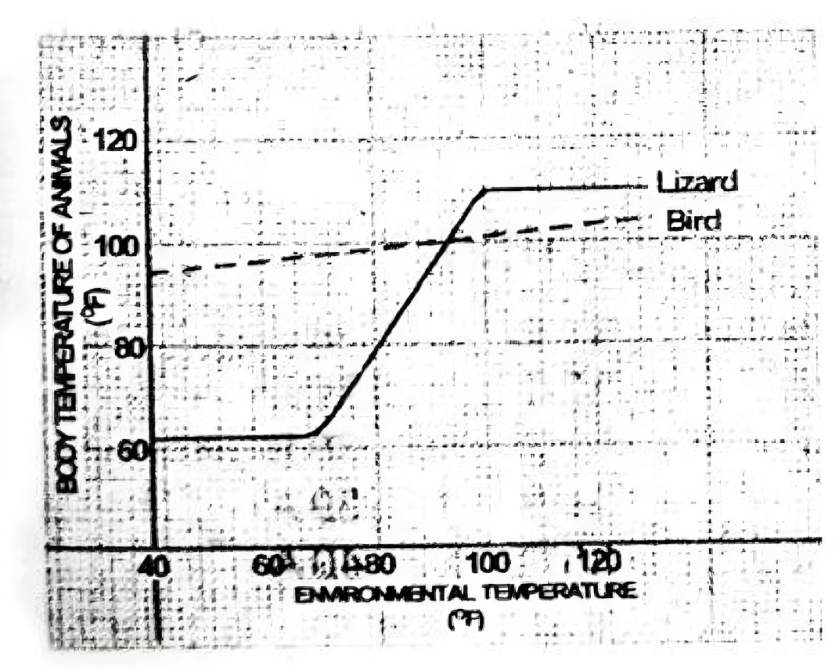
The graph below shows the results of a laboratory investigation which measured the body temperatures of a lizard and a bird under changing artificial conditions.
Use it to answer the question.
A situation in which the bulk of the urban population in a country is concentrated in one town is best described as?