
Blood Relation All Reasoning Aptitude

Question 61
‘ A + B,’ means ‘A is the brother of B’ ‘A - B’ means ‘A is the wife of B’. ‘A × B’ means ‘A is the daughter of B’. ‘A ÷ B’ means ‘A is the father of B’. If P + S × Q × R - T ÷ V ÷ U, then how is T related to P ?
Let's break down the expression step-by-step:
- P + S: This means P is the brother of S.
- × Q: This means Q is the daughter of S (since S is the parent, Q must be the child).
- × R: This means R is the daughter of Q (similarly, Q is the parent, R is the child).
- - T: This means T is the wife of R.
- ÷ V: This means V is the father of T.
- ÷ U: This means U is the father of V.
Now, to determine how T is related to P, we need to consider the relationships established:
- P is the brother of S.
- S is the parent of Q, who is the parent of R.
- R is the wife of T.
- T is the child of V, who is the child of U.
There are two potential relationships between T and P:
- Paternal grandfather: If S is the brother of P, then S's descendant (R) is married to someone (T) whose lineage leads back to P (through V and U). This would make P the paternal grandfather of T.
- Maternal grandfather: If S is the daughter of P, then P would be the maternal grandfather of Q, R, and ultimately T.
However, the expression doesn't explicitly specify whether S is the parent or child of P. Therefore, both A. Paternal grandfather and C. Maternal grandfather are technically possible answers.
Not clear enough?
Question 62
' A + B' means ' A is the sister of B'
'A - B' means ' A is the daughter of B'
'A × B' means ' A is the brother of B'
'A ÷ B' means ' A is the husband of B'
If V + U ×Q - T ÷ R + P × S, then how is P related to V ?
Let's decode the given expressions:
- A + B means 'A is the sister of B'
- A - B means 'A is the daughter of B'
- A × B means 'A is the brother of B'
- A ÷ B means 'A is the husband of B'
Given the expression: V + U × Q - T ÷ R + P × S
Let's solve it step by step:
1. V + U: This means 'V is the sister of U'.
2. U × Q: This means 'U is the brother of Q'.
3. Q - T: This means 'Q is the daughter of T'.
4. T ÷ R: This means 'T is the husband of R'.
5. R + P: This means 'R is the sister of P'.
6. P × S: This means 'P is the brother of S'.
From these deductions:
- V is the sister of U.
- U is the brother of Q.
- Q is the daughter of T.
- T is the husband of R.
- R is the sister of P.
- P is the brother of S.
Based on the information provided, P is the brother of S and R is the sister of P. Also, T is the husband of R.
Therefore, P is the brother of R's sister, which makes P the maternal uncle of V.
So, according to the given expression, P is related to V as:
C. Maternal uncle
Not clear enough?
Question 63
A + B means ‘A is husband of B’ A – B means ‘A is brother of B’ A × B means ‘A is sister of B’ A ÷ B means ‘A is mother of B’ If P + R ÷ S × M – K, then how is R related to K ?
Let's break down the expression P + R ÷ S × M - K step-by-step:
- P + R: P is the husband of R (since + indicates spouses with P as the husband).
- ÷ S: S is the daughter of R (since ÷ indicates parent-child with R as the parent).
- × M: M is the daughter of S (since × indicates parent-child with S as the parent).
- - K: K is the wife of M (since - indicates spouses with K as the wife).
Now, to determine how R is related to K, we need to analyze the established relationships:
- R is the parent of S, who is the parent of M.
- K is the spouse of M.
This tells us that R is C. Mother to K.
Here's the reasoning:
- B cannot be the paternal grandmother because the information given only points to R being S's parent (mother or father) but not their grandparent.
- B cannot be the daughter because R is established as the parent of S, who is then the parent of M (K's spouse).
- B cannot be the sister because there's no indication of siblingship between R and K in the expression.
Therefore, based on the information provided, R's only confirmed relationship to K is that of a mother.
Not clear enough?
Question 64
Manju introduced Sushma to her friend, “Her (Sushma’s) father’s only son’s wife is my mother-in-law.” How is Manju’s husband related to Sushma ?
Let's break down the sentence and analyze the relationships:
- Manju introduced Sushma to her friend: This establishes that Manju and Sushma are acquaintances.
- Her (Sushma's) father's only son's wife: This refers to Sushma's father's son, who is also the wife's husband. Since the son is the only one, it implies that he is Sushma's brother.
- is my mother-in-law: This means that the wife mentioned earlier is married to Manju's husband's father.
Now, to determine Manju's husband's relationship to Sushma:
- If Sushma's brother (her father's only son) is married to Manju's mother-in-law, then his wife is Manju's husband's mother.
- Therefore, Sushma's brother is Manju's husband's uncle.
Therefore, the answer is C. Nephew.
Here's the simplified family tree:
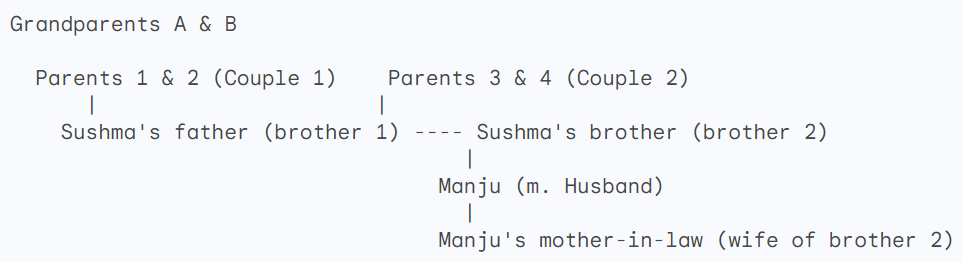
Not clear enough?
Question 65
A+ B means ‘A is the father of B; A - B means ‘A is the sister of B; A × B means ‘A is the brother of B; A ÷ B means ‘A is the mother of B; If, U + H × L - Q ÷ R - Y, then how is L related to Y ?
Let's decode the given expressions:
- A + B means 'A is the father of B'
- A - B means 'A is the sister of B'
- A × B means 'A is the brother of B'
- A ÷ B means 'A is the mother of B'
Given the expression: U + H × L - Q ÷ R - Y
Let's solve it step by step:
1. U + H: This means 'U is the father of H'.
2. H × L: This means 'H is the brother of L'.
3. L - Q: This means 'L is the sister of Q'.
4. Q ÷ R: This means 'Q is the mother of R'.
5. R - Y: This means 'R is the sister of Y'.
From these deductions:
- U is the father of H.
- H is the brother of L.
- L is the sister of Q.
- Q is the mother of R.
- R is the sister of Y.
Now, let's find the relation between L and Y:
- L is the sister of Q.
- Q is the mother of R.
- R is the sister of Y.
Therefore, based on the deductions, L is the maternal aunt of Y.
Hence, according to the given expression, L is related to Y as:
D. Mother’s Sister
Not clear enough?
Question 66
‘A + B’ means ‘A is the mother of B’. ‘ A - B’ means ‘A is the wife of B’. ‘ A ? B’ means ‘A is the brother of B’. ‘ A ÷ B’ means ‘A is the husband of B’. If T ÷ V + Q - J ? M + U , then how is T related to J ?
Let's break down the given expressions:
- A + B means 'A is the mother of B'
- A - B means 'A is the wife of B'
- A ? B means 'A is the brother of B'
- A ÷ B means 'A is the husband of B'
Given the expression: T ÷ V + Q - J ? M + U
Let's solve it step by step:
1. T ÷ V: This means 'T is the husband of V'.
2. V + Q: This means 'V is the mother of Q'.
3. Q - J: This means 'Q is the wife of J'.
4. J ? M: This means 'J is the brother of M'.
5. M + U: This means 'M is the mother of U'.
From these deductions:
- T is the husband of V.
- V is the mother of Q.
- Q is the wife of J.
- J is the brother of M.
- M is the mother of U.
Now, let's find the relation between T and J:
- T is the husband of V.
- V is the mother of Q.
- Q is the wife of J.
Therefore, based on the deductions, T is the father-in-law of J.
Hence, according to the given expression, T is related to J as:
A. Father-in-law
Not clear enough?
Question 67
‘A + B’ means ‘A is the brother of B’. ‘A - B’ means ‘A is the husband of B’. ‘A ? B’ means ‘A is the mother of B’. ‘A ÷ B’ means ‘A is the sister of B’. If P + R ÷ T - K ? O ? C, then how is P related to O ?
Let's break down the given expressions:
- A + B means 'A is the brother of B'
- A - B means 'A is the husband of B'
- A ? B means 'A is the mother of B'
- A ÷ B means 'A is the sister of B'
Given the expression: P + R ÷ T - K ? O ? C
Let's solve it step by step:
1. P + R: This means 'P is the brother of R'.
2. R ÷ T: This means 'R is the sister of T'.
3. T - K: This means 'T is the husband of K'.
4. K ? O: This means 'K is the mother of O'.
5. O ? C: This means 'O is the brother of C'.
From these deductions:
- P is the brother of R.
- R is the sister of T.
- T is the husband of K.
- K is the mother of O.
- O is the brother of C.
Now, let's find the relation between P and O:
- P is the brother of R.
- R is the sister of T.
- T is the husband of K.
- K is the mother of O.
Therefore, based on the deductions, P is the maternal uncle of O.
Hence, according to the given expression, P is related to O as:
C. Paternal Uncle
Not clear enough?
Question 68
‘A + B’ means ‘A is the sister of B’. ‘A - B’ means ‘A is the brother of B’. ‘A × B’ means ‘A is the mother of B’. ‘A ÷ B’ means ‘A is the father of B’. If V + S × Q - P ÷ T + R × U, then how is R related to S ?
Let's decode the given expressions:
- A + B means 'A is the sister of B'
- A - B means 'A is the brother of B'
- A × B means 'A is the mother of B'
- A ÷ B means 'A is the father of B'
Given the expression: V + S × Q - P ÷ T + R × U
Let's solve it step by step:
1. V + S: This means 'V is the sister of S'.
2. S × Q: This means 'S is the mother of Q'.
3. Q - P: This means 'Q is the brother of P'.
4. P ÷ T: This means 'P is the father of T'.
5. T + R: This means 'T is the sister of R'.
6. R × U: This means 'R is the mother of U'.
From these deductions:
- V is the sister of S.
- S is the mother of Q.
- Q is the brother of P.
- P is the father of T.
- T is the sister of R.
- R is the mother of U.
Now, let's find the relation between R and S:
- R is the mother of U.
Therefore, based on the deductions, R is the maternal grandmother of U.
Hence, according to the given expression, R is related to S as:
C. Grand-Daughter
Not clear enough?
Question 69
Pointing to a portrait of a lady, kanika said, “Her daughter-in-law is the wife of my son’s grandfather’s only son.” How is the lady in the portrait related to kanika ?
Let's break down the information provided:
Kanika said, "Her daughter-in-law is the wife of my son’s grandfather’s only son."
This implies the following relationships:
- The lady in the portrait has a daughter-in-law.
- The daughter-in-law is married to someone who is described as "my son’s grandfather’s only son" by Kanika.
Let's decipher this:
- Kanika's son's grandfather's only son would be Kanika's husband or Kanika's son (as the son is the only son of Kanika's husband).
Therefore, the lady in the portrait is Kanika's mother-in-law. So, Kanika is related to the lady in the portrait as:
B. Mother-in-law
Not clear enough?
Question 70
Pointing to a portrait of a man, Ravish said, “ I am the only child of my parents but that man’s father is my father’s son”. How is the man in the portrait related to Ravish ?
Let's break down the statement:
Ravish said, "I am the only child of my parents but that man’s father is my father’s son."
From the given statement:
- Ravish mentioned that he is the only child of his parents.
- Ravish stated that the man in the portrait's father is Ravish's father’s son.
If the man in the portrait's father is Ravish's father’s son, then that person is actually Ravish himself. This is because Ravish's father’s son refers directly to Ravish.
Therefore, the man in the portrait is Ravish himself. So, Ravish is related to the man in the portrait as:
D. Son
Not clear enough?
You might like
3 men or 5 women can do a work in 12 days. How long will 6 men and 5 women take to finish the work ?
Choose the word or phrase which is most nearly opposite in meaning to the word in capitals.
SUBROSA :
Which of the following ions require the largest quantity of electricity for discharge at an electrode?