
Agricultural Science 2020 Jamb Examination
Agricultural Science 2020 Jamb Examination

Question 31
Crop rotation has the following effects on the soil except
Crop rotation is an agricultural practice where different crops are planted in succession on the same land to maintain soil productivity. It helps replenish soil nutrients, reduces the build-up of crop-specific pests and diseases, and improves soil structure by alternating between deep-rooted and shallow-rooted crops. However, it does not predispose the soil to leaching. Instead, leaching is mainly influenced by excessive rainfall, poor soil type, and lack of proper land management. Therefore, crop rotation is beneficial rather than harmful in this regard.
Not clear enough?
Question 32
Which of the following is an example of igneous rock?
Igneous rocks are formed from the cooling and solidification of molten magma. Granite is a well-known igneous rock composed mainly of quartz, feldspar, and mica, giving it a coarse-grained texture. Gneiss is a metamorphic rock, limestone is sedimentary, and sandstone is also sedimentary. Hence, granite is the correct example of an igneous rock.
Not clear enough?
Question 33
A biotic factor influencing agricultural production is
Biotic factors are living components that affect agricultural production. Examples include predators, pests, parasites, and diseases. Predators, such as birds or insects that feed on crops or livestock, directly influence productivity. Rainfall, soil structure, and wind are abiotic (non-living) factors. Therefore, predators are biotic influences on agriculture.
Not clear enough?
Question 34
Which of the following nutrient element is a macro-nutrient?
Macronutrients are mineral nutrients required by plants in large quantities, such as nitrogen, phosphorus, potassium, calcium, magnesium, and sulphur. Phosphorus plays a major role in energy transfer, root development, and flowering. Zinc, iron, and manganese, though essential, are required in very small quantities and are classified as micronutrients.
Not clear enough?
Question 35
In encouraging farmers to produce more of a particular crop, the Nigerian government has helped farmers in marketing that crop through the establishment of
Marketing boards were established by the government to regulate and promote the sale of cash crops such as cocoa, groundnut, and palm produce. They guaranteed stable prices, provided a ready market for farmers, and helped encourage production. Schools of agriculture and extension offices provide education and training, while markets exist for sales but are not government-established structures for stabilising trade.
Not clear enough?
Question 36

The diagram above shows parts of a plough.
Study it and answer this question.
The part labelled I in the diagram is the
In a plough, the mould board is the curved surface that turns over the cut slice of soil. It works in conjunction with the plough share, which cuts into the soil, while the mould board lifts and inverts it. The hitch is the connecting point to the tractor or draught animal, and the handle provides control. From the diagram, the part labelled I corresponds to the mould board.
Not clear enough?
Question 37
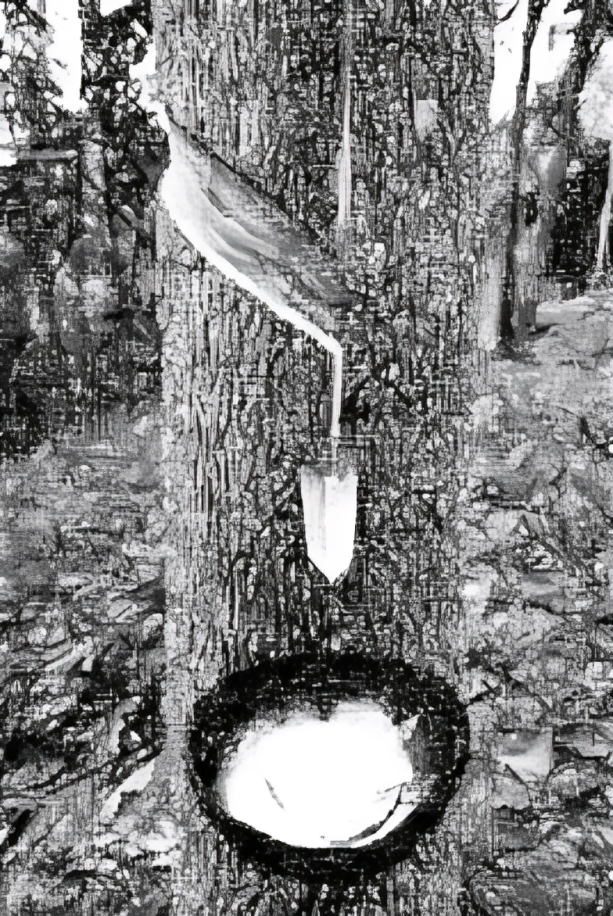
Study the diagram above and answer the question.
The crop associated with the diagram above is?
The diagram depicts latex tapping, which involves cutting grooves into the bark of a rubber tree to extract latex. This method is unique to Hevea brasiliensis, the natural rubber tree. Theobroma cacao produces cocoa pods, Zingiber officinale is ginger, and Gossypium hirsutum is cotton, none of which are tapped for latex.
Not clear enough?
Question 38
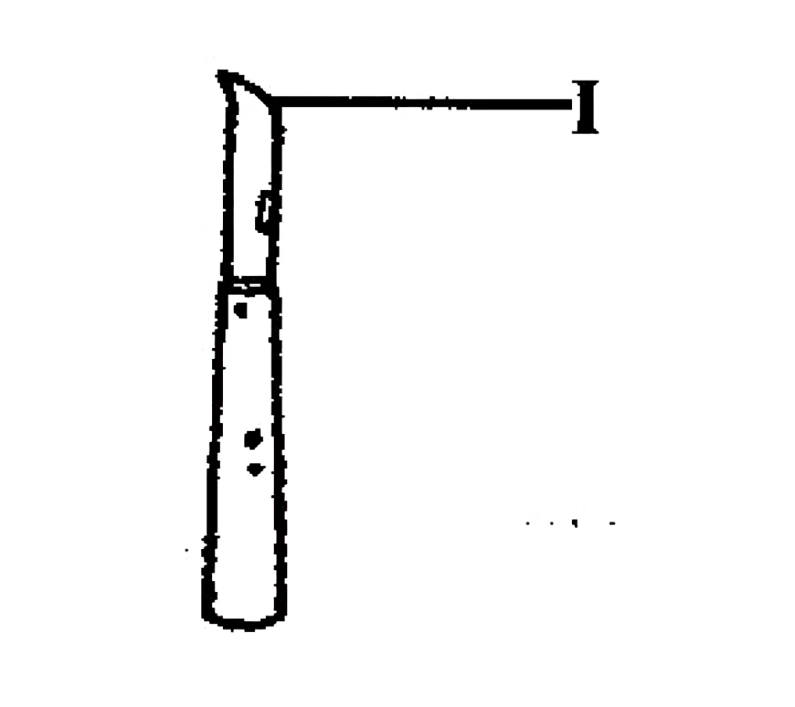
During which of the following plant propagation methods is the tool represented used?
The tool shown is a budding knife, which is specifically designed for budding, a vegetative propagation method. In budding, a bud from a desired plant is inserted under the bark of a rootstock so that it grows and forms a new plant. This knife allows precise cuts necessary for successful budding, unlike seed planting, transplanting, or layering which require different tools.
Not clear enough?
Question 39
Study the diagram above and answer the question.
The farm tool associated with the diagram above is
The tool in the diagram is long and narrow, resembling a tapping knife used in rubber plantations. It is designed to make precise cuts into the bark for latex collection. Secateurs and shears are for pruning, while cutlasses are for clearing. Thus, the tool is most accurately identified as a knife.
Not clear enough?
Question 40

From the curve above, at what point is it advisable for the farmer to stop further addition of input?
The diagram represents the law of diminishing returns, where output increases initially with added input, but eventually the rate of increase slows and becomes uneconomical. Point III typically represents the stage where the marginal returns begin to decline, meaning further input would not significantly increase output and may reduce profit. Thus, the rational decision is to stop at point III.
Not clear enough?
You might like
A bullet fired vertically upward from a gun held 2.0 m above the ground reaches its maximum height in 4.0 s. Calculate its initial velocity.
[g = 10 m/s²]
To what volume must 300 cm³ of 0.60 M sodium hydroxide solution be diluted to give a 0.40 M solution?
In a database, all the information about one specific subject (such as a single person, product, or transaction) is called a __________.
"Blessed is the King who comes in the name of the Lord! Peace in heaven and glory in the highest!". This verse is connected with
8 men can do a work in 12 days. After 6 days of work, 4 more men were engaged to finish the work. In how many days would the remaining work be completed ?