
Chemistry 2004 Jamb Examination

Question 31
Hardness of water is caused by the presence of the ions of
The correct option is A. calcium and magnesium.
Hardness in water is primarily caused by the presence of calcium (Ca²⁺) and magnesium (Mg²⁺) ions. These ions react with soap to form insoluble compounds, which is why hard water can lead to soap scum and scaling.
Not clear enough?
Question 32
It is difficult to achieve an orderly arrangement of the molecules of a gas because they.
The correct option is C. have little force of attraction between them.
In gases, the molecules are far apart and interact minimally with each other due to the weak intermolecular forces. This weak attraction means that gas molecules move freely and randomly, making it difficult to achieve an orderly arrangement.
Not clear enough?
Question 33
The shape of the s-orbital is
The correct option is D. spherical.
The shape of the s-orbital is spherical, meaning it is symmetric around the nucleus and extends equally in all directions.
Not clear enough?
Question 34
Which of the following mixtures of gases is likely to burn in flame?
The correct option is C. Neon and hydrogen.
Hydrogen is a flammable gas, and when mixed with neon (which is inert), the hydrogen can still burn in a flame. The other mixtures consist of gases that are not flammable or do not support combustion.
Not clear enough?
Question 35
The property of chlorine which cause hydrogen chloride to bemore ionic than the chlorine molecule is its.
The correct option is A. electronegativity.
The property of chlorine that causes hydrogen chloride (HCl) to be more ionic than the chlorine molecule (Cl₂) is its electronegativity. Chlorine has a high electronegativity, which means it attracts electrons strongly when it forms bonds, leading to the formation of a more ionic bond in HCl.
Not clear enough?
Question 36
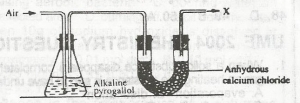
In the experiment above, X is mixture of nitrogen, carbon 1V) oxide and
B. inert gas
Not clear enough?
Question 37
A given volume ofmethane diffuses in 20s. How long will it take same volume of sulphur (V1) oxide to diffuse
under the same conditions?
[C=12,H=1, S=32,O=16]
The correct option is A. 40 s
To solve this, use Graham's law of effusion, which states that the rate of diffusion of a gas is inversely proportional to the square root of its molar mass:
\[ \dfrac{\text{Rate}_1}{\text{Rate}_2} = \sqrt{\dfrac{\text{Molar mass}_2}{\text{Molar mass}_1}}\]
For methane (CH₄) and sulfur dioxide (SO₂):
- Molar mass of CH₄: \(12 + (1 \times 4) = 16 \text{ g/mol}\)
- Molar mass of SO₂: \(32 + (16 \times 2) = 64 \text{ g/mol}\)
Thus:
\[ \dfrac{\text{Rate}_{\text{CH}_4}}{\text{Rate}_{\text{SO}_2}} = \sqrt{\dfrac{64}{16}} = \sqrt{4} = 2\]
So, sulfur dioxide diffuses at half the rate of methane. If methane takes 20 seconds to diffuse, sulfur dioxide will take twice as long:
\[ \text{Time}_{\text{SO}_2} = 2 \times 20 \text{ s} = 40 \text{ s}\]
Not clear enough?
Question 38
Chlorine consisting of two isotopes of mass numbers 35 and 37 in the ratio 3:1 has an atomic mass of 35.5.
Calculate the relative abundance of the isotope of mass number 37.
The correct option is D. 25.
To find the relative abundance of the isotope with mass number 37, we use the following method:
- Denote the abundances:
• Let \( x \) be the abundance of the isotope with mass number 35.
• Let \( y \) be the abundance of the isotope with mass number 37. - Set up the equations:\[ x + y = 100 \]\[ x = 3y \]
- Substitute \( x = 3y \) into the total abundance equation:\[ 3y + y = 100 \]\[ 4y = 100 \]\[ y = 25 \]
Thus, the relative abundance of the isotope with mass number 37 is 25%.
Not clear enough?
Question 39
An electron can be added to a halogen atom to form a halide ion with
The correct option is A. 8 valence electrons.
When an electron is added to a halogen atom, which originally has 7 valence electrons, it forms a halide ion (X⁻) with 8 valence electrons, achieving a stable electron configuration similar to the nearest noble gas.
Not clear enough?
Question 40
The correct option is D. 222.
In the given nuclear reaction:
The alpha particle is represented as . When an alpha particle is emitted, the mass number decreases by 4 and the atomic number decreases by 2. Therefore, the resulting element is radon ().