
Chemistry 2006 Jamb Examination

Question 41
When inert platinum electrodes are used, Cu²⁺ ions are discharged at the cathode, while OH⁻ ions (from water) are discharged at the anode. The correct anode reaction is:
\[4OH⁻ → 2H₂O + O₂ + 4e⁻\]
This corresponds to option B.
Not clear enough?
Question 42
Calculate moles of HCl used.
\[ = C \times V = 0.05 \times \dfrac{10}{1000} = 5.0 \times 10^{-4} \text{ mol}\]
From equation, 2 mol HCl neutralizes 1 mol Na₂CO₃.
So moles of Na₂CO₃ = \(\dfrac{5.0 \times 10^{-4}}{2} = 2.5 \times 10^{-4}\).
That is the number of moles present in 25 cm³ solution. To find per dm³ (not asked, but check):
\[\dfrac{2.5 \times 10^{-4}}{25 \times 10^{-3}} = 0.010 \text{ mol dm}^{-3}.\]
Hence, the moles in 25 cm³ = 0.010 mol. Option C.
Not clear enough?
Question 43
Heat of combustion of hydrogen refers to the reaction:
\[H₂(g) + \tfrac{1}{2}O₂(g) → H₂O(l) \]\[\quad \Delta H = -285.8 \text{ kJ}\]
This is the same as the enthalpy of formation of water from its elements. Therefore:
\[\Delta H_f (H₂O) = -285.8 \text{ kJ mol}^{-1}\]
So the correct answer is option C.
Not clear enough?
Question 44
KMnO₄ is purple due to MnO₄⁻. In acidic medium, MnO₄⁻ is reduced to Mn²⁺, which is almost colourless in solution:
\[MnO₄⁻ + 8H⁺ + 5e⁻ → Mn²⁺ + 4H₂O\]
Thus, the purple colour disappears, leaving a colourless solution. Option D is correct.
Not clear enough?
Question 45
In the diagram below, gas X is:
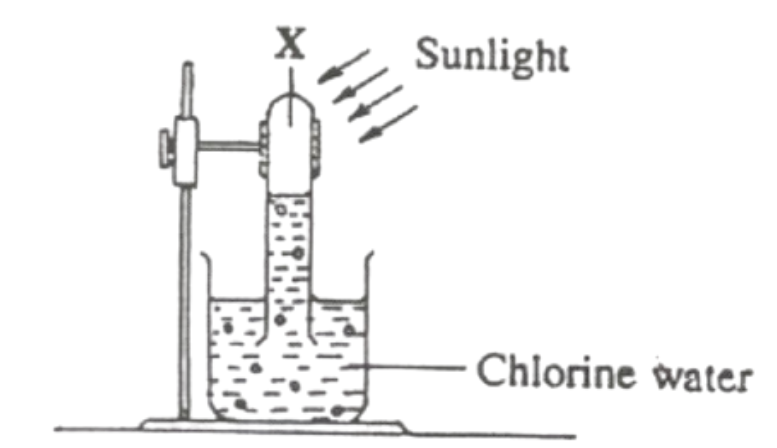
Gas X is collected over water. For this method, the gas must be insoluble (or only slightly soluble) in water.
Hydrogen (H₂) is light, insoluble in water, and collected by upward delivery. Chlorine (Cl₂) and hydrogen chloride (HCl) are soluble in water.
Therefore, the gas is hydrogen. Correct answer: A.
Not clear enough?
Question 46
In the diagram below, mixture Y is:
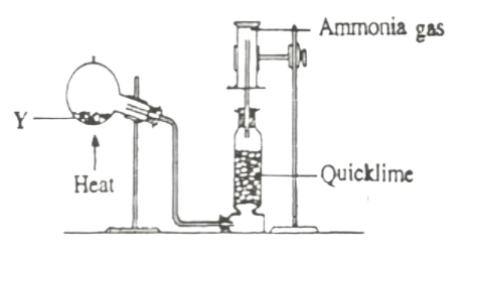
2NH₄Cl + Ca(OH)₂ → CaCl₂ + 2NH₃ + 2H₂O
The reaction between ammonium chloride and calcium hydroxide is a double displacement reaction. However, in the reaction between ammonium chloride (NH₄Cl) and calcium hydroxide (Ca(OH)₂), quicklime (CaO) is used to dry the ammonia gas (NH₃) produced by absorbing water, preventing the formation of ammonium sulphate when sulphuric acid is used to dry the gas.
Not clear enough?
Question 47
The oxidation of the compound below produces:
CH₃—CH₂—CH(OH)—CH₃
The compound is a secondary alcohol (2-butanol).
Oxidation of secondary alcohols yields ketones:
\[ CH₃CH₂CH(OH)CH₃ → CH₃CH₂COCH₃ + H₂ \]
That product is 2-butanone. Correct option A.
Not clear enough?
Question 48
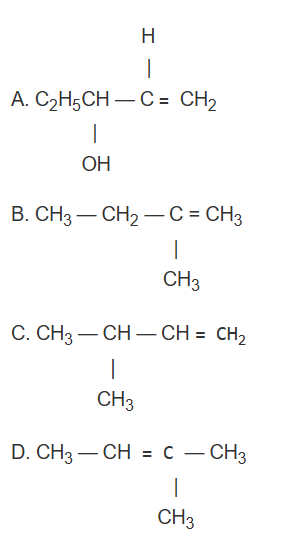
2-methylbut-2-ene has the structure:
2-methylbut-2-ene = a 5-carbon chain with a double bond at C-2 and a methyl substituent at C-2: $CH_3C(CH_3) = CHCH_3 $
This matches option D.
Not clear enough?
Question 49
Which of the following functional groups will give gas bubbles when treated with NaHCO₃(aq)?
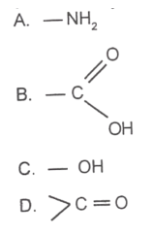
When a carboxylic acid (RCOOH) reacts with sodium bicarbonate (NaHCO3), it forms a salt (RCOONa), water (H2O), and carbon dioxide (CO2). The carbon dioxide gas produced in this reaction is what causes the bubbles or effervescence observed.
- RCOOH + NaHCO3 → RCOONa + H2O + CO2
This reaction is a simple and reliable test to distinguish carboxylic acids from other organic compounds, as most other functional groups (like alcohols or phenols) are not acidic enough to react with bicarbonate and produce a gas.
Not clear enough?
Question 50
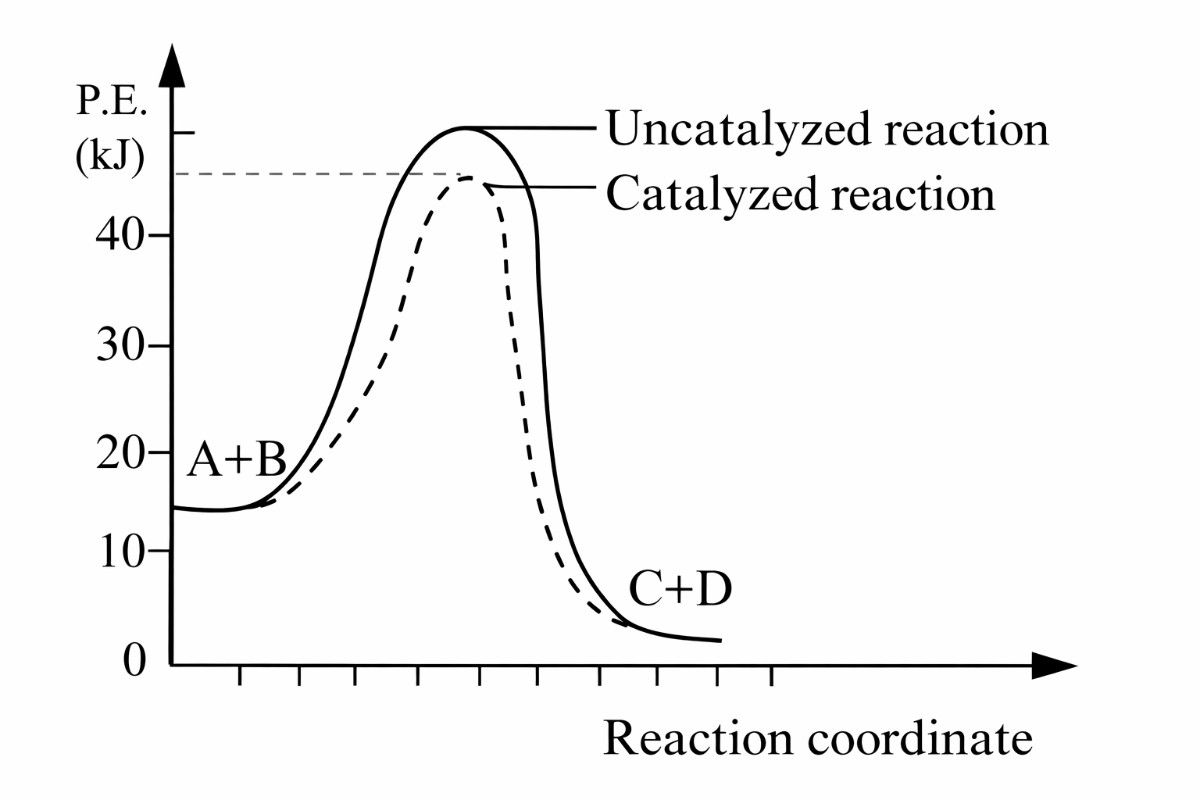
In the diagram above, the respective activation energies for the catalyzed and uncatalyzed reactions in kJ are:
The activation energy, Ea is the energy of the transition state, (T.E) minus the reactant energy (R.E).
For Catalyzed reaction, Ea = T.E - R.E = 45 - 15 = 30
For Uncatalyzed reaction, Ea = T.E - R.E = 50 - 15 = 35
Not clear enough?
You might like
A machine bought for ₦35,000 was estimated to have a life span of 5 years with a scrap value of ₦9,000. If the scrap value is presently ₦15,000, what will be the yearly depreciation using the straight line method?
A physical weathering process in which sheets of rock are fractured and detached from an outcrop is termed as:
Choose the word or phrase which is most nearly opposite in meaning to the word in capitals.
CALUMINATE: