Chemistry 2009 Jamb Examination

Chemistry 2009 Jamb Examination

Available Sections
2. Career
4. Job
123456

Question 31

$$C(s) + H_2O(g) \rightarrow H_2(g) + CO_2(g)$$

ΔG for the reaction above at 1300 K is $$\Delta G = -43\ \text{kJ}$$. At this temperature, the reaction is
Show explanation Expand Question
Gibbs free energy determines spontaneity. A negative value of $$\Delta G$$ indicates the reaction can proceed without external work. Here, $$\Delta G = -43\ \text{kJ}$$ at 1300 K, which shows the process is thermodynamically spontaneous (feasible) under those conditions. Note: exothermic refers to enthalpy change, not directly to $$\Delta G$$.
Not clear enough?

Question 32

Two equal bulbs, one containing ammonia and the other nitrogen are opened mouth-to-mouth to each other at room temperature. The entropy in the mixture of gases is likely to
Show explanation Expand Question
Mixing two different ideal gases increases the number of accessible microstates and therefore increases disorder. Entropy is a measure of that disorder. When ammonia and nitrogen mix spontaneously, randomness rises and the system entropy increases in accordance with the second law of thermodynamics.
Not clear enough?

Question 33

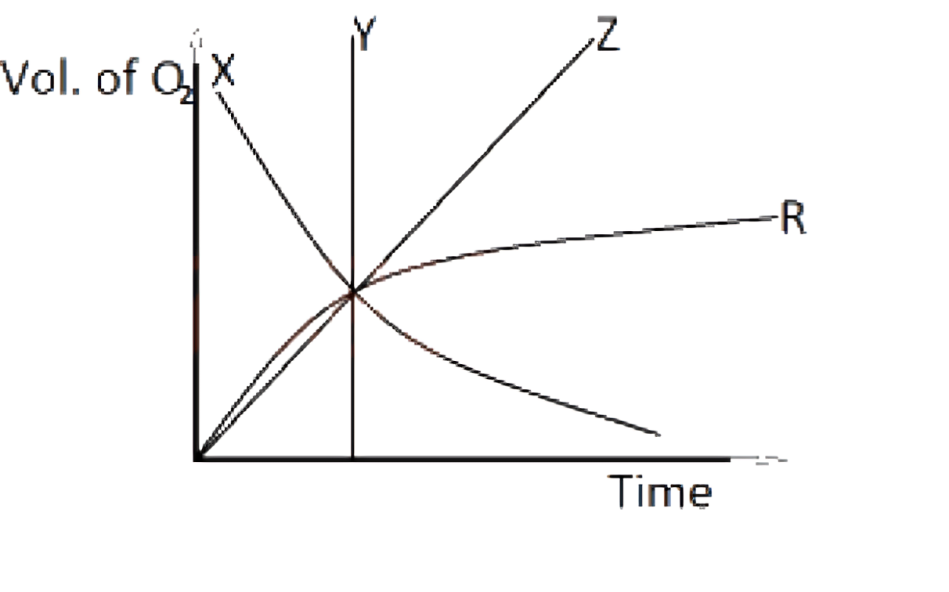
the evolution of oxygen with time in the equation 2KClO3(s) → 2KCl(s) + 3O2(g)?

In the diagram above, which of the curves represents the evolution of oxygen with time in the equation $2KClO_3(s) \rightarrow 2KCl(s) + 3O_2(g)$?

Show explanation Expand Question

Decomposition of potassium chlorate produces oxygen gas gradually until the reactant is consumed. The oxygen volume rises with time and then levels off as the reaction nears completion. Curve Z best matches that kinetic profile: a steady increase followed by a plateau when the solid is exhausted.

Not clear enough?

Question 34

The acid used in electrolysis of water is dilute
Show explanation Expand Question
Dilute sulfuric acid, $$H_2SO_4$$, is commonly used to increase the conductivity of water for electrolysis. Sulfate ions are stable under conditions used and do not produce interfering gases the way chloride can; nitric acid and acetic acid are less commonly used for routine electrolysis of pure water.
Not clear enough?

Question 35

What volume of 1.5 M solution of KOH would contain 0.045 moles?

(Give your answer in cm$^3$)
Show explanation Expand Question
Use the relation between moles, concentration and volume. First compute volume in litres, then convert to cm³.
$$n = 0.045\ \text{mol}$$$$C = 1.5\ \text{mol L}^{-1}$$$$V = \dfrac{n}{C} = \dfrac{0.045}{1.5} = 0.03\ \text{L}$$Converting to cubic centimetres: $$0.03\ \text{L} = 30.0\ \text{cm}^3$$. Thus the correct volume is 30.00 cm³.
Not clear enough?

Question 36

The salt formed from a reaction between citric acid and sodium hydroxide in solution will be
Show explanation Expand Question
Citric acid is a triprotic weak acid and sodium hydroxide is a strong base. Neutralization yields the conjugate base (a citrate salt) which, because it comes from a weak acid and a strong base, produces a basic solution due to hydrolysis of the anion. For example:

C6H8O7 + 3NaOH → Na3C6H5O7 + 3H2O

The citrate anion hydrolyzes slightly to produce OH⁻, making the solution basic.
Not clear enough?

Question 37

The colour changes observed when testing for reducing agents using acidified potassium heptaoxodichromate (VI) solution is
Show explanation Expand Question
Acidified potassium dichromate ($K_2Cr_2O_7$) contains chromium in the +6 oxidation state (orange). Reducing agents convert Cr(VI) to Cr(III), which is green in solution. Therefore the observable colour change when a reducing agent is present is from orange to green.
Not clear enough?

Question 38

The oxidation state of Cr in $K_2Cr_2O_7$ is

Show explanation Expand Question

Calculate oxidation state by assigning known charges and solving for chromium. Potassium is +1 and oxygen is -2.

$$2(+1) + 2(x) + 7(-2) = 0$$

$$2 + 2x -14 = 0$$

$$2x -12 = 0 \Rightarrow x = +6$$

So chromium is in the +6 oxidation state in dichromate.

Not clear enough?

Question 39

When sodium trioxocarbonate (IV) decahydrate loses its water of crystallization to the atmosphere, the process is
Show explanation Expand Question
Efflorescence is the loss of water of crystallization from a hydrated salt when exposed to air, causing the crystalline solid to become powdery or to lose mass. Deliquescence is absorption of moisture to dissolve, hygroscopic describes substances that absorb moisture, and effervescence is bubbling due to gas release.
Not clear enough?

Question 40

Water can be obtained as the only product during the
Show explanation Expand Question
Combustion of hydrogen with oxygen yields only water as product when stoichiometric amounts are used. For example, the balanced equation is:
$$2H_2 + O_2 \rightarrow 2H_2O$$This reaction produces water exclusively (no carbon-containing products), unlike hydrocarbon combustion which also yields CO₂.
Not clear enough?

123456
In this page
Chemistry 2009 Jamb Examination
Open Model!