Chemistry 2010 Jamb Examination

Chemistry 2010 Jamb Examination

Available Sections
2. Career
4. Job
12345

Question 1

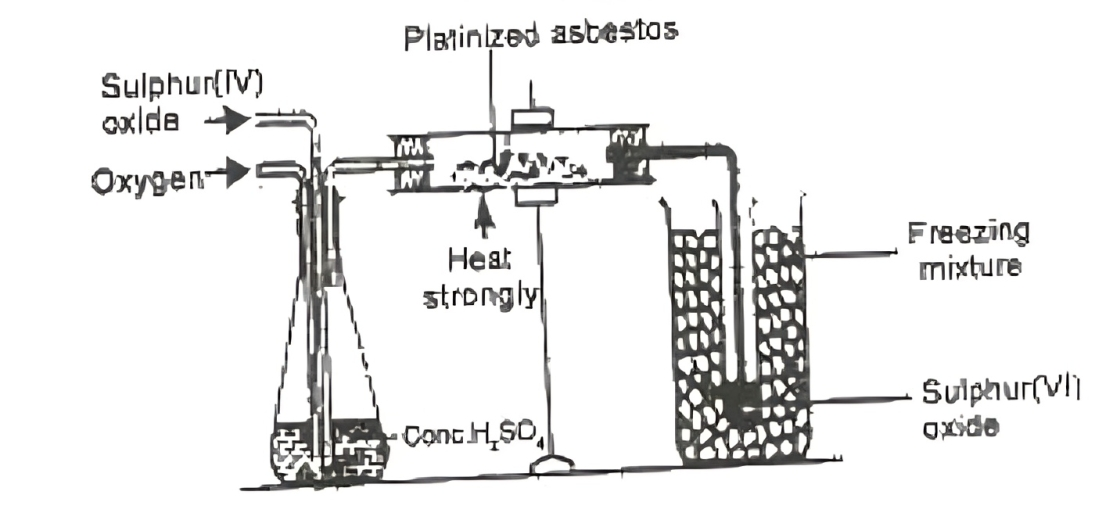
In the diagram above, the purpose of the asbestos to
Show explanation Expand Question
Asbestos in gas-generation setups is used as an inert porous packing that provides a large surface area and improves contact between reactants and any catalytic surface; it does not chemically absorb impurities as its main role. It effectively acts as a support to help the reaction proceed, so the best choice is that it aids/catalyses the reaction.
[Role of asbestos: inert porous support increasing contact acting as a catalytic support]
Not clear enough?

Question 2

In the diagram above, the gas produced is
Show explanation Expand Question
In many laboratory reactions (for example, copper with dilute nitric acid) the primary gas produced is nitric oxide (NO), which is colourless. On exposure to air it oxidises to nitrogen dioxide (NO2), which is brown; that is why fumes may turn brown shortly after formation. No numerical calculation is required.
Not clear enough?

Question 3

The correct order of increasing boiling points of the following compounds C3H7OH, C7H16 and C4H10 is
Show explanation Expand Question
Boiling points depend on molecular mass and intermolecular forces. C4H10 (butane, small alkane) has the lowest boiling point. C3H7OH (propanol) has hydrogen bonding, raising its boiling point above alkanes of similar mass. C7H16 (heptane, larger alkane) has higher van der Waals forces due to greater molar mass, so its boiling point exceeds that of propanol. Thus, the order is: C4H10 → C3H7OH → C7H16.
Not clear enough?

Question 4

One of the major uses of alkane is
Show explanation Expand Question
Alkanes, being saturated hydrocarbons, burn readily in oxygen and release large amounts of energy. This makes them suitable as fuels for domestic and industrial purposes. Other listed uses are not primary for alkanes.
Not clear enough?

Question 5

The haloalkanes used in dry-cleaning industries are
Show explanation Expand Question
The common halogenated solvents used in dry-cleaning are trichloromethane (chloroform) and tetrachloromethane (carbon tetrachloride).
Not clear enough?

Question 6

Two hydrocarbons X and Y were treated with bromine water. X decolorised the solution and Y did not. Which class of compound does Y belong?
Show explanation Expand Question
Decolourisation of bromine water indicates unsaturation (C=C or C≔C). Compound Y did not decolourise, so it must be saturated, i.e., an alkane.
Not clear enough?

Question 7

The compound that is used as an anaesthetic is
Show explanation Expand Question
Chloroform (CHCl3) is historically known for its use as an anaesthetic, although less common today due to toxicity concerns.
Not clear enough?

Question 8

Which of the following is used as fuel in miners' lamp?
Show explanation Expand Question
Calcium carbide and water produce ethyne (acetylene), which was widely used as fuel in miners' lamps due to its bright flame.
Not clear enough?

Question 9

Which of the following organic compounds is very soluble in water?
Show explanation Expand Question
Ethanoic acid (CH3COOH) is highly soluble in water because it can form hydrogen bonds with water molecules. Hydrocarbons and esters are less soluble.
Not clear enough?

Question 10

Benzene reacts with hydrogen in the presence of nickel catalyst at 180°C to give
Show explanation Expand Question
Hydrogenation of benzene (C6H6) with hydrogen in the presence of a nickel catalyst yields cyclohexane (C6H12).
Not clear enough?

12345
In this page
Chemistry 2010 Jamb Examination
Open Model!