
Chemistry 2014 Jamb Examination
Chemistry 2014 Jamb Examination

Question 1
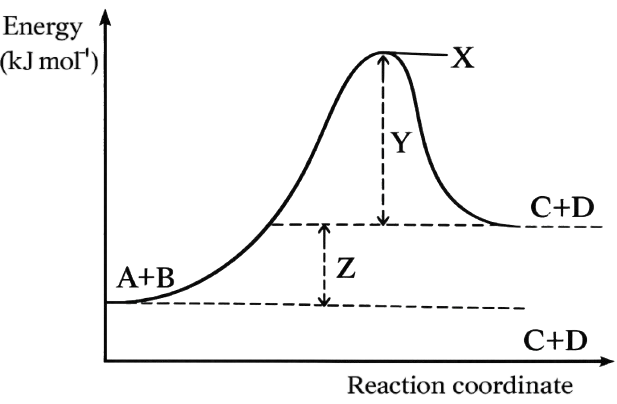
Z in diagram above represents
In an energy profile diagram, the heat of reaction represents the difference in energy between the products and the reactants. When the products are at a lower energy level than the reactants, the reaction is exothermic; if higher, it is endothermic. The vertical distance between these two points, labelled as Z in the diagram, corresponds to the heat of reaction, which indicates the overall energy released or absorbed during the process.
Not clear enough?
Question 2

In the diagram, the function of the concentrated H2SO4 is to
Concentrated sulphuric acid is a powerful dehydrating agent used to remove moisture from gases. In gas preparation setups, it ensures that the gas collected is completely dry by absorbing any water vapour present. It does not purify or liquefy the gas but serves solely as a drying agent due to its strong affinity for water molecules.
Not clear enough?
Question 3
The gas that is removed by the water in the flask is
Hydrogen chloride \(\text{HCl}\) is a highly soluble gas in water, forming hydrochloric acid upon dissolution. When water is used in gas purification systems, it effectively removes soluble gases such as \(\text{HCl}\) but not insoluble gases like \(\text{O}_2\) or \(\text{H}_2\). Thus, the water in the flask absorbs \(\text{HCl}\), leaving other gases to pass through unabsorbed.
Not clear enough?
Question 4
The petroleum fraction that is used in heating furnaces in industries is
Diesel oil, a heavy fraction obtained from petroleum distillation, is commonly used as fuel in heating furnaces and industrial boilers. It has a high boiling point and produces more heat energy upon combustion than lighter fractions like gasoline or kerosene, making it suitable for large-scale industrial heating processes.
Not clear enough?
Question 5
The polymer used in making car rear lights is
Perspex, also known as polymethyl methacrylate (PMMA), is a transparent, rigid, and shatter-resistant polymer that transmits light effectively. Its optical clarity and toughness make it ideal for car rear lights and other applications requiring durable, transparent materials such as lenses and signboards.
Not clear enough?
Question 6
CH₃COOC₂H₅(l) + H₂O(l) ⇌ CH₃COOH(aq) + C₂H₅OH(aq)
The purpose of H⁺ in the reaction above is to
The purpose of H⁺ in the reaction above is to
The hydrolysis of esters such as ethyl ethanoate is catalysed by acids. The hydrogen ion \(\text{H}^+\) acts as a catalyst by protonating the carbonyl oxygen, increasing the electrophilicity of the carbonyl carbon and making it more susceptible to nucleophilic attack by water molecules. This process enhances the rate of hydrolysis without altering the equilibrium position of the reaction.
Not clear enough?
Question 7
A hydrocarbon has an empirical formula CH and a vapour density of 39. Determine its molecular formula. [C = 12, H = 1]
Vapour density (VD) is related to molecular mass (M) by the formula:\[ M = 2 \times \text{VD} \]\[ M = 2 \times 39 = 78 \]The empirical formula CH has a mass of \(12 + 1 = 13\).
To find the number of empirical units in the molecular formula:\[ \dfrac{78}{13} = 6 \]Thus, the molecular formula is \(\text{C}_6\text{H}_6\), which corresponds to benzene.
To find the number of empirical units in the molecular formula:\[ \dfrac{78}{13} = 6 \]Thus, the molecular formula is \(\text{C}_6\text{H}_6\), which corresponds to benzene.
Not clear enough?
Question 8
Polystyrene is widely used as packaging material for fragile objects during transportation because of its
Polystyrene foam, commonly known as Styrofoam, is lightweight and has a low density. Its structure contains numerous air pockets that provide excellent cushioning, impact absorption, and protection against shocks. These properties make it ideal for packaging fragile items such as electronics and glassware during transportation.
Not clear enough?
Question 9
The process of converting linear alkanes to branched-chain and cyclic hydrocarbons by heating in the presence of a catalyst to improve the quality of petrol is referred to as
Reforming is the process in which straight-chain hydrocarbons are converted into branched or cyclic hydrocarbons using heat and a catalyst such as platinum. This increases the octane rating of petrol, leading to more efficient combustion and reduced engine knocking. It differs from cracking, which breaks larger molecules into smaller ones.
Not clear enough?
Question 10
The alkanol obtained from the production of soap is
During soap production through the saponification of fats and oils with alkali, glycerol (propane-1,2,3-triol) is formed as a by-product. It is a trihydric alcohol known for its sweet taste, hygroscopic nature, and use in cosmetics, pharmaceuticals, and the food industry.