Chemistry 2015 Jamb Examination
Chemistry 2015 Jamb Examination

Question 21
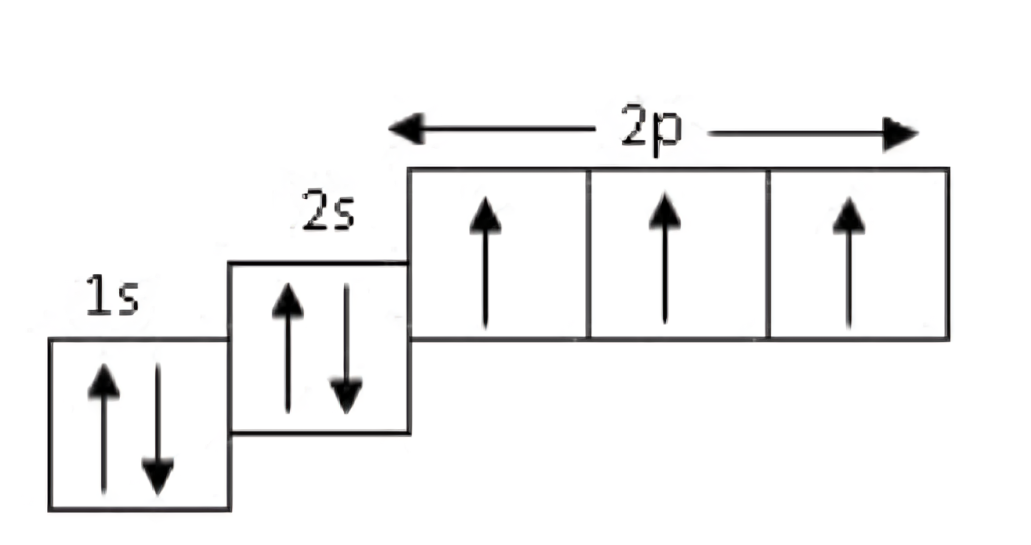
The above orbital diagram shown the electronic configuration of
The diagram represents the electronic configuration of nitrogen with atomic number 7. Its configuration is \(1s^2 2s^2 2p^3\). The 2p subshell contains three electrons that occupy separate orbitals following Hund’s rule, which states that electrons fill degenerate orbitals singly before pairing. This gives nitrogen three unpaired electrons, consistent with the orbital diagram shown. Elements like chlorine, calcium, and neon would have more electrons and different filling patterns, making nitrogen the correct match.
Not clear enough?
Question 22
Atomicity of ozone is
Ozone has the molecular formula \(O_3\). Atomicity refers to the number of atoms present in one molecule of a substance. Since ozone consists of three oxygen atoms bonded together, its atomicity is three. This distinguishes it from diatomic oxygen \(O_2\), which has an atomicity of two. The triatomic nature of ozone contributes to its instability and strong oxidising properties.
Not clear enough?
Question 23
Which of the noble gases has the greatest ionization energy
Helium possesses the highest ionisation energy among the noble gases. Ionisation energy is the amount of energy required to remove one electron from an atom in its gaseous state. Helium’s atomic structure has a very small atomic radius and strong attraction between its nucleus and electrons, making electron removal extremely difficult. As atomic size increases down the group from helium to xenon, the ionisation energy decreases due to increased electron shielding and distance from the nucleus.
Not clear enough?
Question 24
Which of these require crystallization most?
Crystallisation is essential in drug manufacturing to obtain pure solid compounds. It helps remove impurities from crude products and ensures the correct crystalline form, which affects drug solubility and bioavailability. In pharmaceutical processes, crystallisation ensures consistent potency and stability of the active ingredient. Industries like cement, paint, or perfume rely on other physical or chemical processes rather than crystallisation.
Not clear enough?
Question 25
In the industrial production of H₂ is removed by (solution)
During the industrial production of hydrogen, impurities such as carbon dioxide, carbon monoxide, and sulphur compounds are often removed through various purification stages. Hydrogen itself is separated by washing the gas mixture under pressure, a process that allows hydrogen to pass through while other gases are absorbed or condensed. This ensures a pure hydrogen product suitable for further industrial use, such as in ammonia production or fuel processes.
Not clear enough?
Question 26
Chlorine, consisting of two isotopes of mass numbers 35 and 37, has an atomic mass of 35.5.
The relative abundance of the isotope of mass number 37 is?
The relative abundance of the isotope of mass number 37 is?
Let the percentage abundance of \(^{35}Cl\) be \(x\) and \(^{37}Cl\) be \(100 - x\). The average atomic mass is given by:\[35x + 37(100 - x) = 35.5 \times 100\]\[3500 + 200x = 3550\]\[200x = 50\]\[x = 25\]Therefore, \(^{37}Cl\) has a relative abundance of 25%. The slight difference in isotope masses gives the weighted average of 35.5 observed in chlorine’s atomic mass.
Not clear enough?
Question 27
What is the pH of 0.001 mol dm⁻³ solution of sodium hydroxide
Sodium hydroxide is a strong base and completely dissociates in solution.\[ [OH^-] = 0.001 = 10^{-3} \; \text{mol dm}^{-3} \]pOH is calculated as:\[ \text{pOH} = -\log [OH^-] = 3 \]Since \( \text{pH} + \text{pOH} = 14 \):\[ \text{pH} = 14 - 3 = 11 \]Hence, the pH of the solution is 11, indicating a moderately basic solution.
Not clear enough?
Question 28
The oxidation state of oxygen in tetraoxosulphate (VI) acid is
The molecular formula of tetraoxosulphate (VI) acid is \(H_2SO_4\). Let the oxidation state of sulphur be \(x\). The total charge is zero:\[2(+1) + x + 4(-2) = 0\]\[x + 2 - 8 = 0\]\[x = +6\]
Therefore, each oxygen atom contributes an oxidation state of \(-2\). This negative value reflects oxygen’s high electronegativity and its tendency to attract electrons when bonded to less electronegative elements.
Not clear enough?
Question 29
Tartaric acid is used industrially to
Tartaric acid is widely used in the food industry as a component of baking powder, where it reacts with sodium bicarbonate to release carbon dioxide during heating. This gas evolution helps dough and batter rise. The acid also contributes to the flavour and stabilisation of food products, but its main industrial use is as a leavening agent in baking powder formulations.
Not clear enough?
Question 30
A suitable reagent for distinguishing between ethanoic acid and ethanol is
Ethanoic acid reacts with sodium hydrogen trioxocarbonate (IV) to produce carbon dioxide gas, forming effervescence, while ethanol does not. The reaction occurs because ethanoic acid is an acid and neutralises the carbonate to form a salt, water, and carbon dioxide. This difference provides a clear distinction between the two compounds.
The reaction is represented as:
2CH3COOH + Na2CO3 → 2CH3COONa + H2O + CO2
Ethanol lacks the carboxylic acid functional group necessary for this reaction, hence shows no effervescence.
The reaction is represented as:
2CH3COOH + Na2CO3 → 2CH3COONa + H2O + CO2
Ethanol lacks the carboxylic acid functional group necessary for this reaction, hence shows no effervescence.
Not clear enough?
You might like
| 30/9/06 | 30/9/07 | |
| N | N | |
| Accrued insurance premium | 600 | 710 |
| Prepaid rent income | 490 | 630 |
The cash book includes N1,850 and N,2,100 in respect of insurance premium and rent income respectively.
What amount is to be credited to the profit and loss account in respect of rent income?
A body is moving initially at 4m/s. If its impulse after accelerating at 5m/s\(^{2}\) for 2s is 60Kgms\(^{-1}\). What is its mass?
The amount A to which a principal P amounts at r% compound interest for n years is given by the formula A = P(1 + r/100)n. Find A, if P = 126, r = 4 and n = 2.
A hydraulic press consists of two cylinders of cross-sectional radius \( r_1 \) and \( r_2 \). If a force of 200N applied to the smaller piston (\( r_1 \)), causes a force of 3200N to be transmitted onto the larger piston (\( r_2 \)). The ratio \( r_1 : r_2 \) is?