
Chemistry 2016 Jamb Examination
Chemistry 2016 Jamb Examination

Question 41
H H H H
| | | |
H - C - C - C - C - Cl
| | | |
H OH H Cl
The functional groups present in the compound above are
| | | |
H - C - C - C - C - Cl
| | | |
H OH H Cl
The functional groups present in the compound above are
The given structure shows the presence of an \( \text{OH} \) group (hydroxyl group) attached to one of the carbon atoms and \( \text{Cl} \) atoms (chloro substituents) on the terminal and another carbon atom.
There are no carbon–carbon double bonds, so it is not an alkene.
Hence, the compound contains hydroxyl and chloro functional groups.
There are no carbon–carbon double bonds, so it is not an alkene.
Hence, the compound contains hydroxyl and chloro functional groups.
Not clear enough?
Question 42
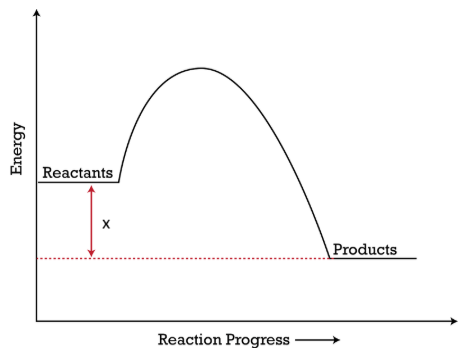
In the diagram above, X is the
In an energy profile diagram, the curve shows the progress of a reaction against the energy change.
The highest point on the curve represents the activated complex, while the energy difference between the reactants and this highest point is called the activation energy (X).\[ E_a = E_{\text{activated complex}} - E_{\text{reactants}} \] Hence, X is the activation energy.
The highest point on the curve represents the activated complex, while the energy difference between the reactants and this highest point is called the activation energy (X).\[ E_a = E_{\text{activated complex}} - E_{\text{reactants}} \] Hence, X is the activation energy.
Not clear enough?
Question 43
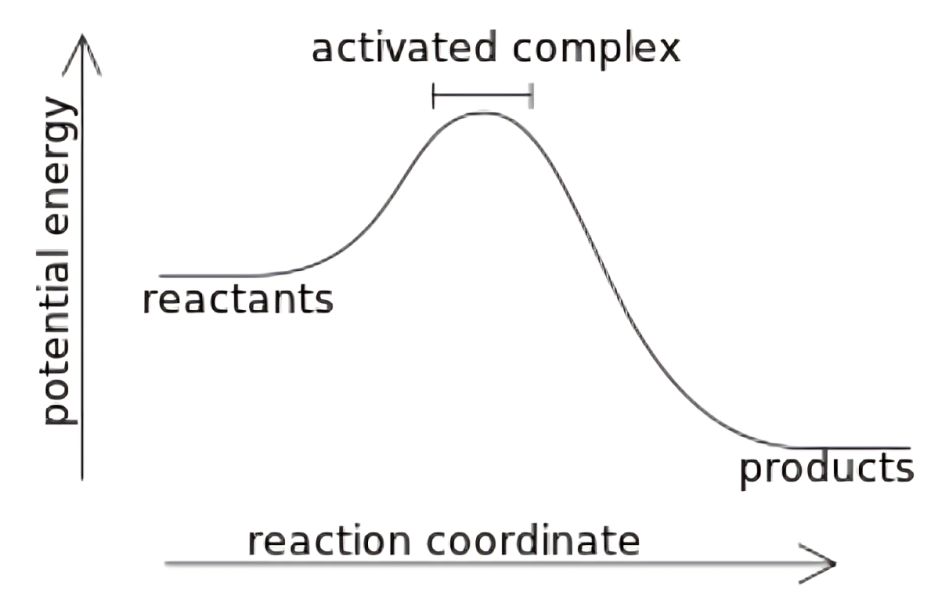
The diagram represents
In the potential energy diagram, the products have lower potential energy than the reactants. This means energy is released to the surroundings.
The difference in energy between reactants and products represents the enthalpy change (\( \Delta H \)), which is negative for exothermic reactions:
\[ \Delta H = E_{\text{products}} - E_{\text{reactants}} < 0 \]
Hence, the diagram represents an exothermic reaction.
The difference in energy between reactants and products represents the enthalpy change (\( \Delta H \)), which is negative for exothermic reactions:
\[ \Delta H = E_{\text{products}} - E_{\text{reactants}} < 0 \]
Hence, the diagram represents an exothermic reaction.
Not clear enough?
Question 44
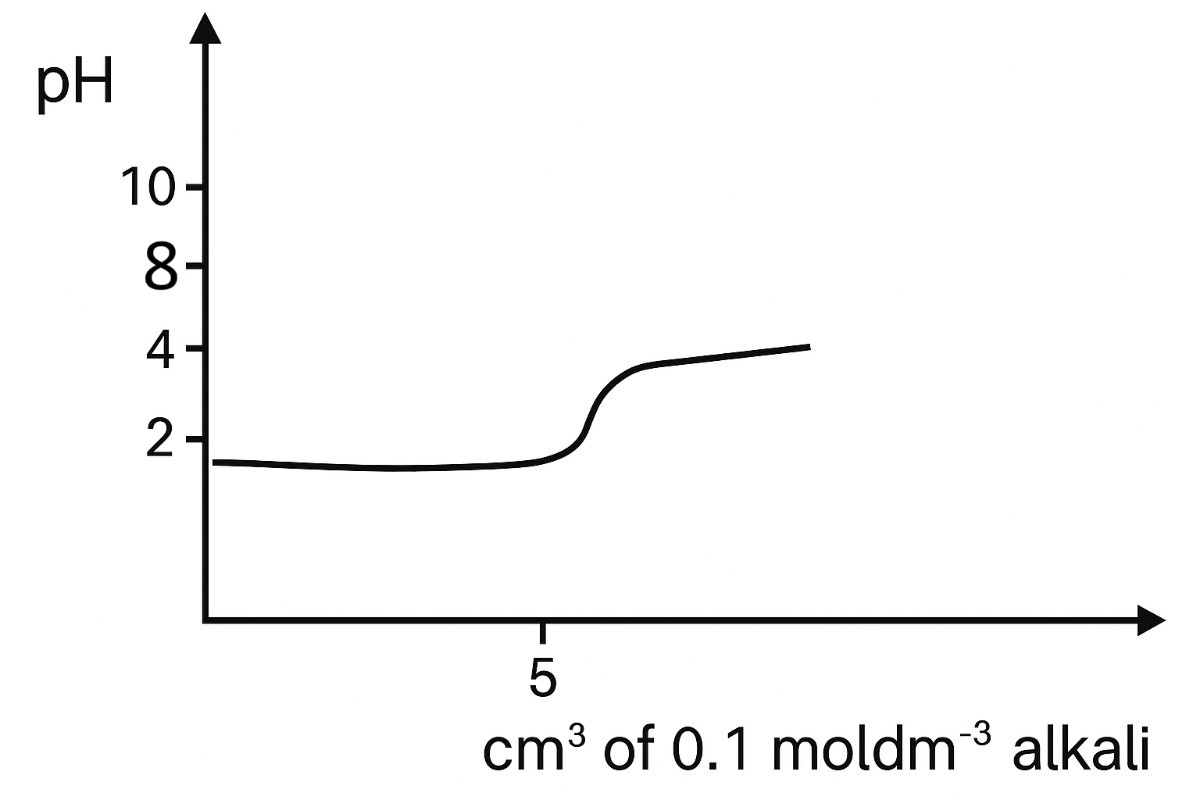
The curve depicts titration between a strong acid of pH
The titration curve starts at a very low pH (indicating a strong acid) and ends at a high pH (indicating a strong base).
The steep and nearly vertical jump around the equivalence point at pH 7 is characteristic of strong acid–strong base titrations.
\[ \text{HCl} + \text{NaOH} \rightarrow \text{NaCl} + \text{H}_2\text{O} \]
Thus, the curve represents titration between a strong acid and strong base.
The steep and nearly vertical jump around the equivalence point at pH 7 is characteristic of strong acid–strong base titrations.
\[ \text{HCl} + \text{NaOH} \rightarrow \text{NaCl} + \text{H}_2\text{O} \]
Thus, the curve represents titration between a strong acid and strong base.
Not clear enough?
Question 45
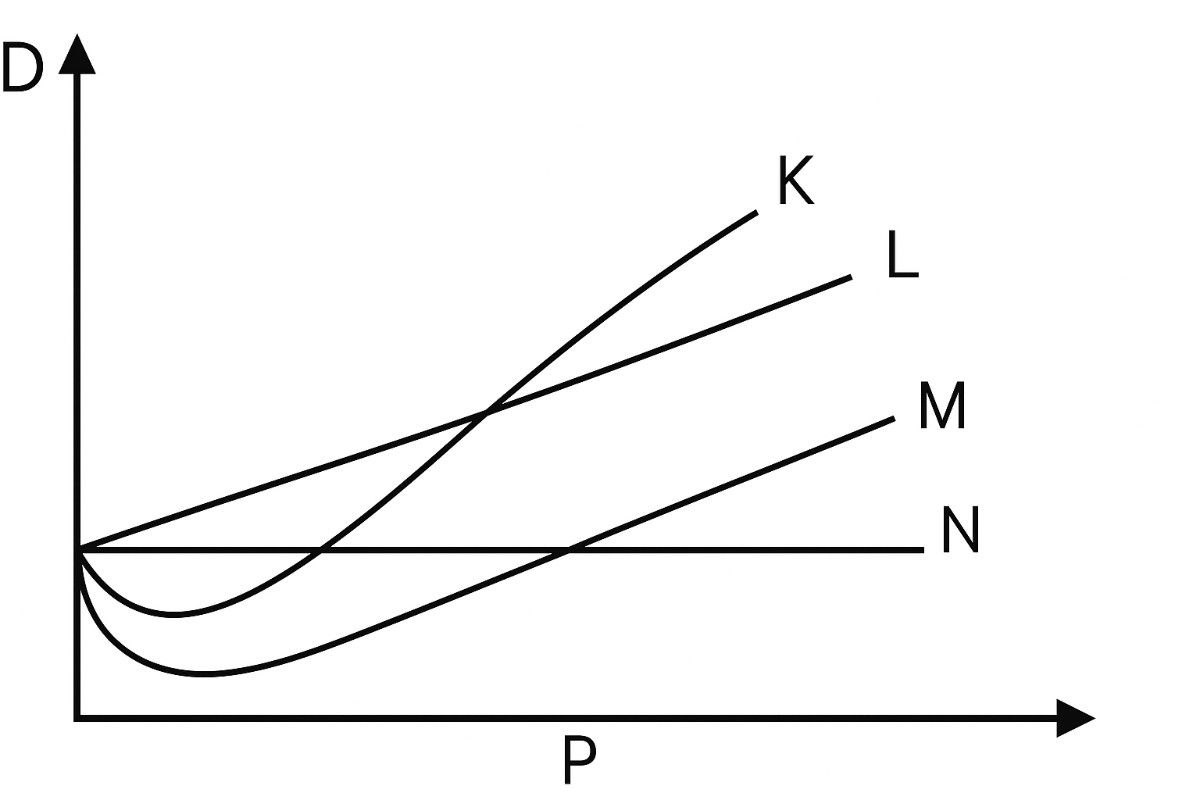
From the diagram above, an ideal gas can be represented by
An ideal gas obeys Boyle’s law perfectly, which states that \( PV = \text{constant} \).
This relationship produces a smooth rectangular hyperbola when \( P \) is plotted against \( V \).
Among the curves shown, L represents the ideal gas because it shows a perfect hyperbolic relationship between \( P \) and \( V \).
Hence, the ideal gas is represented by L.
This relationship produces a smooth rectangular hyperbola when \( P \) is plotted against \( V \).
Among the curves shown, L represents the ideal gas because it shows a perfect hyperbolic relationship between \( P \) and \( V \).
Hence, the ideal gas is represented by L.
Not clear enough?
Question 46
CH4(g) + Cl2(g) → CH2Cl(s) + HCl(g)
The major factor that influences the rate of the reaction above is
The major factor that influences the rate of the reaction above is
The reaction between methane and chlorine occurs through a free radical substitution mechanism initiated by light energy (photochemical reaction).
The UV light provides the energy to dissociate \( \text{Cl}_2 \) molecules into chlorine radicals:
\[ \text{Cl}_2 \xrightarrow{hv} 2\text{Cl} \cdot \]
Hence, light is the major factor influencing the rate of this reaction.
The UV light provides the energy to dissociate \( \text{Cl}_2 \) molecules into chlorine radicals:
\[ \text{Cl}_2 \xrightarrow{hv} 2\text{Cl} \cdot \]
Hence, light is the major factor influencing the rate of this reaction.
Not clear enough?
Question 47
N2O4(aq) ⇌ 2NO2(g), \( \Delta H = +\text{ve} \)
In the reaction above, an increase in temperature will
In the reaction above, an increase in temperature will
The reaction is endothermic since \( \Delta H = +\text{ve} \).
According to Le Chatelier’s principle, increasing temperature favors the endothermic direction (forward reaction).
This increases the concentration of \( \text{NO}_2 \) and raises the equilibrium constant \( K \):
\[ \text{N}_2\text{O}_4 (aq) \rightleftharpoons 2\text{NO}_2 (g) \]\[ \text{Forward reaction is endothermic.} \]
Therefore, an increase in temperature will increase the value of the equilibrium constant.
Not clear enough?
Question 48
MnO4-(aq) + Y + 5Fe2+(aq) → Mn2+(aq) + 5Fe3+(aq) + 4H2O(l).
In the equation above, Y is
In the equation above, Y is
The balanced redox reaction between permanganate ion and iron(II) in acidic medium is:
MnO4- + 8H+ + 5Fe2+ → Mn2+ + 5Fe3+ + 4H2O
Hence, Y = 8H+(aq).
MnO4- + 8H+ + 5Fe2+ → Mn2+ + 5Fe3+ + 4H2O
Hence, Y = 8H+(aq).
Not clear enough?
Question 49
H
|
CH3 — C — COOH
|
OH
The compound above exhibits
|
CH3 — C — COOH
|
OH
The compound above exhibits
Geometric (cis–trans) isomerism occurs due to restricted rotation around a double bond or ring structure with different substituents on each carbon. Since the compound in question meets this condition, it exhibits geometric isomerism.
Not clear enough?
Question 50
n monosaccharide ⇌ PQ polysaccharide − n water.
In the process above, P and Q respectively represent
In the process above, P and Q respectively represent
When monosaccharides combine to form polysaccharides, they undergo polymerization by the condensation process, releasing water molecules:
\[ n\, \text{C}_6\text{H}_{12}\text{O}_6 \rightarrow (\text{C}_6\text{H}_{10}\text{O}_5)_n + n\,\text{H}_2\text{O} \]Therefore, P = Polymerization and Q = Condensation.
\[ n\, \text{C}_6\text{H}_{12}\text{O}_6 \rightarrow (\text{C}_6\text{H}_{10}\text{O}_5)_n + n\,\text{H}_2\text{O} \]Therefore, P = Polymerization and Q = Condensation.
Not clear enough?
You might like
For this question, select the option that best explains the information conveyed in the question.
Jumai will do well if she was given a fair crack of the whip.
What is the relationship mechanical advantage (MA) velocity Ratio (V.R) and efficiency with percentage?
When a person enters a dark room from bright light he is not able to see clearly for little while because the_____?
Find the value of α2 + β2 if α + β = and the distance between the points (1, α) ands (β, 1) is 3 units.
Which of the following signs general warrant for the release of money from the consolidated revenue fund?