
Chemistry 2018 Jamb Examination
Chemistry 2018 Jamb Examination

Question 81
Which of the compounds is composed of Al, Si, O and H?
Clay is a hydrated aluminium silicate containing aluminium (Al), silicon (Si), oxygen (O), and hydrogen (H).
Epsom salt is magnesium sulphate (MgSO₄·7H₂O), limestone is calcium carbonate (CaCO₃), and urea is an organic compound (CO(NH₂)₂). Hence, clay fits the description.
Epsom salt is magnesium sulphate (MgSO₄·7H₂O), limestone is calcium carbonate (CaCO₃), and urea is an organic compound (CO(NH₂)₂). Hence, clay fits the description.
Not clear enough?
Question 82
When large hydrocarbon molecules are heated at high temperature in the presence of a catalyst to give smaller molecules, the process is known as
Cracking is the process of breaking down large hydrocarbon molecules into smaller ones by heating them in the presence of a catalyst. It is widely used in the petroleum industry to produce more useful fractions such as petrol and alkenes.
Polymerisation is the reverse process, where smaller molecules join to form larger ones.
Polymerisation is the reverse process, where smaller molecules join to form larger ones.
Not clear enough?
Question 83
In the removal of water hardness, permutit is regenerated with a strong solution of
Permutit (sodium zeolite) is used to soften hard water by exchanging its sodium ions for calcium and magnesium ions. When the zeolite becomes exhausted, it is regenerated by washing with concentrated sodium chloride (NaCl) solution, which restores the sodium ions to the resin.
Not clear enough?
Question 84
A sample of hard water contains some calcium sulphate and calcium hydrogen carbonate. The total hardness may therefore be removed by
Temporary hardness due to calcium hydrogen carbonate can be removed by boiling, but permanent hardness due to calcium sulphate cannot. To remove both types of hardness (total hardness), sodium carbonate (Na₂CO₃) is used because it precipitates calcium ions as insoluble calcium carbonate.
Thus, sodium carbonate removes both temporary and permanent hardness.
Thus, sodium carbonate removes both temporary and permanent hardness.
Not clear enough?
Question 85
Which of the following separation techniques can be employed in obtaining solvent from its solution?
Distillation is used to obtain a solvent from its solution. It involves heating the solution so that the solvent vaporises and then condensing the vapour to recover the pure solvent.
Evaporation would only remove the solvent and leave the solute behind, while filtration and precipitation are used for solid-liquid separation.
Evaporation would only remove the solvent and leave the solute behind, while filtration and precipitation are used for solid-liquid separation.
Not clear enough?
Question 86
In the upper atmosphere, the ultraviolet light breaks off a free chlorine atom from a chlorofluorocarbon molecule. The effect of this is that the free chlorine atom will
Ultraviolet radiation breaks chlorofluorocarbon (CFC) molecules, releasing chlorine atoms. These chlorine atoms are highly reactive and attack ozone (O₃) molecules, converting them into oxygen (O₂) and chlorine monoxide (ClO).
This process leads to depletion of the ozone layer, which protects the Earth from harmful UV radiation.
This process leads to depletion of the ozone layer, which protects the Earth from harmful UV radiation.
Not clear enough?
Question 87
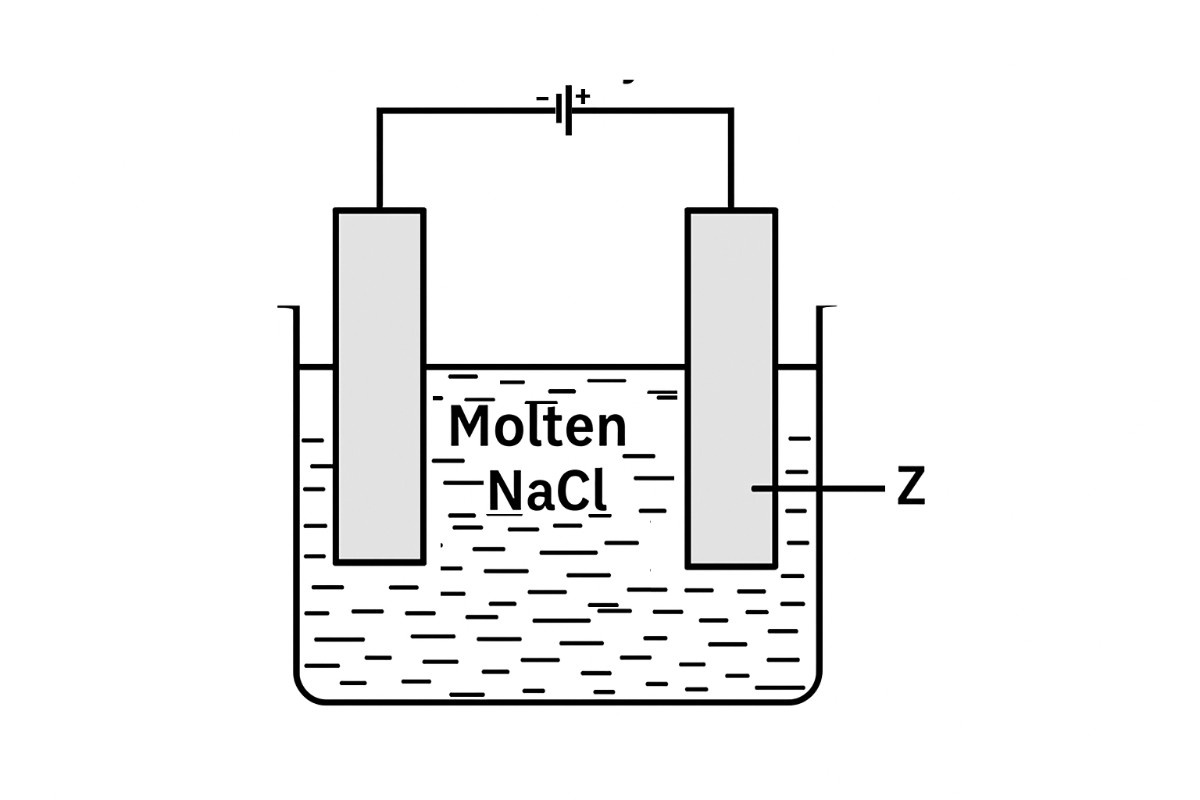
The figure above shows the electrolysis of molten sodium chloride. Z is the
During the electrolysis of molten sodium chloride (NaCl), sodium ions (Na⁺) migrate to the cathode where they are reduced to sodium metal, while chloride ions (Cl⁻) move to the anode where they are oxidised to chlorine gas. The oxidation reaction at the anode is:\[2Cl^- \rightarrow Cl_2 + 2e^-\]Therefore, Z represents the anode where the chloride ions are oxidised to chlorine gas.
Not clear enough?
You might like
A proposal for a new library was included on an election ballot. A radio show stated that 3 times as many people voted in favor of the proposal as people who voted against it. A social media post reported that 15,000 more people voted in favor of the proposal than voted against it.
Based on these data, how many people voted against the proposal?
The policy designed to accelerate the greater participation of Nigerians in the ownership and management of business enterprises in Nigeria is called
Choose the option that has the same consonant sound as the one represented by the letter(s) underlined.
Rest