
Chemistry 2020 Jamb Examination
Chemistry 2020 Jamb Examination

Question 31
The electronic configuration of an element is 1S2 2S2 2P6 3S2 3P3. How many unpaired electrons are there in the element?
The given configuration ends with 3p3, which corresponds to phosphorus (atomic number 15).
In the 3p orbital, there are three electrons, each occupying separate orbitals according to Hund’s rule — which states that electrons occupy degenerate orbitals singly before pairing.
Hence, there are three unpaired electrons in the element.
In the 3p orbital, there are three electrons, each occupying separate orbitals according to Hund’s rule — which states that electrons occupy degenerate orbitals singly before pairing.
Hence, there are three unpaired electrons in the element.
Not clear enough?
Question 32
Which of the following can be obtained by fractional distillation?
Fractional distillation separates components of a mixture based on differences in boiling points. Liquid air is a mixture of gases with different boiling points, so fractional distillation is used to separate nitrogen, oxygen, and argon from it.
Other listed methods such as crystallisation or evaporation apply to solids in solution, not gases.
Other listed methods such as crystallisation or evaporation apply to solids in solution, not gases.
Not clear enough?
Question 33
Duralumin consists of aluminium, copper?
Duralumin is an alloy primarily composed of aluminium (over 90%), copper, manganese, and magnesium. It is lightweight yet strong, making it suitable for aircraft construction.
Thus, manganese and magnesium are the additional elements in Duralumin.
Thus, manganese and magnesium are the additional elements in Duralumin.
Not clear enough?
Question 34
An example of a polysaccharide is?
Polysaccharides are complex carbohydrates formed by condensation of many monosaccharide units. Starch is a typical polysaccharide made up of multiple glucose molecules joined by glycosidic bonds.
Dextrose, mannose, and glucose are all monosaccharides.
Dextrose, mannose, and glucose are all monosaccharides.
Not clear enough?
Question 35
8g of CH4 occupies 11.2dm3 at S.T.P. What volume would 22g of CH3CH2CH3 occupy under the same condition?
At S.T.P, 1 mole of any gas occupies 22.4dm3.
Molar mass of CH4 = 16g/mol → 8g = 0.5mol → 0.5 × 22.4 = 11.2dm3 (verified).
Molar mass of CH3CH2CH3 = 44g/mol → 22g = 0.5mol → 0.5 × 22.4 = 11.2dm3.
Hence, both gases occupy the same volume at S.T.P.
Molar mass of CH4 = 16g/mol → 8g = 0.5mol → 0.5 × 22.4 = 11.2dm3 (verified).
Molar mass of CH3CH2CH3 = 44g/mol → 22g = 0.5mol → 0.5 × 22.4 = 11.2dm3.
Hence, both gases occupy the same volume at S.T.P.
Not clear enough?
Question 36
The best treatment for a student who accidentally poured conc tetraoxosulphate(VI) acid on his skin in the laboratory is to wash his skin with?
Concentrated tetraoxosulphate(VI) acid (H2SO4) causes severe burns on contact with skin. The immediate treatment is to flush the affected area with plenty of cool running water to dilute and remove the acid.
Neutralising with alkali can worsen the injury due to heat generated in neutralisation.
Neutralising with alkali can worsen the injury due to heat generated in neutralisation.
Not clear enough?
Question 37
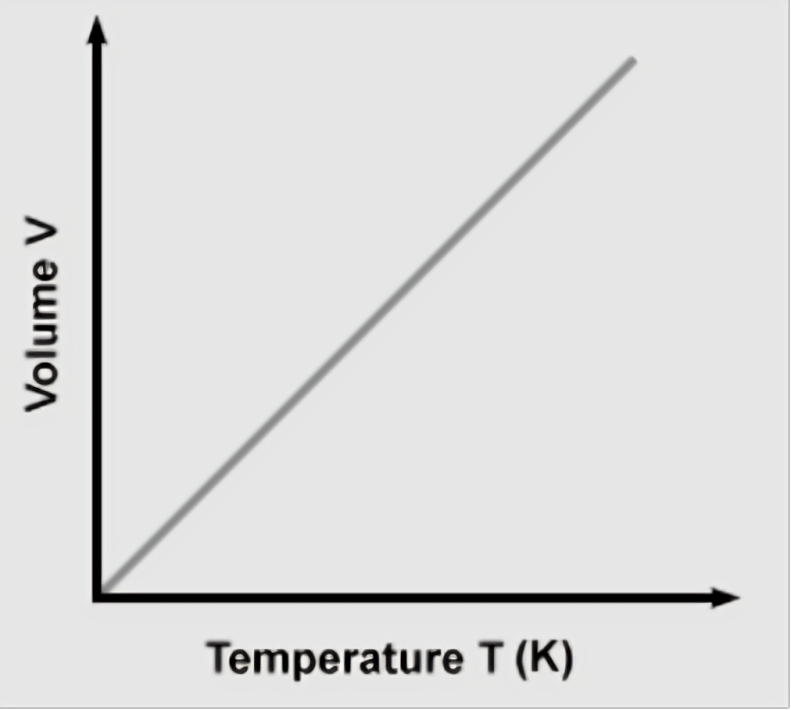
Which of the gas laws does this graph illustrate?
Charles’ law states that at constant pressure, the volume of a fixed mass of gas is directly proportional to its absolute temperature (V ∝ T).
The graph of volume against temperature (Kelvin) is a straight line, illustrating Charles’ law.
The graph of volume against temperature (Kelvin) is a straight line, illustrating Charles’ law.
Not clear enough?
Question 38
What are the possible oxidation numbers of an element if its atomic number is 17?
The element with atomic number 17 is chlorine (Cl). It has seven valence electrons and can gain one electron to achieve a stable octet (oxidation number -1) or lose electrons in compounds to show positive oxidation states up to +7.
Hence, possible oxidation numbers are -1 and +7.
Hence, possible oxidation numbers are -1 and +7.
Not clear enough?
Question 39
What process would coal undergo to give coal gas, coal tar, ammoniacal liquor and coke?
Destructive distillation involves heating a substance (like coal) in the absence of air. This breaks down the coal into several useful products — coal gas, coal tar, ammoniacal liquor, and coke.
It is an industrial process for obtaining fuel and chemical feedstocks.
It is an industrial process for obtaining fuel and chemical feedstocks.
Not clear enough?
Question 40
Liquid black soap is made by boiling palm oil with liquid extract of ash. The function of the ash is to provide the
The ash extract from burnt plant material contains potassium carbonate, which acts as an alkali. When palm oil (a fat) reacts with this alkali, saponification occurs, producing soap and glycerol.
Thus, the ash provides the alkaline medium necessary for soap formation.
Thus, the ash provides the alkaline medium necessary for soap formation.
Not clear enough?
You might like
Prepaid b/f.......................N10 000
Cash paid during the year.........N20 000
The amount to be charged to the profit and loss account is?
The table below shows the frequency distribution of marks obtained by a group of students.\[
\begin{array}{|c|c|c|c|}
\hline
\text{Mark} & 2 & 3 & 4 \\
\hline
\text{Frequency} & 4 & 4 & y \\
\hline
\end{array}
\]If the total mark is 48, find the value of y.