
Chemistry 2023 Jamb Examination
Chemistry 2023 Jamb Examination

Question 1
What happens to the position of equilibrium, if a reversible exothermic reaction is subjected to a decrease in temperature?
For a reversible exothermic reaction, heat can be considered a product. When the temperature decreases, the system shifts in the direction that produces more heat to counter the change according to Le Chatelier’s principle.
This means the equilibrium shifts to the right (towards the products) to release more heat and restore balance.
This means the equilibrium shifts to the right (towards the products) to release more heat and restore balance.
Not clear enough?
Question 2
Which noble gas is radioactive and is produced as a decay product of uranium and thorium?
Radon (Rn) is a radioactive noble gas formed naturally from the decay of uranium and thorium in the Earth's crust.
It is colourless, odourless, and tasteless, but highly radioactive and can accumulate in enclosed spaces, posing health risks when inhaled over time.
It is colourless, odourless, and tasteless, but highly radioactive and can accumulate in enclosed spaces, posing health risks when inhaled over time.
Not clear enough?
Question 3
Which of the following reactions would be expected to have the highest entropy change?
Entropy measures the degree of disorder in a system. When a substance changes from a liquid to a gas, there is a large increase in the randomness and energy distribution of particles.
Therefore, the change from liquid to gas results in the highest increase in entropy compared to other phase changes listed.
Therefore, the change from liquid to gas results in the highest increase in entropy compared to other phase changes listed.
Not clear enough?
Question 4
What is the sum of the oxidation numbers in a neutral compound?
In any neutral compound, the sum of all oxidation numbers of the atoms must equal zero because the total positive and negative charges balance each other.
For example, in water (H\(_2\)O), the oxidation number of hydrogen is +1 and oxygen is -2, giving a total of 2(+1) + (-2) = 0.
For example, in water (H\(_2\)O), the oxidation number of hydrogen is +1 and oxygen is -2, giving a total of 2(+1) + (-2) = 0.
Not clear enough?
Question 5
According to the kinetic theory of gases, the pressure exerted by a gas is due to
The kinetic theory of gases explains that gas particles are in constant random motion. The pressure exerted by a gas arises from the collisions of these particles with the walls of the container.
The more frequent and forceful the collisions, the higher the pressure. The theory assumes that the size of gas particles and intermolecular forces are negligible.
The more frequent and forceful the collisions, the higher the pressure. The theory assumes that the size of gas particles and intermolecular forces are negligible.
Not clear enough?
Question 6
What is eutrophication?
Eutrophication occurs when water bodies receive excess nutrients, especially nitrates and phosphates, often from agricultural runoff or sewage discharge.
This nutrient enrichment promotes the overgrowth of algae (algal bloom), which depletes oxygen levels in the water, leading to the death of aquatic organisms and ecological imbalance.
This nutrient enrichment promotes the overgrowth of algae (algal bloom), which depletes oxygen levels in the water, leading to the death of aquatic organisms and ecological imbalance.
Not clear enough?
Question 7
What is the name of the process by which ammonia is produced on an industrial scale?
The Haber process is the industrial method used to synthesise ammonia (NH\(_3\)) from nitrogen (N\(_2\)) and hydrogen (H\(_2\)) gases under high temperature and pressure, in the presence of an iron catalyst.
This process revolutionised agriculture by enabling large-scale production of nitrogen-based fertilisers.
This process revolutionised agriculture by enabling large-scale production of nitrogen-based fertilisers.
Not clear enough?
Question 8
Who proposed the planetary model of the atom with electrons orbiting the nucleus?
Niels Bohr proposed the planetary model of the atom, where electrons revolve around the nucleus in fixed energy levels or shells, much like planets orbit the sun.
This model explained atomic emission spectra, marking a major advancement from Rutherford’s earlier nuclear model of the atom.
This model explained atomic emission spectra, marking a major advancement from Rutherford’s earlier nuclear model of the atom.
Not clear enough?
Question 9
Which of the following is an example of an endothermic reaction?
Endothermic reactions absorb heat from their surroundings. During the decomposition of hydrogen peroxide (H\(_2\)O\(_2\)), energy is absorbed to break the chemical bonds, forming water and oxygen gas.
This contrasts with combustion and formation reactions, which are typically exothermic, releasing heat energy.
This contrasts with combustion and formation reactions, which are typically exothermic, releasing heat energy.
Not clear enough?
Question 10
What happens to the value of the equilibrium constant (Kc) for a reaction if the reaction is reversed?
When a chemical reaction is reversed, the equilibrium constant for the new reaction becomes the reciprocal of the original Kc value.
This is because the concentrations of products and reactants in the expression for Kc are interchanged, effectively inverting the ratio.
This is because the concentrations of products and reactants in the expression for Kc are interchanged, effectively inverting the ratio.
Not clear enough?
You might like
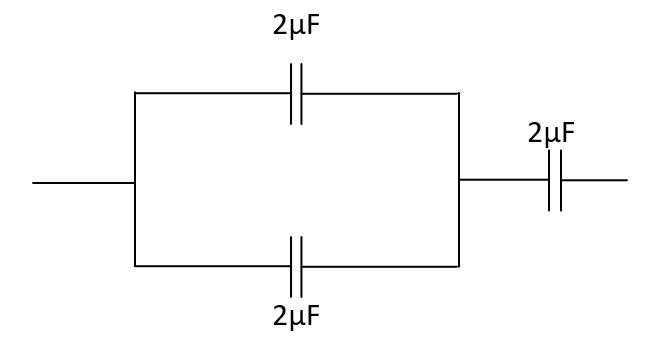 The net capacitance in the circuit above is
X can do a piece of work in 24 days. When he had worked for 4 days, Y joined him. If complete work was finished in 16 days, Y can alone finish that work in ?
30 men can repair a road in 18 days. They are joined by 6 more workers. Now the road can be repaired in ?
For existence of aquatic life in water, the dissolved oxygen content in it, should not be less than __________ ppm.
Direction: Three of the following four number pairs are alike in a certain way and one is different. Find the odd one out ?