
Chemistry 2025 Jamb Examination
Chemistry 2025 Jamb Examination

Question 101
How many molecules are there in 4.0 moles of glucose?
[Avogadro's number = 6.02 × 10²³]
[Avogadro's number = 6.02 × 10²³]
To find the number of molecules, we use the relationship between moles and Avogadro's constant. The number of particles \(N\) is equal to the number of moles \(n\) multiplied by Avogadro's number \(L\):\[N = n \times L\]\[N = 4.0 \times 6.02 \times 10^{23}\]\[N = 24.08 \times 10^{23}\]To express this in standard scientific notation, we move the decimal point one place to the left and increase the exponent by one:\[N = 2.408 \times 10^{24}\]Rounding to three significant figures, we get 2.41 × 1024 molecules.
Not clear enough?
Question 102
What is the product obtained at the anode in the electrolysis of concentrated sodium chloride using graphite electrode?
Concentrated sodium chloride (brine) contains \(Na^+\), \(Cl^-\), \(H^+\), and \(OH^-\) ions. During electrolysis, the anode is the positive electrode, attracting the negative ions (\(Cl^-\) and \(OH^-\)). Although \(OH^-\) is easier to discharge according to the electrochemical series, the high concentration of chloride ions causes \(Cl^-\) to be preferentially discharged.
The half-reaction is:\[2Cl^- \rightarrow Cl_2 + 2e^-\]Consequently, chlorine gas is evolved at the anode.
The half-reaction is:\[2Cl^- \rightarrow Cl_2 + 2e^-\]Consequently, chlorine gas is evolved at the anode.
Not clear enough?
Question 103
Freons pollution in the air are released from
Freons are a brand name for a group of chlorofluorocarbons (CFCs). These stable, non-flammable gases were historically used as propellants in aerosol cans (such as hairsprays and deodorants) and as refrigerants in air conditioning and cooling systems. When these products are used or disposed of improperly, the Freons are released into the atmosphere, where they contribute to the depletion of the ozone layer.
Not clear enough?
Question 104
In welding and cutting of metals, the organic gas commonly used in the heating process is
Ethyne, also known as acetylene (\(C_2H_2\)), is the gas used in 'oxy-acetylene' welding. When ethyne burns in a plentiful supply of oxygen, it produces an extremely hot flame (reaching temperatures above 3,000°C). This intense heat is sufficient to melt and cut through metals.
The complete combustion reaction is:\[2C_2H_2(g) + 5O_2(g) \rightarrow 4CO_2(g) + 2H_2O(g)\]
The complete combustion reaction is:\[2C_2H_2(g) + 5O_2(g) \rightarrow 4CO_2(g) + 2H_2O(g)\]
Not clear enough?
Question 105
Bronze is used in making
Bronze is an alloy consisting primarily of copper, usually with about 12% tin. It is highly resistant to corrosion and is harder than pure copper. Because of these properties, along with its aesthetic appeal, it is extensively used in the production of coins, medals, statues, and various artistic ornaments. While it has industrial uses, its use in medals and coins is a classic application often tested in chemistry.
Not clear enough?
Question 106
Find the hydrogen ion, \(H^+\) concentration and hydroxide ion, \(OH^-\) concentration in 0.06 moldm-3 solution of \(H_2SO_4\).
Sulphuric acid (\(H_2SO_4\)) is a strong diprotic acid, meaning it dissociates completely into two hydrogen ions per molecule:\[H_2SO_4 \rightarrow 2H^+ + SO_4^{2-}\]\[[H^+] = 2 \times 0.06 = 0.12 = 1.2 \times 10^{-1} \text{ moldm}^{-3}\]Next, we use the ionic product of water (\(K_w\)) at 25°C, which is \(1.0 \times 10^{-14}\):\[K_w = [H^+][OH^-]\]\[1.0 \times 10^{-14} = (1.2 \times 10^{-1}) \times [OH^-]\]\[[OH^-] = \frac{1.0 \times 10^{-14}}{1.2 \times 10^{-1}} = 0.833 \times 10^{-13} = 8.3 \times 10^{-14} \text{ moldm}^{-3}\]Note: Based on standard calculations, Option C matches the computed exponents.
Not clear enough?
Question 107
After breathing in a test tube that contains acidified \(K_2Cr_2O_7\), a man noticed a change in the colour of the acidified \(K_2Cr_2O_7\) from orange to green. This suggests the presence of
Acidified potassium heptaoxodichromate(VI) (\(K_2Cr_2O_7\)) is a strong oxidising agent. Its characteristic orange colour is due to the chromium (VI) ion. When it reacts with a reducing agent, such as an alkanol (alcohol), it is reduced to chromium (III) ions, which are green. This colour change is commonly used as a breathalyser test to detect ethanol in the breath of drivers, as alcohols are easily oxidised to alkanals or alkanoic acids.
Not clear enough?
Question 108
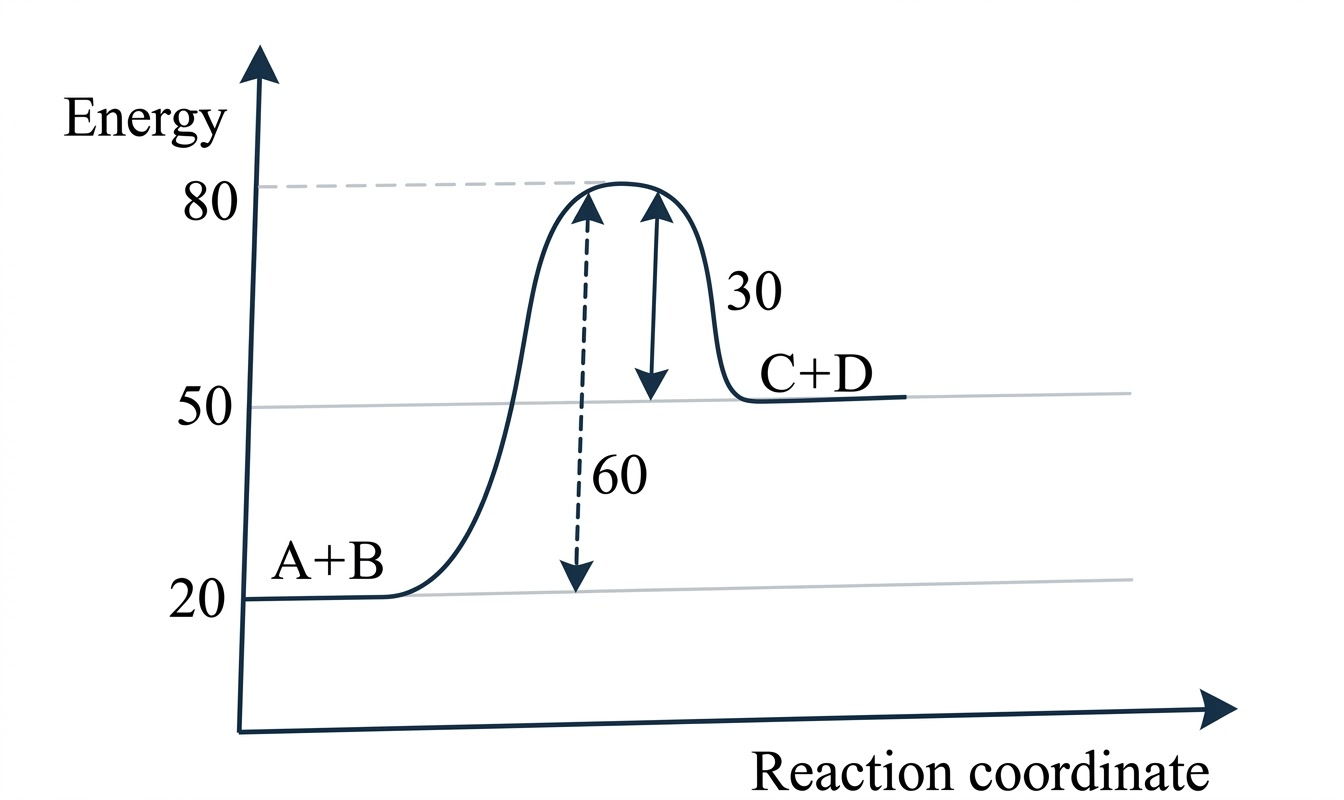
The reaction illustrated above is
The diagram provided is an energy level profile for a chemical reaction. On the vertical axis (potential energy), the level for the products is higher than the level for the reactants. This indicates that energy was absorbed from the surroundings during the reaction.
Such a reaction, where \(\Delta H\) (the enthalpy change) is positive, is defined as an endothermic reaction.
Such a reaction, where \(\Delta H\) (the enthalpy change) is positive, is defined as an endothermic reaction.
Not clear enough?
Question 109
The 5th member of an alkyne series is
The alkyne series follows the general formula \(C_nH_{2n-2}\). The first member of the series is ethyne (\(n = 2\)). Counting the members:
1. Ethyne (\(n=2\))
2. Propyne (\(n=3\))
3. Butyne (\(n=4\))
4. Pentyne (\(n=5\))
5. Hexyne (\(n=6\))
For the 5th member (Hexyne), \(n = 6\). Substituting into the formula:\[C_6H_{2(6)-2} = C_6H_{10}\]
1. Ethyne (\(n=2\))
2. Propyne (\(n=3\))
3. Butyne (\(n=4\))
4. Pentyne (\(n=5\))
5. Hexyne (\(n=6\))
For the 5th member (Hexyne), \(n = 6\). Substituting into the formula:\[C_6H_{2(6)-2} = C_6H_{10}\]