
Economics 2013 Jamb Examination
Economics 2013 Jamb Examination

Question 1
The profit of a monopolist can be eliminated where price equals
A monopolist makes normal profit when the price equals the average cost (AC). However, profit is eliminated when total revenue equals total cost, which happens when price equals AC.
When price equals marginal cost (MC), it indicates the point of allocative efficiency, not necessarily zero profit.
Therefore, elimination of profit occurs when price equals AC, not MC.
When price equals marginal cost (MC), it indicates the point of allocative efficiency, not necessarily zero profit.
Therefore, elimination of profit occurs when price equals AC, not MC.
Not clear enough?
Question 2
Life insurance companies contribute to economic development by holding a part of their assets in
Life insurance companies usually invest in long-term financial instruments such as bonds and government securities.
These investments provide capital for infrastructural development and economic expansion.
Since life insurance involves long-term savings, long-term investments are appropriate to match their liabilities and promote economic stability.
These investments provide capital for infrastructural development and economic expansion.
Since life insurance involves long-term savings, long-term investments are appropriate to match their liabilities and promote economic stability.
Not clear enough?
Question 3
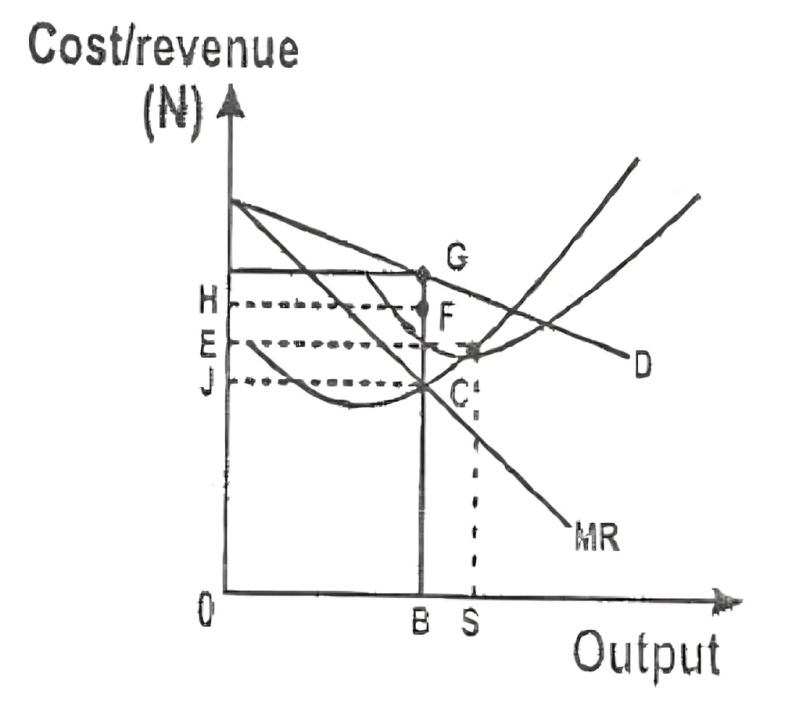
The optimum level of output of the firm is
The optimum level of output is the level at which the firm achieves productive efficiency, where long-run average cost is at its minimum.
From the graph, this occurs at output level OB, where the firm operates at the lowest point on its long-run average cost curve.
This ensures maximum efficiency and minimum cost per unit of output.
From the graph, this occurs at output level OB, where the firm operates at the lowest point on its long-run average cost curve.
This ensures maximum efficiency and minimum cost per unit of output.
Not clear enough?
Question 4
The total revenue of the firm is represented by
Total revenue is obtained by multiplying price by quantity sold, which graphically corresponds to the rectangular area under the price line up to the quantity sold.
From the diagram, the area GHOB represents this, showing the firm’s total income from sales at the equilibrium price and output level.
From the diagram, the area GHOB represents this, showing the firm’s total income from sales at the equilibrium price and output level.
Not clear enough?
Question 5
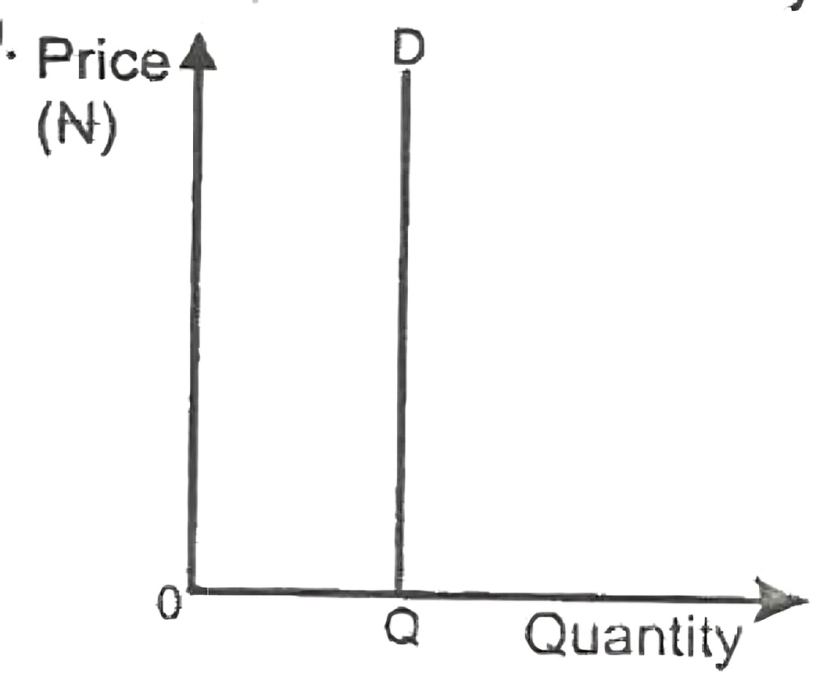
From the graph above, the price elasticity of demand is
A perfectly inelastic demand curve is represented by a vertical line showing that a change in price does not affect the quantity demanded.
From the graph, the demand remains constant regardless of price changes, which means the elasticity is zero.
Hence, demand is perfectly inelastic.
From the graph, the demand remains constant regardless of price changes, which means the elasticity is zero.
Hence, demand is perfectly inelastic.
Not clear enough?
Question 6
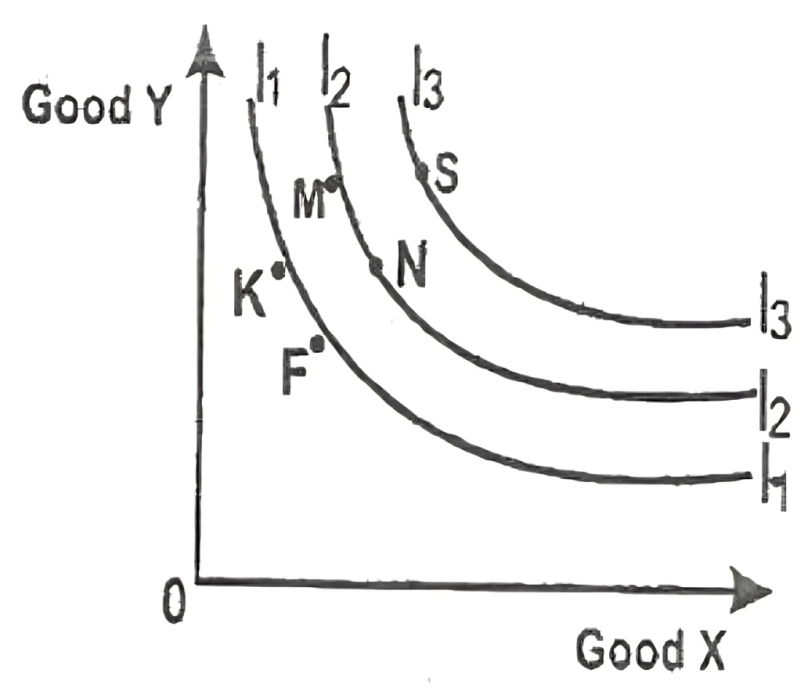
From the indifference curve above, consumer will prefer combination
Higher indifference curves represent higher levels of satisfaction because they provide more combinations of goods.
From the diagram, point S lies on the highest indifference curve compared to other combinations, indicating greater utility.
Therefore, the consumer will prefer combination S.
From the diagram, point S lies on the highest indifference curve compared to other combinations, indicating greater utility.
Therefore, the consumer will prefer combination S.
Not clear enough?
Question 7
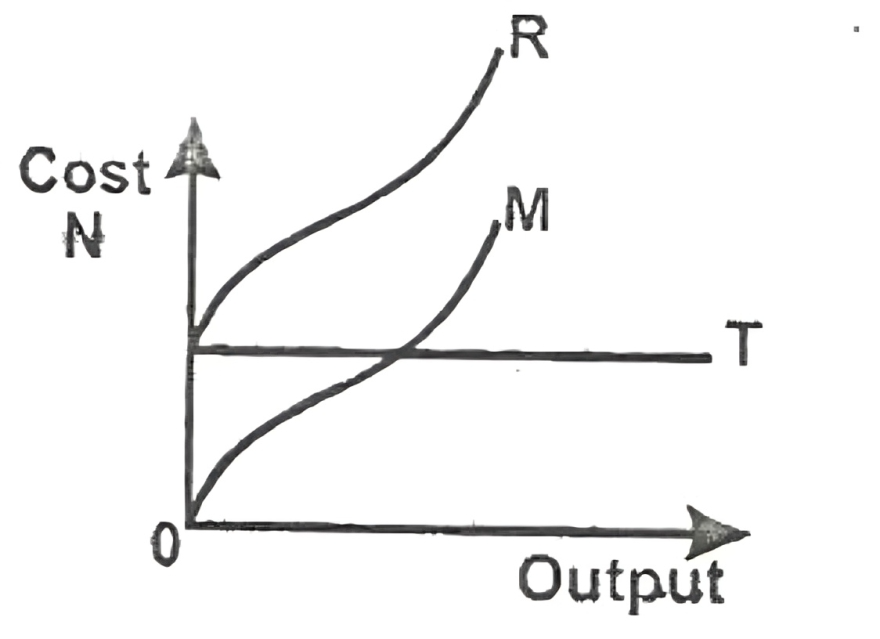
From the graph above, R represents
In cost curves, the vertical distance between the total cost curve and the total fixed cost line represents total variable cost.
From the diagram, R signifies the total variable cost component, which varies directly with output level.
This differentiates it from fixed cost, which remains constant regardless of production.
From the diagram, R signifies the total variable cost component, which varies directly with output level.
This differentiates it from fixed cost, which remains constant regardless of production.
Not clear enough?
Question 8
The rate of interest change on loans depends largely on
Lenders charge interest based on the perceived level of risk associated with granting a loan.
The higher the risk of default, the higher the interest rate required to compensate for potential loss.
Therefore, the rate of interest primarily depends on the riskiness of the borrower or investment project.
The higher the risk of default, the higher the interest rate required to compensate for potential loss.
Therefore, the rate of interest primarily depends on the riskiness of the borrower or investment project.
Not clear enough?
Question 9
A valid explanation for real wage growth is
Real wage growth occurs when workers’ purchasing power increases, usually resulting from higher productivity levels.
When labour becomes more productive, firms can afford to pay higher wages without raising prices, improving real incomes.
Thus, productivity growth is the key driver of real wage increases.
When labour becomes more productive, firms can afford to pay higher wages without raising prices, improving real incomes.
Thus, productivity growth is the key driver of real wage increases.
Not clear enough?
Question 10
If Mr. X lost his clerical job at a store and searched for a similar job for ten months before finding one, this implies that Mr. X was
Frictional unemployment occurs when workers are temporarily unemployed while transitioning between jobs or searching for better opportunities.
Mr. X’s situation fits this description because his unemployment was due to job search duration, not structural or cyclical causes.
This type of unemployment is normal in a dynamic economy.
Mr. X’s situation fits this description because his unemployment was due to job search duration, not structural or cyclical causes.
This type of unemployment is normal in a dynamic economy.