
Economics 2014 Jamb Examination
Economics 2014 Jamb Examination

Question 1
Given that \( Q_d = 40 + 2P \) and \( Q_s = 6P - 24 \). Calculate the equilibrium price.
At equilibrium, quantity demanded equals quantity supplied.\[ Q_d = Q_s \]Substitute the given equations:\[ 40 + 2P = 6P - 24 \]Collect like terms:\[ 40 + 24 = 6P - 2P \Rightarrow 64 = 4P \]\[ \therefore P = 16 \]The equilibrium price is 16 units, where the market demand equals supply.
Not clear enough?
Question 2
The consumer is at equilibrium at point
A consumer reaches equilibrium where the indifference curve is tangent to the budget line.
At this point, the marginal rate of substitution equals the price ratio, indicating the best combination of goods the consumer can afford.
Point N represents this tangency and, therefore, consumer equilibrium.
At this point, the marginal rate of substitution equals the price ratio, indicating the best combination of goods the consumer can afford.
Point N represents this tangency and, therefore, consumer equilibrium.
Not clear enough?
Question 3
\[\begin{array}{|c|c|}\hline \textbf{Price} & \textbf{Quantity Supplied} \\ \hline 8 & 20 \\ \hline 10 & 24 \\ \hline\end{array}\]
From the table above, calculate the price elasticity of supply.
From the table above, calculate the price elasticity of supply.
Price elasticity of supply (Es) is given by:\[ E_s = \dfrac{\Delta Q / Q_1}{\Delta P / P_1} \]From the table, \( Q_1 = 20, Q_2 = 24, P_1 = 8, P_2 = 10 \)\[ \Delta Q = 4, \; \Delta P = 2 \]\[ E_s = \dfrac{4/20}{2/8} = \dfrac{0.2}{0.25} = 0.8 \]The elasticity of supply is 0.8, showing supply is inelastic.
Not clear enough?
Question 4
| Unit of Labour | Total Product | Average Product | Marginal Product |
|---|---|---|---|
| 1 | 8 | 8 | - |
| 2 | 20 | 10 | 12 |
| 3 | E | 9 | 7 |
| 4 | 28 | 7 | F |
| 5 | 40 | 8 | 12 |
From the table above, find the values of E and F respectively.
Average Product (AP) is given by \( \text{AP} = \dfrac{\text{TP}}{\text{Labour}} \).
For the 3rd unit of labour:\[ 9 = \dfrac{E}{3} \Rightarrow E = 27 \]Marginal Product (MP) is the change in total product when an extra unit of labour is employed.\[ MP = TP_4 - TP_3 = 28 - 27 = 1 \]Thus, E = 27 and F = 1.
For the 3rd unit of labour:\[ 9 = \dfrac{E}{3} \Rightarrow E = 27 \]Marginal Product (MP) is the change in total product when an extra unit of labour is employed.\[ MP = TP_4 - TP_3 = 28 - 27 = 1 \]Thus, E = 27 and F = 1.
Not clear enough?
Question 5
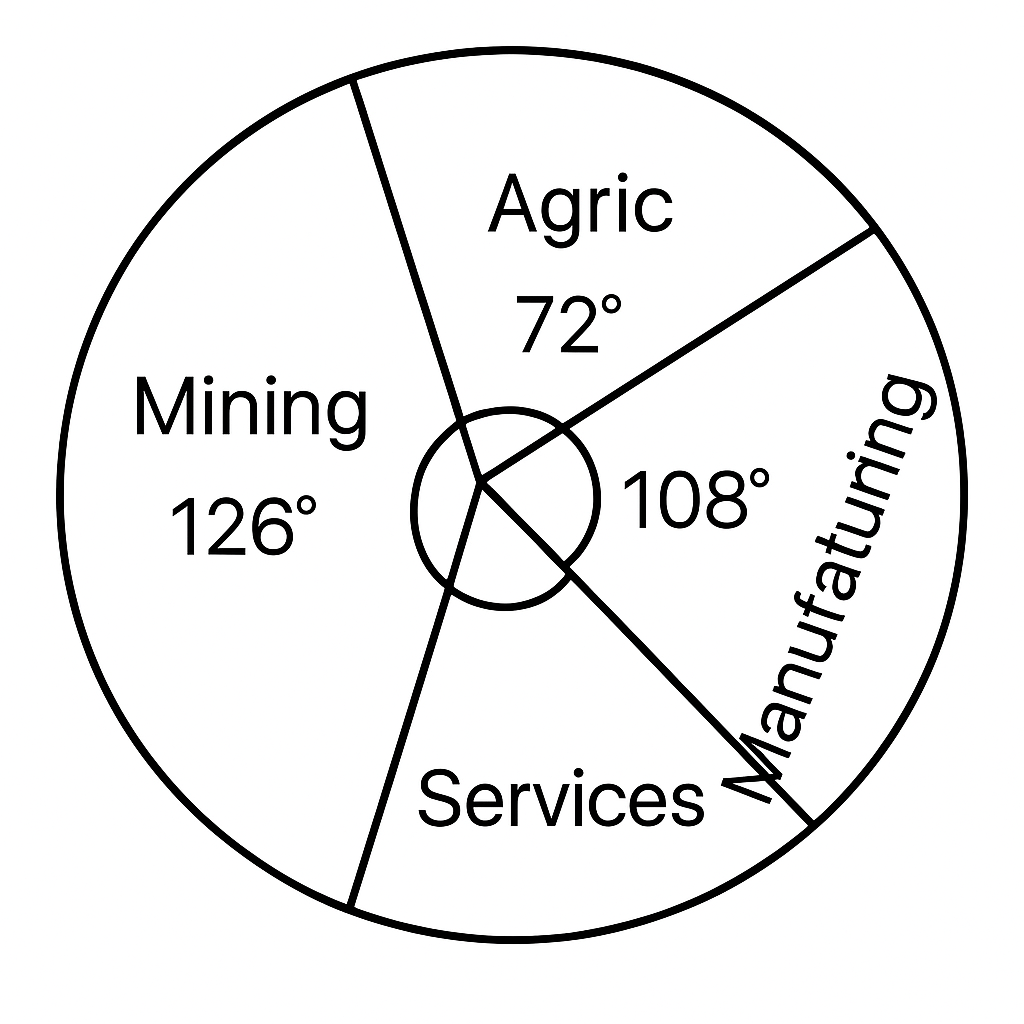
What is the percentage contribution of services to the national income?
From the given pie chart, Service contribution: 360 - (126 + 108 + 72) = 54o$$\text{% services to the national income}$$ $$ = \dfrac{54}{360} \times 100\% = 15\%$$
Not clear enough?
Question 6
If the national income is 60m, the contribution of the manufacturing sector is
From the given pie chart, manufacturing sector: $$\text{% manufacturing sector to the national income}$$ $$ = \dfrac{108}{360} \times 100\% = 30\%$$ The manufacturing sector contributes 30% to the national income (as inferred from the chart), then:\[ 30\% \times 60m = \dfrac{30}{100} \times 60 = 18m \]Therefore, the manufacturing sector contributes 18 million to the national income.
Not clear enough?
Question 7
The labour force of a country is determined by the
The labour force refers to the segment of the population that is able and willing to work.
It largely depends on the age structure — typically those within the working-age group (15–64 years).
This group forms the active workforce of the economy.
It largely depends on the age structure — typically those within the working-age group (15–64 years).
This group forms the active workforce of the economy.
Not clear enough?
Question 8
An accurate population census is important in order to
A reliable population census provides essential data for determining the total population and national income.
This helps in estimating the per capita income — an indicator of the standard of living and economic development of a country.
This helps in estimating the per capita income — an indicator of the standard of living and economic development of a country.
Not clear enough?
Question 9
A major determinant of floating exchange rate is
In a floating exchange rate system, the value of a country's currency is determined by market forces.
When demand for a currency increases, its value rises, and when supply exceeds demand, it depreciates.
Thus, demand and supply in the foreign exchange market are the major determinants.
When demand for a currency increases, its value rises, and when supply exceeds demand, it depreciates.
Thus, demand and supply in the foreign exchange market are the major determinants.
Not clear enough?
Question 10
If the importation of a commodity is limited to a definite quantity, the trade control measure imposed is
A quota is a quantitative restriction that limits the amount of a commodity that can be imported or exported.
It helps protect domestic industries and control balance of payments by directly restricting supply from foreign sources.
It helps protect domestic industries and control balance of payments by directly restricting supply from foreign sources.
Not clear enough?
You might like
These question is based on General Literary Principles.
A literary work that ridicules the shortcomings of people or ideas is
The insurance principle that allows an insurance company to take over the rights of the insured once he has been compensated is
If the American operations of IKE Computers had a January sales turnover in the ratio of 4:5 (American:UK) then what was the January sales turnover for American operations in \$ (at an exchange rate of 1.6\$ to the £)?