
Economics 2022 Jamb Examination
Economics 2022 Jamb Examination

Question 11
The mining sector of an economy contributes 60% to the Gross Domestic Product (GDP). If the GDP is \$540, what is the contribution of the mining sector?
The mining sector contributes 60% of the total GDP.
To find the value contributed, multiply the GDP by the percentage:
\( 60\% = 0.60 \)\[ 0.60 \times 540 = 324 \]This shows that the mining sector accounts for \$324 of the GDP. Therefore, option C is correct.
To find the value contributed, multiply the GDP by the percentage:
\( 60\% = 0.60 \)\[ 0.60 \times 540 = 324 \]This shows that the mining sector accounts for \$324 of the GDP. Therefore, option C is correct.
Not clear enough?
Question 12
A major disadvantage of a capitalist economy is that it
A capitalist economy encourages private ownership and competition. While this promotes efficiency, it also leads to unequal distribution of income because wealth is concentrated among those who own productive assets.
As a result, economic inequality becomes more pronounced since individuals with fewer resources cannot compete at the same level. This makes option D correct.
As a result, economic inequality becomes more pronounced since individuals with fewer resources cannot compete at the same level. This makes option D correct.
Not clear enough?
Question 13
The supply curve of a locally-produced good may shift to the right if
A rightward shift of the supply curve means supply increases at every price level. Government subsidies reduce production costs and allow firms to produce more goods.
This makes it easier for producers to supply higher quantities, shifting the supply curve to the right. Increased taxes would reduce supply, while price increases cause movements along the curve, not shifts. Therefore, option B is correct.
This makes it easier for producers to supply higher quantities, shifting the supply curve to the right. Increased taxes would reduce supply, while price increases cause movements along the curve, not shifts. Therefore, option B is correct.
Not clear enough?
Question 14
In perfectly elastic supply, the supply curve
Perfectly elastic supply means producers are willing to supply any quantity at a particular price. This is represented by a horizontal line, showing that even the slightest price change would stop supply entirely.
This makes the supply curve horizontal, matching option B.
This makes the supply curve horizontal, matching option B.
Not clear enough?
Question 15
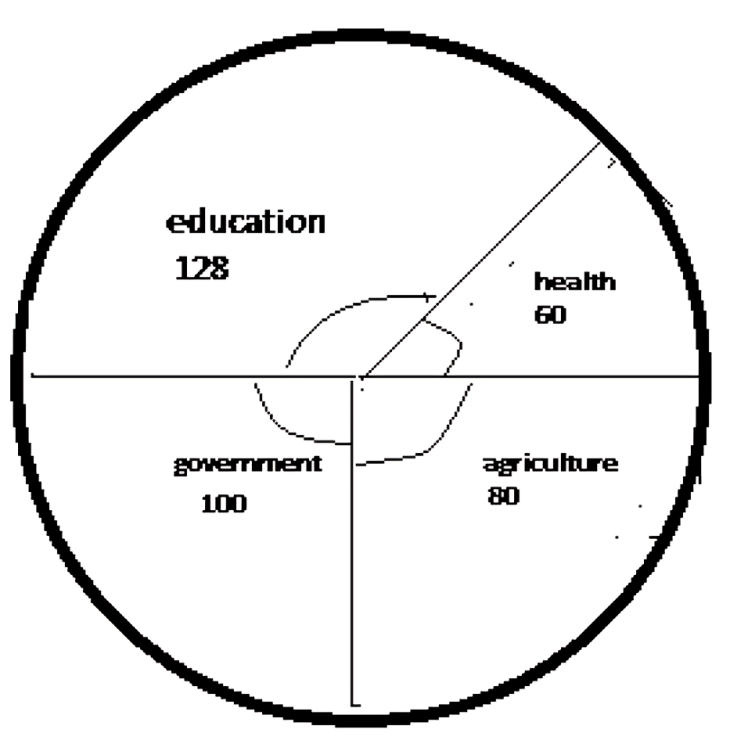
A country's budget allocation to various sectors of the economy is shown in the pie chart above...
Use it to answer this question.
If the budget of the country was \$7,200, how much is allocated to Education?
The pie chart indicates that Education receives one-third of the total budget.
To find the amount allocated:\[ \dfrac{120}{360} \times 7200 = 2400 \]Thus, Education receives \$2,400, making option A correct.
To find the amount allocated:\[ \dfrac{120}{360} \times 7200 = 2400 \]Thus, Education receives \$2,400, making option A correct.
Not clear enough?
Question 16
A country's budget allocation to various sectors of the economy is shown in the pie chart above...
Use it to answer this question.
What is the ratio of expenditure on Health to Agriculture if the yearly budget is 7200?
From the pie chart, Health and Agriculture represent specific proportions of the total budget.
The angles show Health = 60° and Agriculture = 80°.
The ratio is therefore:\[ 60 : 80 = 3 : 4 \]This simplified ratio matches option B.
The angles show Health = 60° and Agriculture = 80°.
The ratio is therefore:\[ 60 : 80 = 3 : 4 \]This simplified ratio matches option B.
Not clear enough?
Question 17
A consumer of a single commodity is in equilibrium when
Consumer equilibrium is achieved when the marginal utility derived from the last unit consumed equals the price paid for that unit.
This ensures maximum satisfaction per unit of expenditure. If marginal utility exceeds price, consumption increases; if it is lower, consumption decreases. Therefore, equilibrium occurs when marginal utility equals price. Option B is correct.
This ensures maximum satisfaction per unit of expenditure. If marginal utility exceeds price, consumption increases; if it is lower, consumption decreases. Therefore, equilibrium occurs when marginal utility equals price. Option B is correct.
Not clear enough?
Question 18
The production cost that varies inversely with output is the
Average fixed cost decreases as output increases because total fixed cost is spread over a larger quantity.
This inverse relationship is unique to average fixed cost, since marginal and total costs do not behave this way. Average cost does not always fall with output. Therefore, the correct choice is option C.
This inverse relationship is unique to average fixed cost, since marginal and total costs do not behave this way. Average cost does not always fall with output. Therefore, the correct choice is option C.
Not clear enough?
Question 19
A firm that closes down will still incur
When a firm shuts down temporarily, it stops production and avoids variable costs because no inputs are used. However, fixed costs—such as rent or machinery depreciation—must still be paid regardless of output.
Therefore, the firm continues to incur fixed costs. This makes option B correct.
Therefore, the firm continues to incur fixed costs. This makes option B correct.
Not clear enough?
Question 20
In manufacturing, division of labour may be hindered by
Division of labour depends heavily on technology because specialised tasks require machinery and efficient production methods.
If technology is underdeveloped, tasks cannot be broken down effectively, limiting specialisation. Excess demand or supply does not prevent division of labour. Therefore, option B is correct.
If technology is underdeveloped, tasks cannot be broken down effectively, limiting specialisation. Excess demand or supply does not prevent division of labour. Therefore, option B is correct.
Not clear enough?
You might like
| Total current assets | N2,000 |
| Total fixed assets | N4,000 |
| Current liabilities | N1,200 |
| Drawings | N200 |
| Long-term loan | N2,000 |
What is the net working capital?
This question is based on Femi Ademiluyi's The New Man.
Brigadier General Johnson's plan to assassinate President Monye is revealed to