
Islamic Religious Knowledge 2019 Jamb Examination
Islamic Religious Knowledge 2019 Jamb Examination

Question 21
'Still less can their knowledge comprehend the hereafter ...' (Q. 27:66). This verse above of the Qur'ān implies that
The verse from Surah An-Naml (27:66) addresses the limitations of human intellect and perception regarding the metaphysical realm of the Akhirah (the Hereafter). It suggests that despite man's advancements in worldly sciences, the true nature, timing, and full reality of the Day of Judgment and the life beyond are beyond the scope of empirical human observation. This implies that human knowledge concerning the Hereafter is inherently limited and partial, relying primarily on Divine Revelation (Wahy) rather than independent intellectual discovery. The verse highlights the gap between finite human understanding and the infinite reality of the Unseen world, emphasizing that man can never possess comprehensive or exhaustive knowledge of the hereafter while in this earthly life.
Not clear enough?
Question 22
Where the husband and wife mutually agree to termite their marriage contract without anything against each other, such a dissolution is termed
In Islamic jurisprudence, 'Mubāra'ah' refers to a form of divorce by mutual consent and agreement between both the husband and the wife. Unlike 'Khul', where the wife typically initiates the divorce and offers some compensation (like returning the mahr) to the husband to release her, 'Mubāra'ah' occurs when both parties are equally disillusioned with the marriage and desire to end it amicably without specific claims or grievances against one another. The term literally means 'clearing one another' or 'mutual release', signifying that both parties are freed from the marital bonds and their respective obligations to each other by mutual release, bringing the contract to a peaceful conclusion.
Not clear enough?
Question 23
The importance of knowledge of isnād and matn lies in the fact that
The 'Isnād' (chain of narrators) and the 'Matn' (the actual text or message) are the two fundamental components of a Hadith. The science of Hadith criticism ('Ilm al-Jarh wa al-Ta'dil') focuses on examining both these parts to determine the authenticity of a report. By scrutinising the 'Isnād', scholars can identify if there are broken links or unreliable narrators, while examining the 'Matn' allows them to check for contradictions with the Qur'an or established historical facts. Therefore, the primary importance of mastering these two elements is that they provide the tools necessary to distinguish between authentic (Sahih), fair (Hasan), and weak (Da'if) or fabricated (Mawdu) narrations, making it possible to identify faults and ensure the integrity of the prophetic traditions.
Not clear enough?
Question 24
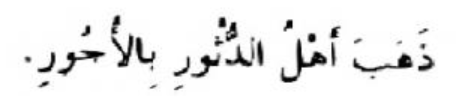
The statement in Hadīth 25 above gave rise to the explanation as to the different ways by which
Hadith 25 of Imam an-Nawawi's collection begins with a group of companions complaining to the Prophet (S.A.W) that the wealthy have outpaced them in rewards because they can give charity (Sadaqah) from their excess wealth. In response, the Prophet (S.A.W) explained that every act of goodness is a form of charity. He mentioned that saying 'SubhanAllah', 'Alhamdulillah', 'La ilaha illa Allah', and 'Allahu Akbar' are all acts of charity. He further included enjoining good, forbidding evil, and even personal intimate relations within marriage as acts of Sadaqah. This Hadith fundamentally broadened the definition of 'alms' or charity in Islam, showing that those without financial means can still earn the rewards of Sadaqah through various spiritual and social deeds.
Not clear enough?
Question 25
The man who analyzed the first encounter the Prophet (S.A.W) with Angel Jibril was
When the Prophet Muhammad (S.A.W) received the first revelation in the Cave of Hira, he returned home trembling with fear. His wife, Khadijah (R.A), took him to see her cousin, Waraqah b. Nawfal, who was an elderly man well-versed in the scriptures of the Christians and Jews. Upon hearing the details of the encounter with Angel Jibril, Waraqah recognized the signs of prophethood. He analyzed the event by identifying the visitor as the 'Namus' (the Angel of Revelation) who had previously come to Prophet Musa (A.S). Waraqah confirmed that Muhammad (S.A.W) was the awaited Prophet and warned him of the hardships and opposition he would eventually face from his own people.
Not clear enough?
Question 26

From the above, the goal of luqmān's counsel to his son:... As contained in sūrah 31:13 is to
The image displays the Arabic text of Surah Luqman (31:13): "Wa-idh qāla Luqmānu li-ibnihi wahuwa ya‘izuhu yā bunayya lā tushrik billāh; inna ash-shirka la-zulmun ‘azīm." This translates to: "And remember when Luqman said to his son while he was advising him, 'O my son, do not associate anything with Allah. Indeed, association with Him is a great injustice.'" The primary goal of this specific counsel was to warn his son against the sin of Shirk (associating partners with Allah). Luqman emphasizes that Shirk is the most significant form of injustice (Zulm) because it misplaces worship—which belongs solely to the Creator—and directs it toward created beings or objects.
Not clear enough?
Question 27
'It is most hateful in the sight of Allah that you say that which you do not' (Q. 61:3). The main teaching of the verse above is honesty in
This verse from Surah As-Saff (61:3) addresses the concept of hypocrisy and the lack of integrity. It serves as a stern warning against making promises, claims, or declarations that one does not intend to fulfill or embody. The core teaching is the necessity of alignment between what a person speaks (words) and what they actually perform (deeds). In Islam, true righteousness requires sincerity (Ikhlas), where an individual's outward actions are a true reflection of their inward intentions and verbal commitments. Discrepancy between speech and action is viewed as a sign of spiritual sickness and is highly detestable to Allah.
Not clear enough?
Question 28
An aspect of the Nigerian culture which may be regarded as shirk is
Shirk is the Islamic concept of polytheism or the act of attributing partners to Allah. In the context of traditional Nigerian cultures, certain practices involve the veneration and worship of ancestors (Egungun, etc.) or deities (Orishas). Worship of ancestors involves offering sacrifices, prayers, or libations to deceased relatives in the belief that they possess divine powers, can intercede with God, or control the fortunes of the living. Since Islam teaches that worship, sacrifice, and the seeking of supernatural aid must be directed only to Allah, the act of worshipping ancestors is considered a direct violation of Tawhid (the Oneness of God) and is thus classified as Shirk.
Not clear enough?
Question 29
The period of custody of a baby girl after her mother has been divorced lasts until she is
In Islamic family law (Sharia), the custody of children (Hadanah) after a divorce is primarily centered on the welfare of the child. For a female child, most schools of Islamic jurisprudence—particularly the Maliki school, which is prevalent in many regions—stipulate that the mother has the right of custody until the girl reaches the age of marriage or is actually married. The rationale behind this is that a daughter requires the guidance, protection, and specific nurturing of her mother throughout her formative years and puberty until she transitions into her own marital home. While the father remains responsible for the financial maintenance of the daughter, the physical custody and daily upbringing remain with the mother during this period.
Not clear enough?
Question 30
The Muslim soldier who introduced Islam into Tripoli was
Amr ibn al-As (often rendered as 'Amar b. al ās) was the prominent Muslim general responsible for the conquest of Egypt during the caliphate of 'Umar ibn al-Khattab. After securing Egypt, he extended the Islamic campaign westward into North Africa. In 642-643 CE, he led the Muslim forces to the region of Tripolitania (modern-day Libya) and successfully captured the city of Tripoli. His military successes laid the groundwork for the spread of Islam across the Maghreb. Although 'Uqbah ibn Nafi later played a major role in the further expansion into the deep west (Ifriqiya and the Atlantic coast), it was Amr ibn al-As who initially brought Tripoli under Islamic rule.
Not clear enough?
You might like
While researching a topic, a student has taken the following notes: • Abdulrazak Gurnah was awarded the 2021 Nobel Prize in Literature. • Gurnah was born in Zanzibar in East Africa and currently lives in the United Kingdom. • Many readers have singled out Gurnah’s 1994 book *Paradise* for praise. • *Paradise* is a historical novel about events that occurred in colonial East Africa. The student wants to introduce *Paradise* to an audience unfamiliar with the novel and its author. Which choice most effectively uses relevant information from the notes to accomplish this goal?