
Mathematics 2016 Jamb Examination
Mathematics 2016 Jamb Examination

Question 41
If Q is a factor of 18 and T is prime numbers between 2 and 18. What is \( Q \cap T \)?
First, list the elements of set Q (factors of 18): \( Q = \{1, 2, 3, 6, 9, 18\} \). Next, list set T (prime numbers between 2 and 18, inclusive of 2): \( T = \{2, 3, 5, 7, 11, 13, 17\} \). The intersection \( Q \cap T \) consists of elements common to both sets: \[ Q \cap T = \{2, 3\} \]
Not clear enough?
Question 42

From the cyclic quadrilateral above, find ∠TSV
< TVS = 180o - (80 + 20) = 180 - 100 = 80o
Not clear enough?
Question 43
Find the mean of 10, 8, 5, 11, 12, 9, 6, 3, 15, and 23.
The mean is calculated by finding the sum of all values and dividing by the count (n = 10): \[ \text{Sum} = 10 + 8 + 5 + 11 + 12 + 9 + 6 + 3 + 15 + 23 = 102 \] \[ \text{Mean} = \dfrac{\sum x}{n} = \dfrac{102}{10} = 10.2 \]
Not clear enough?
Question 44

In the cyclic quadrilateral above . Find ∠PRO
PRO = 180° - (110 + 50)°
= 180 - 160 = 20°
= 180 - 160 = 20°
Not clear enough?
Question 45
OGIVE is constructed using
An Ogive, also known as a cumulative frequency polygon, is a graph that represents the cumulative frequencies of a dataset. It is constructed by plotting cumulative frequencies against the upper class boundaries of the data intervals.
Not clear enough?
Question 46
Rationalize \( \dfrac{\sqrt{6} - \sqrt{4}}{\sqrt{6} + \sqrt{4}} \)
To rationalize the expression, multiply the numerator and denominator by the conjugate of the denominator, which is \( \sqrt{6} - \sqrt{4} \). Since \( \sqrt{4} = 2 \), we simplify it to: \[ \dfrac{\sqrt{6} - 2}{\sqrt{6} + 2} \times \dfrac{\sqrt{6} - 2}{\sqrt{6} - 2} = \dfrac{(\sqrt{6})^2 - 2(2)\sqrt{6} + 2^2}{(\sqrt{6})^2 - 2^2} \] \[ = \dfrac{6 - 4\sqrt{6} + 4}{6 - 4} = \dfrac{10 - 4\sqrt{6}}{2} = 5 - 2\sqrt{6} \]
Not clear enough?
Question 47
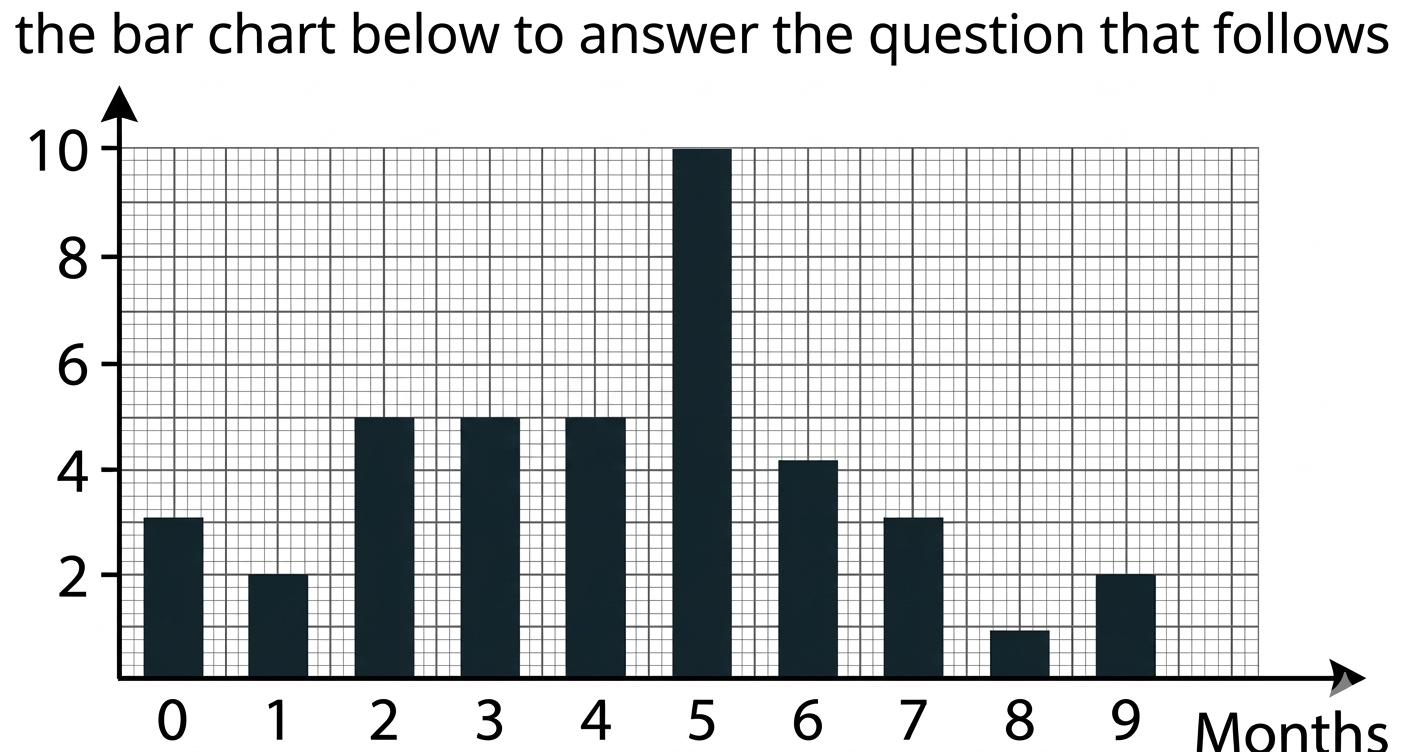 The bar chart above shows the marks obtained by students in a mathematics test. How many students in all took the test?
3 + 2 + 5 + 5 + + 5 + 10 + 4 + 3 + 1 + 2 = 40
Not clear enough?
Question 48
Determine the mean score of the student that took the mathematics test?
To calculate the mean:
\[ \begin{aligned}
\text{Mean} &= \frac{(3 \times 0) + (1 \times 2) + (5 \times 2) + (5 \times 3) + (5 \times 4)}{40} \\
&\quad + \frac{(10 \times 5) + (4 \times 6) + (3 \times 7) + (1 \times 8) + (2 \times 9)}{40} \\
&= \frac{168}{40} \\
&= 4.2
\end{aligned}\]
\[ \begin{aligned}
\text{Mean} &= \frac{(3 \times 0) + (1 \times 2) + (5 \times 2) + (5 \times 3) + (5 \times 4)}{40} \\
&\quad + \frac{(10 \times 5) + (4 \times 6) + (3 \times 7) + (1 \times 8) + (2 \times 9)}{40} \\
&= \frac{168}{40} \\
&= 4.2
\end{aligned}\]
Not clear enough?
Question 49

From the diagram above. Find the fraction of the shaded position?
\(\theta\) = 180o -(90 + 60) \(\theta\)
= 180o - 150o = 30o
Fraction of shaded position
= \(\dfrac{30}{360}\) + \(\dfrac{30}{360}\)
= \(\dfrac{1}{12}\) + \(\dfrac{1}{12}\) = \(\dfrac{1}{6}\)
= 180o - 150o = 30o
Fraction of shaded position
= \(\dfrac{30}{360}\) + \(\dfrac{30}{360}\)
= \(\dfrac{1}{12}\) + \(\dfrac{1}{12}\) = \(\dfrac{1}{6}\)
Not clear enough?
Question 50
 From the diagram above, find the required roots/region of x.
The graph represents a quadratic function (parabola) that opens upwards and intersects the x-axis at \( x = -1 \) and \( x = 4 \). The shaded region is the part of the curve below the x-axis, which corresponds to the inequality where the function is less than or equal to zero.
\[ \text{The region is } -1 \le x \le 4 \]