
Physics 2005 Jamb Examination

Question 41
Formula: \(Q = mL\). So, \(L = Q/m\).
Given \(Q = 10^6\,\text{J}, m = 2\,\text{kg}\):
\[L = \dfrac{10^6}{2} = 5.0 \times 10^5 \, \text{J kg}^{-1}.\]
Correct option: D.
Not clear enough?
Question 42
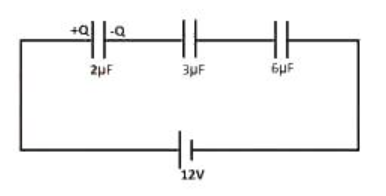
The figure above shows three capacitors, 2 μF, 3 μF and 6 μF connected in series. If the p.d across the system is 12 V, the p.d across the 6 μF capacitor is
For capacitors in series: \(\tfrac{1}{C_{eq}} = \tfrac{1}{2} + \tfrac{1}{3} + \tfrac{1}{6} = 1\). So \(C_{eq} = 1\,\mu\text{F}.\)
Total charge: \(Q = C_{eq}V = 1 \times 12 = 12 \, \mu\text{C}.\)
Charge on each capacitor is the same. Voltage across 6 μF: \(V = Q/C = 12/6 = 2\,\text{V}.\)
Correct option: C.
Not clear enough?
Question 43
Coulomb’s law: \(F \propto 1/r^2\). If distance \(r\) becomes 4 times, force becomes \(1/4^2 = 1/16\) of its former value.
Correct option: B.
Not clear enough?
Question 44
Velocity of sound in air: \(v \propto \sqrt{T}\) where \(T\) is absolute temperature.
To double \(v\), need \(\sqrt{T_{new}/T_{old}} = 2 \implies T_{new}/T_{old} = 4.\)
So the temperature must be quadrupled. Correct option: A.
Not clear enough?
Question 45
Force \(F \propto 1/r^2\). If distance is halved, \(F_{new} = F \times (1/(1/2)^2) = 4F.\)
So new force = \(200 \times 4 = 800\,N.\)
Correct option: D.
Not clear enough?
Question 46
For inductors in series, \(L_{eq} = L_1 + L_2 = 3 + 6 = 9\,H.\)
Correct option: A.
Not clear enough?
Question 47
An elastic material has a length of 36 cm when a load of 40 N is hung on it and a length of 45 cm when a load of 60 N is hung on it. The original length of the string is
Extension due to 40 N: \(36 - L_0\).
Extension due to 60 N: \(45 - L_0\).
For Hooke's law F = Ke
\[ \implies \dfrac{F}{e} = K\]
\[\dfrac{f_1}{e_1} = \dfrac{f_2}{e_2}\]
\[\text{Let the original length} = t_0\]
therefore
\[e_1 = (36 - t_0)cm; e_2 = (45 - t_0)cm\]
\[f_1 = 40N, f_2 = 60N\]
\[ \dfrac{40}{36 - t_0} = \dfrac{60}{45 - t_0}\]
\[ \implies 40(45 - t_0) = 60(36 - t_0)\]
Therefore \(1800 - 40t_0 = 2160 - 60t_0\)
\(60t_0 - 40t_0 = 2160 - 1800\)
\(20t_0 = 360\)
\(t_0 = 18cm\)
Not clear enough?
Question 48
A. 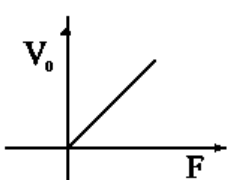 B.
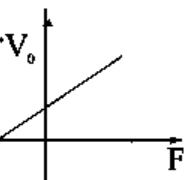 C.
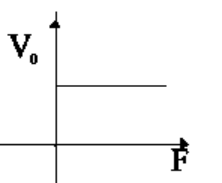 D.
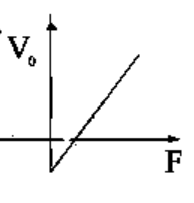
In the photoelectric effect, which of the following graphs correctly represents the graph of stopping potential V₀ against frequency f of incident light?
Option D
is the graph of stopping potential Vo against the frequency of the incident light I. The straight line graph cuts the intercept I = threshold frequency. As the frequency of the incident light increases above this point(threshold frequency), the stopping potential corresponding to the kinetic energy of the photoelectron also increases.
Not clear enough?
Question 49
The amount of energy released when 0.5 kg of uranium is burnt completely is [\(c = 3 × 10^8 m/s\)]
Einstein’s relation: $$E = m c^2$$ $$ m = 0.5 \, \text{kg}, \quad c = 3 \times 10^8 \, \text{m/s} $$ $$ E = 0.5 \times (3 \times 10^8)^2 = 0.5 \times 9 \times 10^{16} = 4.5 \times 10^{16} \, \text{J}. $$
Correct option: D.
Not clear enough?
Question 50
Equation of motion: \(v^2 = u^2 + 2as\).
Here, \(v = 0, u = 30, s = 50, a = ?\).
\(0 = 30^2 + 2a(50) ⇒ 0 = 900 + 100a ⇒ a = -9\,ms^{-2}.\)
Deceleration = 9 ms−2.
Correct option: C.
Not clear enough?
You might like
Samuel Coleridge-Taylor was a prominent classical music composer from England who toured the US three times in the early 1900s. The child of a West African father and an English mother, Coleridge-Taylor emphasized his mixed-race ancestry. For example, he referred to himself as Anglo-African. _______ he incorporated the sounds of traditional African music into his classical music compositions.
A boy receives the echo of his clap reflected by a nearby hill 0.8s later. How far is he from the hill? [ speed of sound in air = 340ms\(^{-1}\) ]
The Tsetse fly acts as a biological vector and transmission factor for which of the following parasitic organisms?