
Physics 2006 Jamb Examination
Physics 2006 Jamb Examination

Question 31
I. The number of neutrons released exceeds the number that caused the fission.
II. There is loss of mass.
III. Energy is produced.
IV. Smaller nuclei merge to form larger nuclei
which of the statement above are correct about nuclear fission?
II. There is loss of mass.
III. Energy is produced.
IV. Smaller nuclei merge to form larger nuclei
which of the statement above are correct about nuclear fission?
Nuclear fission produces more neutrons than the initiating neutron (I is true), there is a mass defect (II is true), and energy is released (III is true). Statement IV describes fusion, not fission (false). Therefore I, II and III are correct.
Not clear enough?
Question 32
A certain manufacturer wishes to make an n-type semiconductor. Which materials would he select for doping?
An n-type semiconductor is produced by doping with pentavalent (group V) elements which donate extra electrons. Arsenic and antimony are group V elements, so they produce n-type material.
Not clear enough?
Question 33
A p-n junction diode is used as?
A p–n junction diode allows current to pass primarily in one direction and is commonly used to convert alternating current (AC) to direct current (DC). Thus it is used as a rectifier in an a.c. circuit.
Not clear enough?
Question 34
An object placed 10cm from a concave mirror of focal length 5cm would have its image
For a concave mirror, the radius of curvature $R=2f=2\times5\;\text{cm}=10\;\text{cm}$. An object placed at $2f$ produces an image at $2f$ (real, inverted, same size). Therefore the image is at the radius of curvature (10 cm).
Not clear enough?
Question 35
A submarine is observed to rise from a real depth of 80 m to 60 m in water. Calculate the change in apparent depth.
[Refraction index of water $\mu=\dfrac{4}{3}$]
[Refraction index of water $\mu=\dfrac{4}{3}$]
Apparent depth $=\dfrac{\text{real depth}}{\mu}$.
Initial apparent depth = $\dfrac{80}{\dfrac{4}{3}}=80\times\dfrac{3}{4}=60\;\text{m}$.
Final apparent depth = $\dfrac{60}{\dfrac{4}{3}}=60\times\dfrac{3}{4}=45\;\text{m}$.
Change in apparent depth = $60-45=15\;\text{m}$.
Initial apparent depth = $\dfrac{80}{\dfrac{4}{3}}=80\times\dfrac{3}{4}=60\;\text{m}$.
Final apparent depth = $\dfrac{60}{\dfrac{4}{3}}=60\times\dfrac{3}{4}=45\;\text{m}$.
Change in apparent depth = $60-45=15\;\text{m}$.
Not clear enough?
Question 36
Non-luminous object can be seen because they
Non-luminous objects do not produce their own light. They are visible only because they reflect light from luminous sources into our eyes.
Not clear enough?
Question 37
The wavelength of the first overtone of a note in a closed pipe of length 33 cm is?
In a closed pipe, the fundamental wavelength $\lambda_1 = 4L = 4\times 33 = 132\;\text{cm}$. The first overtone corresponds to the 3rd harmonic: $\lambda_3 = \dfrac{4L}{3} = \dfrac{132}{3} = 44\;\text{cm}$.
Not clear enough?
Question 38
A person can focus objects when they lie beyond 75 cm from his eyes. The focal length of the lens required to reduce his least distance of distinct vision to 25 cm is?
The least distance of distinct vision required = 25 cm.
\(\therefore\) For the person to see an object clearly at \(25 \, \text{cm}\) from the eye,
the image must be formed at \(75 \, \text{cm}\) on the same side of the lens, at his near point. \\
\(\therefore U = 25 \, \text{cm}, \quad V = -75 \, \text{cm} \; (\text{image should be virtual})\)
\[
\dfrac{1}{f} = \dfrac{1}{v} + \dfrac{1}{u}
\]
\[
= \dfrac{1}{-75} + \dfrac{1}{25}
\]
\[
= -\dfrac{1}{75} + \dfrac{3}{75} = \dfrac{2}{75}
\]
\[
\therefore f = \dfrac{75}{2} = 37.5 \, \text{cm}
\]
Not clear enough?
Question 39
A conductor has a diameter of 1.00 mm and length 2.00 m. If the resistance of the material is $0.1\;\Omega$, its resistivity is?
Resistivity $\rho = R\dfrac{A}{L}$. Diameter $=1.00\;\text{mm} = 1.0\times 10^{-3}\;\text{m}$, radius $r = 0.5\times 10^{-3}\;\text{m}$.
Area $A = \pi r^2 = \pi(0.5\times 10^{-3})^2 = 7.85\times 10^{-7}\;\text{m}^2$.
$\rho = 0.1\times\dfrac{7.85\times 10^{-7}}{2.0} = 3.93\times 10^{-8}\;\Omega\,\text{m}$.
Area $A = \pi r^2 = \pi(0.5\times 10^{-3})^2 = 7.85\times 10^{-7}\;\text{m}^2$.
$\rho = 0.1\times\dfrac{7.85\times 10^{-7}}{2.0} = 3.93\times 10^{-8}\;\Omega\,\text{m}$.
Not clear enough?
Question 40
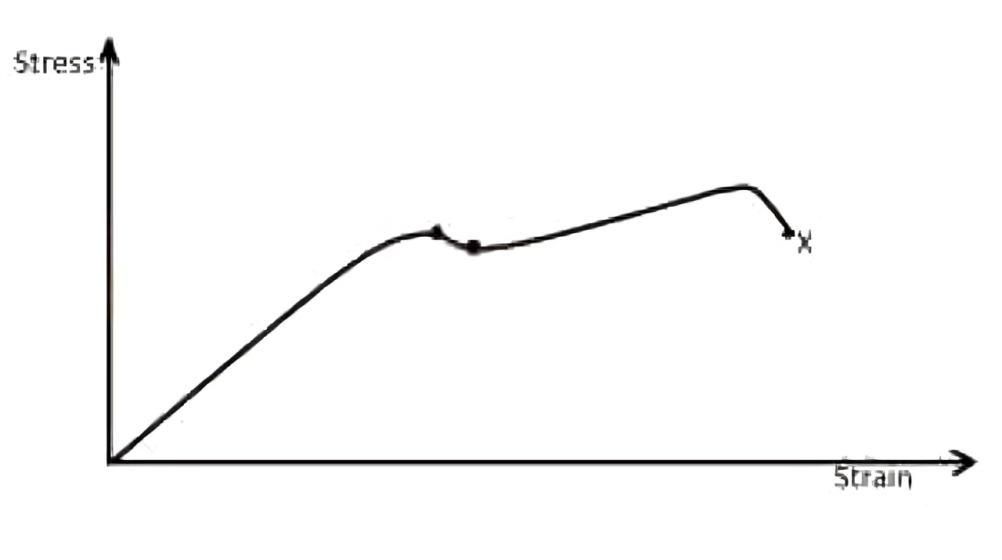
The diagram above represents the stress-strain graph for a typical metal rod. What does the X represent?
In the stress - strain graph shown above, X represents the breaking point of the wire
Not clear enough?
You might like
‘ “…Are you the only visitor to Jerusalem who does not know the things that have happened there in these days?” ’
This question is from the novel 'The Last Days at Forcados High school'.
Who was the teacher to whom the students called “cane”?
When goods are sent to branch at cost plus mark up, it means that the branch should sell at_____________
In the preparation of oxygen by heating KClO3 in the presence of MnO2, only moderate heat is needed because the catalyst acts by