Physics 2008 Jamb Examination
Physics 2008 Jamb Examination

Question 1
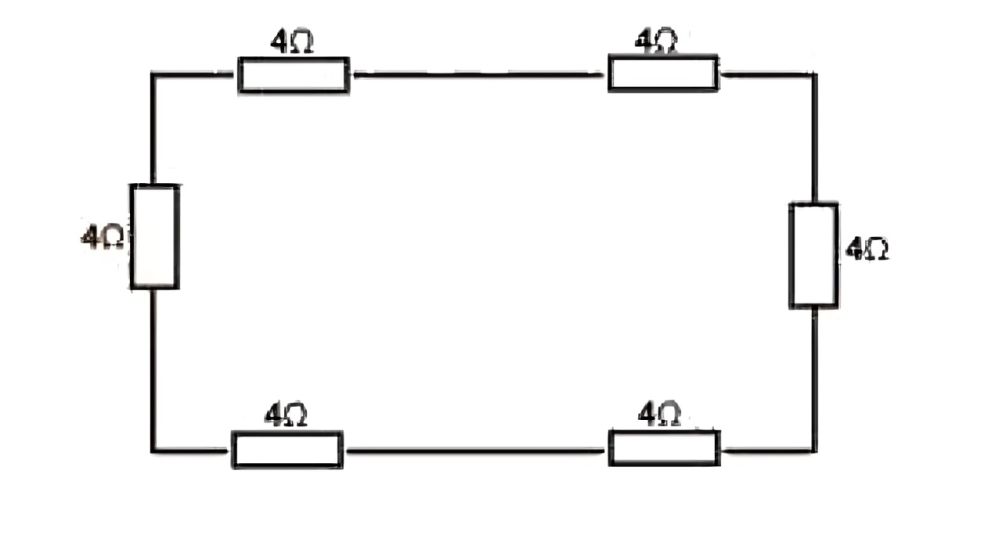
Find the effective resistance in the diagram above
The resistors are connected in such a way that the total resistance adds up to $24\ \Omega$.
Not clear enough?
Question 2

Given the inductor of inductance 5 mH, 10 mH and 20 mH connected in series, the effective inductance is
For inductors in series, $L_{eq} = L_1 + L_2 + L_3 = 5 + 10 + 20 = 35.0\ \text{mH}$.
Not clear enough?
Question 3
If electrons are accelerated from rest through a potential difference of $10\ \text{kV}$, what is the wavelength of the associated electron?
[ $m=9.1\times10^{-31}\ \text{kg},\ e=1.6\times10^{-19}\ \text{C},\ h=6.6\times10^{-34}\ \text{J·s}$ ]
[ $m=9.1\times10^{-31}\ \text{kg},\ e=1.6\times10^{-19}\ \text{C},\ h=6.6\times10^{-34}\ \text{J·s}$ ]
Kinetic energy\[ \begin{aligned}
E &= eV \\
&= 1.6 \times 10^{-19} \times 10^4 \\
&= 1.6 \times 10^{-15}\ \text{J}
\end{aligned}\] Momentum\[ \begin{aligned}
p &= \sqrt{2 m E} \\
&= \sqrt{2 \times 9.1 \times 10^{-31} \times 1.6 \times 10^{-15}} \\
&\approx 5.4 \times 10^{-23}\ \text{kg·m/s}
\end{aligned}\] Wavelength\[ \begin{aligned}
\lambda &= \frac{h}{p} \\
&= \frac{6.6 \times 10^{-34}}{5.4 \times 10^{-23}} \\
&\approx 1.22 \times 10^{-11}\ \text{m}
\end{aligned}\]
Not clear enough?
Question 4
In the nuclear reaction below, identify the particle $X$:
$$^{14}_{7}\text{N} + ^{4}_{2}\text{He} \;\rightarrow\; ^{17}_{8}\text{O} + X$$
$$^{14}_{7}\text{N} + ^{4}_{2}\text{He} \;\rightarrow\; ^{17}_{8}\text{O} + X$$
Balancing the mass numbers: 14+4=18.
RHS has $17$, so $X$ must have mass number 1.
Balancing atomic numbers: $7+2=9$, RHS has 8, so $X$ must have charge 1 (proton).
RHS has $17$, so $X$ must have mass number 1.
Balancing atomic numbers: $7+2=9$, RHS has 8, so $X$ must have charge 1 (proton).
Not clear enough?
Question 5
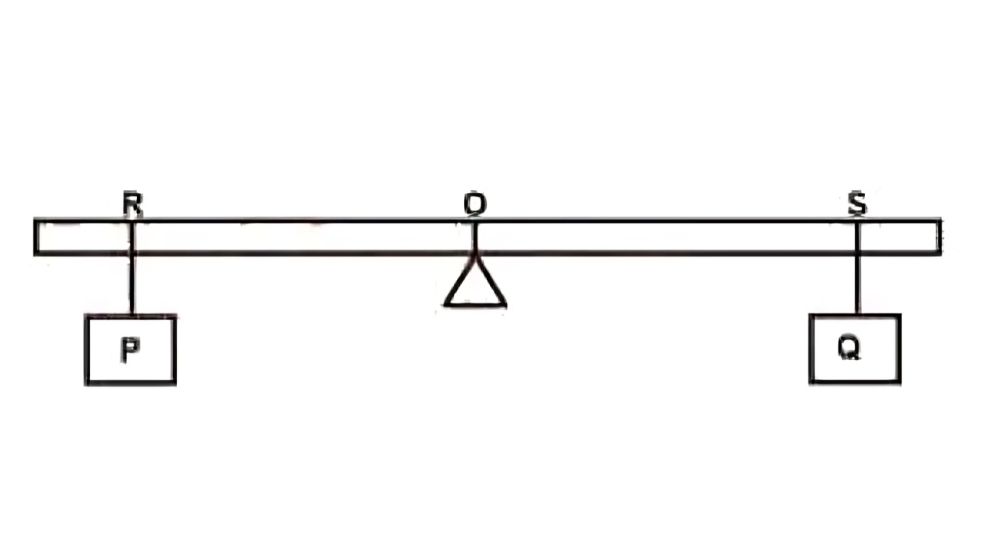
The diagram above shows a plank RS pivoted at its center of gravity O and is in equilibrium with the weights P and Q. If a weight $2P$ is added to P, the plank will be in equilibrium again by
To restore equilibrium, the turning moment of P must be reduced after doubling. This is achieved by moving P nearer to O.
Not clear enough?
Question 6
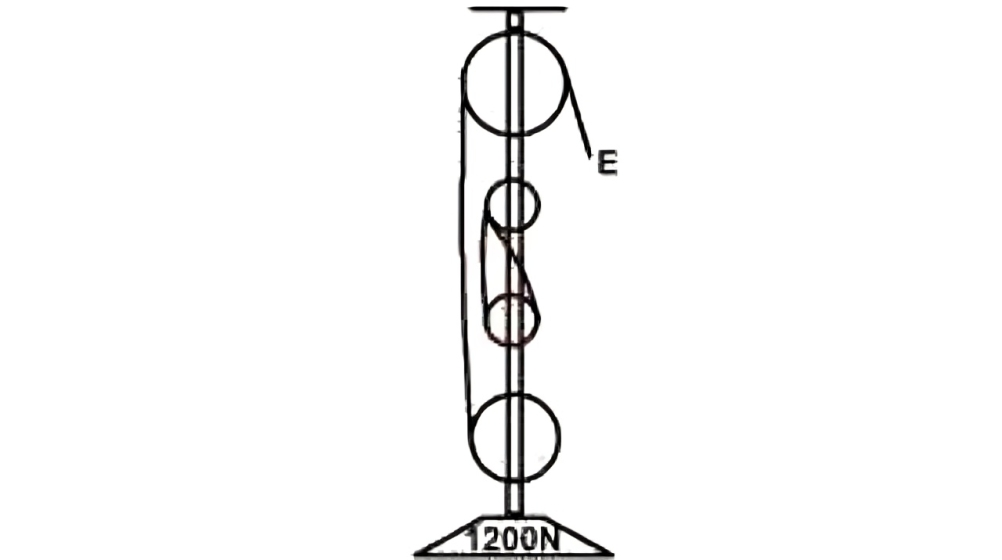
The efficiency of the pulley system shown above is 80%. Find the effort E required to lift the load of $1200\ \text{N}$.
For a pulley system with velocity ratio (VR) = 4 (from diagram), effort $E = \dfrac{Load}{VR\times\eta} = \dfrac{1200}{4\times0.8}=375\ \text{N}$.
Not clear enough?
Question 7
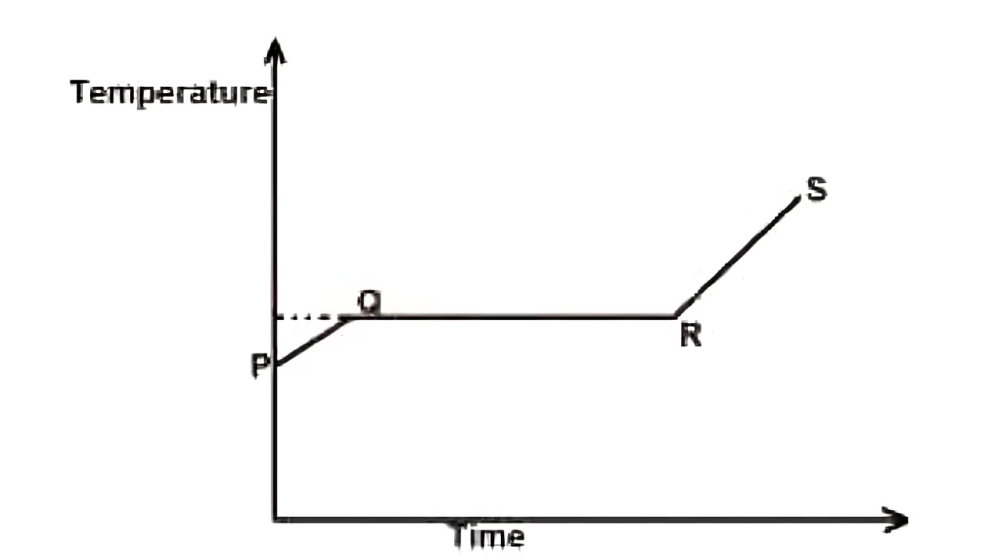
The diagram above is the heating curve for a solid. QR is the
The flat portion QR corresponds to a phase change from solid to liquid, i.e. the melting region.
Not clear enough?
Question 8
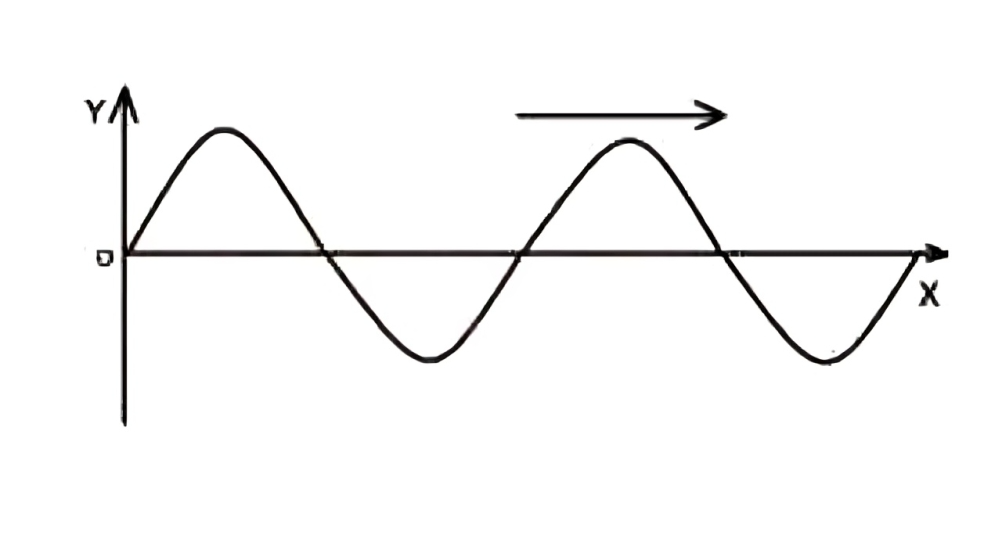
The above figure shows the motion of a progressive wave along a string. The particle motion of the medium is in direction
For a transverse wave, the displacement of particles is perpendicular to the direction of wave propagation. Since wave moves along OX, displacement is parallel to OY.
Not clear enough?
Question 9
If a convex lens of focal length $12\ \text{cm}$ is used to produce a real image four times the size of the object, how far from the lens must the object be placed?
$$\text{Focal length: } f = 12 \, \text{cm}$$$$\text{Magnification: } M = \dfrac{v}{u} = 4$$$$\therefore v = 4u$$\[\text{Lens formula: } \dfrac{1}{f} = \dfrac{1}{v} + \dfrac{1}{u}\]$$\dfrac{1}{12} = \dfrac{1}{4u} + \dfrac{1}{u}$$$$\dfrac{1}{12} = \dfrac{1 + 4}{4u} = \dfrac{5}{4u}$$$$4u = 60$$$$u = 15 \, \text{cm}$$$$\boxed{15 \, \text{cm}}$$
Not clear enough?
Question 10
The dimension of electromotive force (emf) is
Emf has units of energy per charge: $[W]/[Q]$.
Work = force × distance = $MLT^{-2}\times L=ML^2T^{-2}$.
Charge dimension = $I T$.
Thus emf dimension = $ML^2T^{-2}/(IT)=ML^2T^{-3}I^{-1}$.
Work = force × distance = $MLT^{-2}\times L=ML^2T^{-2}$.
Charge dimension = $I T$.
Thus emf dimension = $ML^2T^{-2}/(IT)=ML^2T^{-3}I^{-1}$.