
Physics 2010 Jamb Examination
Physics 2010 Jamb Examination

Question 1
The radioisotope \(^{235}_{92}U\) decays by emitting two alpha particles, three beta particles and a gamma ray. What is the mass and atomic number of the resulting element?
Each alpha particle emission decreases the mass number by 4 and the atomic number by 2.
Therefore, emission of two alpha particles results in a decrease of 8 in mass number and 4 in atomic number.
Each beta particle emission increases the atomic number by 1, without affecting the mass number. Hence, emission of three beta particles increases the atomic number by 3.
Gamma radiation has no effect on either the mass or atomic number.
Thus:
New mass number = 235 − (2 × 4) = 227
New atomic number = 92 − 4 + 3 = 91
The resulting element has a mass number of 227 and an atomic number of 91, which corresponds to protactinium (Pa).
Not clear enough?
Question 2
An object is weighted at different locations on the earth. What will be the right observation?
Mass is an intrinsic property of matter and remains constant irrespective of location. However, weight depends on the acceleration due to gravity, which varies slightly across the Earth's surface due to its shape and rotation. Therefore, while the object's mass remains constant, its weight changes with the local gravitational field strength. Hence, mass is constant while weight varies.
Not clear enough?
Question 3
Rationalize \(\dfrac{2\sqrt{3} + 5}{\sqrt{5} - \sqrt{3}}\)
To rationalize, multiply numerator and denominator by the conjugate of the denominator:\[\dfrac{(2\sqrt{3} + 5)(\sqrt{5} + \sqrt{3})}{(\sqrt{5} - \sqrt{3})(\sqrt{5} + \sqrt{3})}\]The denominator becomes \(5 - 3 = 2\).
Expanding the numerator:\[2\sqrt{3}\sqrt{5} + 2\sqrt{3}\sqrt{3} + 5\sqrt{5} + 5\sqrt{3}\]\[= 2\sqrt{15} + 6 + 5\sqrt{5} + 5\sqrt{3}\]Collect like terms to simplify:\[= (2\sqrt{15} + 5\sqrt{5} + 5\sqrt{3} + 6)\]Hence, divide by 2:\[= \dfrac{3\sqrt{15} + 11}{2}\]\[\Rightarrow \text{Final answer: } \dfrac{3\sqrt{15} + 11}{2}\]
Expanding the numerator:\[2\sqrt{3}\sqrt{5} + 2\sqrt{3}\sqrt{3} + 5\sqrt{5} + 5\sqrt{3}\]\[= 2\sqrt{15} + 6 + 5\sqrt{5} + 5\sqrt{3}\]Collect like terms to simplify:\[= (2\sqrt{15} + 5\sqrt{5} + 5\sqrt{3} + 6)\]Hence, divide by 2:\[= \dfrac{3\sqrt{15} + 11}{2}\]\[\Rightarrow \text{Final answer: } \dfrac{3\sqrt{15} + 11}{2}\]
Not clear enough?
Question 4
Two metals P and Q are heated through the same temperature difference. If the ratio of the linear expansivities of P to Q is 2:3 and the ratio of their lengths is 3:4 respectively, the ratio of the increase in lengths of P to Q is
The increase in length \(\Delta L\) is proportional to the product of the original length \(L\), the linear expansivity \(\alpha\), and the temperature change \(\Delta T\):\[\Delta L \propto \alpha L\]Therefore, the ratio of the increases in lengths of P to Q is:\[\dfrac{\Delta L_P}{\Delta L_Q} = \dfrac{\alpha_P L_P}{\alpha_Q L_Q}\]\[= \dfrac{2 \times 3}{3 \times 4} = \dfrac{6}{12} = 1:2\]Hence, the ratio of increase in lengths is 1:2.
Not clear enough?
Question 5
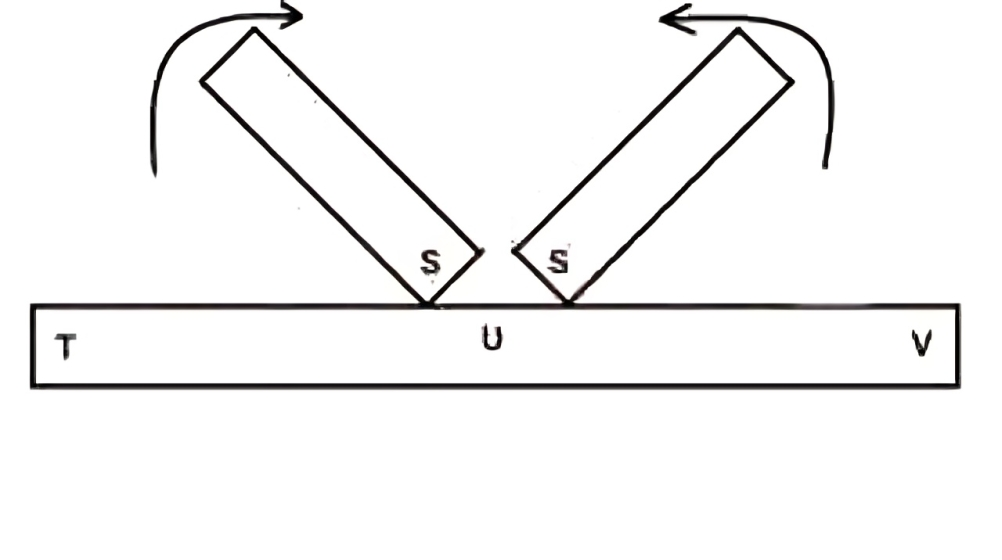
In the diagram above, if the south-poles of two magnets stroke steel bar, the polarities at T and V will respectively be
When the south poles of two magnets stroke a steel bar from both ends towards the centre, the ends being stroked acquire polarities opposite to the stroking poles due to magnetic induction. Since both ends are stroked with south poles, both T and V will become north poles, leaving the centre as south. Therefore, both T and V are north.
Not clear enough?
Question 6
In Faraday’s law of electrolysis, a graph of the mass deposited against the quantity of electricity is plotted. The slope of the graph gives
According to Faraday’s first law of electrolysis, the mass of a substance deposited is directly proportional to the quantity of electricity passed through the electrolyte:\[m = ZQ\]where \(Z\) is the electrochemical equivalent. Hence, when a graph of mass \(m\) is plotted against charge \(Q\), the slope represents the electrochemical equivalent \(Z\).
Not clear enough?
Question 7
Three capacitors of capacitance 2μF, 4μF and 8μF are connected in parallel and a P.D of 6V is maintained across each capacitor, the total energy stored is
In parallel connection, the total capacitance is the sum of individual capacitances:\[C_T = 2 + 4 + 8 = 14 \; μF = 14 × 10^{-6} F\]The energy stored in a capacitor is given by:\[E = \dfrac{1}{2}CV^2\]\[= \dfrac{1}{2} (14 × 10^{-6})(6)^2\]\[= 0.5 × 14 × 10^{-6} × 36 = 252 × 10^{-6} = 2.52 × 10^{-4} J\]Therefore, the total energy stored is \(2.52 × 10^{-4}\; J\).
Not clear enough?
Question 8
A cell of e.m.f 12V and internal resistance 4Ω is connected to an external resistor of resistance 2Ω. Find the current flow.
The current in a circuit is given by Ohm’s law:\[I = \dfrac{E}{R + r}\]\[= \dfrac{12}{2 + 4} = \dfrac{12}{6} = 2 A\]Therefore, the current flowing through the circuit is 2 A.
Not clear enough?
Question 9
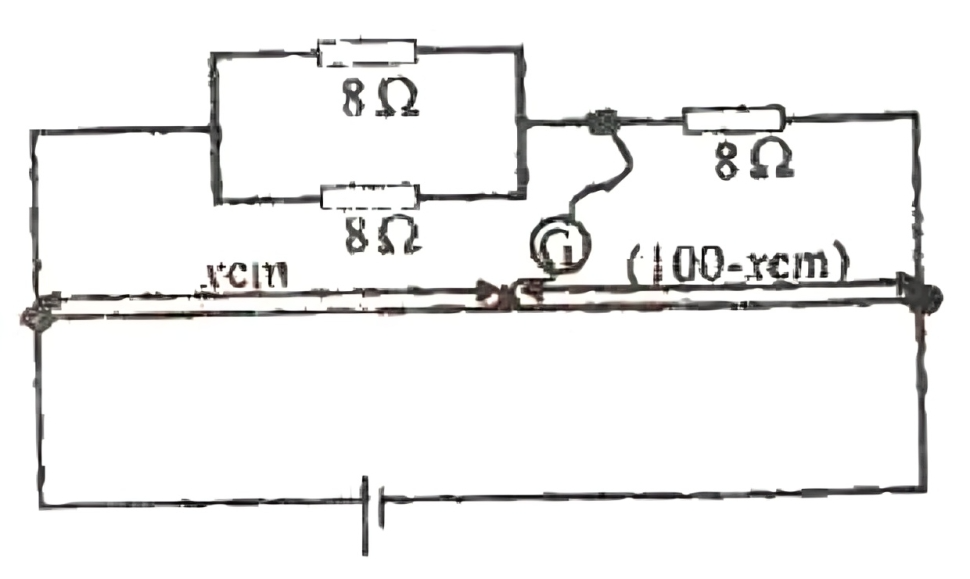
The diagram above shows a balanced metre bridge, the value of x is
For a balanced metre bridge, the ratio of resistances equals the ratio of the bridge wire segments:\[\dfrac{R_1}{R_2} = \dfrac{L_1}{L_2}\]If \(L_1 = x\) and \(L_2 = 100 - x\):\[\dfrac{R_1}{R_2} = \dfrac{x}{100 - x}\] Where $R_1$ is the effective resistance of the parallel combinaton 8//8. $$ R_1 = \dfrac{8\times8}{8+8} = \dfrac{64}{16} = 4 ohms.$$
And $R_2$ is the resistance after the galvanometer.\[\dfrac{4}{8} = \dfrac{x}{100 - x}\] \[\dfrac{1}{2} = \dfrac{x}{100 - x}\]
100−x=2x
Add x to both sides:
100=3x
\(x = 33.3\; cm\)
100−x=2x
Add x to both sides:
100=3x
\(x = 33.3\; cm\)
Not clear enough?
Question 10
Three 4Ω resistors connected in parallel have a potential difference of 16 V applied across them. What is the total current in the circuit?
For resistors in parallel, the reciprocal of the total resistance is the sum of the reciprocals of the individual resistances:\[\dfrac{1}{R_T} = \dfrac{1}{4} + \dfrac{1}{4} + \dfrac{1}{4} = \dfrac{3}{4}\]\[\Rightarrow R_T = \dfrac{4}{3} \; \Omega\]Using Ohm’s law:\[I = \dfrac{V}{R_T} = \dfrac{16}{4/3} = 16 \times \dfrac{3}{4} = 12\; A\]Hence, the total current is 12 A.
Not clear enough?
You might like
'... Not a few of us ended our application letter like this: 'if you are kind enough to accomodate this humble application, Sir/Madam, I shall do my uttermost best to rendered you the greatest services which it is at my desposition to your best satisfactory. Yours obediently servant...' yet without English, you had no education fit for a white collar job
Cameron Daodu: The Gab Boys
The tone of the passage above is