
Physics 2013 Jamb Examination
Physics 2013 Jamb Examination

Question 41
The particle nature of light is demonstrated by the
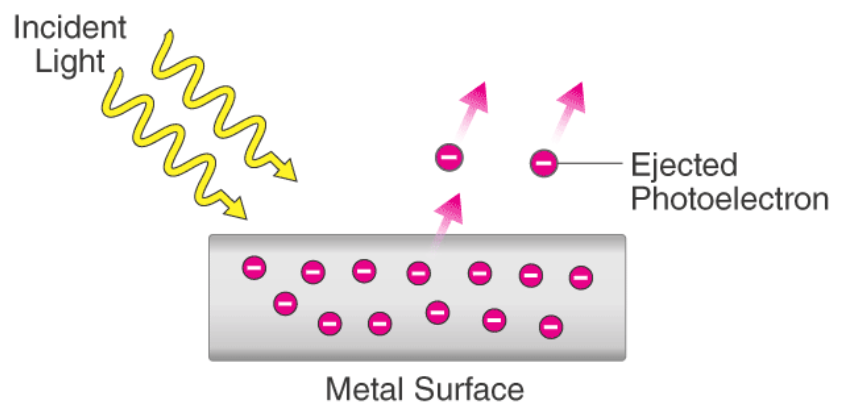
Light exhibits a dual nature, behaving as both a wave and a particle. Phenomena such as interference, polarization, and diffraction (Option D) are best explained by the wave theory of light. However, the photoelectric effect—the emission of electrons from a material when light shines upon it—cannot be explained by wave theory. It requires the concept of light consisting of discrete packets of energy called photons.
Not clear enough?
Question 42
The energy of a photon having a wavelength of 10\(^{-10}\)m is
(h = 6.63 x 10\(^{-34}\)Js, c = 3.0 x 10\(^{8}\)ms\(^{-1}\))
(h = 6.63 x 10\(^{-34}\)Js, c = 3.0 x 10\(^{8}\)ms\(^{-1}\))
The energy \(E\) of a photon is related to its wavelength \(\lambda\) by the equation derived from Planck's law and the wave equation:\[ E = \frac{hc}{\lambda} \]Given:
\(h = 6.63 \times 10^{-34} \text{ Js}\)
\(c = 3.0 \times 10^{8} \text{ ms}^{-1}\)
\(\lambda = 10^{-10} \text{ m}\)
Substituting these values into the formula:\[ E = \frac{(6.63 \times 10^{-34}) \times (3.0 \times 10^{8})}{10^{-10}} \]\[ E = \frac{19.89 \times 10^{-26}}{10^{-10}} \]\[ E = 19.89 \times 10^{-16} \text{ J} \]\[ E = 1.989 \times 10^{-15} \text{ J} \]Rounding to one decimal place as shown in the options, we get \(2.0 \times 10^{-15} \text{ J}\).
Not clear enough?
Question 43
The bond between silicon and germanium is
Silicon (Si) and Germanium (Ge) are both Group 14 elements in the periodic table, meaning they each have four valence electrons in their outermost shells. Like Carbon, they achieve stability by sharing these electrons with neighbouring atoms rather than transferring them completely. This sharing of electron pairs between atoms constitutes a covalent bond. In semiconductor physics and crystal lattice structures, silicon and germanium atoms form tetrahedral structures held together by these strong covalent bonds. Dative bonds involve one atom providing both electrons, while ionic bonds involve the transfer of electrons between a metal and a non-metal, neither of which applies to these metalloids.