
Physics 2018 Jamb Examination
Physics 2018 Jamb Examination

Question 71
To keep a vehicle moving at a constant speed V requires power P from the engine. The force provided by the engine is
Power is defined as the rate of doing work. In linear motion, work is the product of force and displacement. Therefore, power can be expressed as:\[ P = \frac{\text{Work}}{\text{Time}} = \frac{F \times s}{t} \]Since velocity \( V \) is displacement \( s \) divided by time \( t \), we can substitute to get:\[ P = F \times V \]To find the force provided by the engine, we rearrange the formula to isolate \( F \):\[ F = \frac{P}{V} \]
Not clear enough?
Question 72
Which of the following is the dimension of pressure
Pressure is defined as Force per unit Area. To find its dimensions, we break it down into fundamental units of Mass (M), Length (L), and Time (T). \[ \text{Pressure} = \frac{\text{Force}}{\text{Area}} \]Force has dimensions of mass \( \times \) acceleration:\[ F = M \times LT^{-2} = MLT^{-2} \]Area has dimensions of length squared:\[ A = L^{2} \]Therefore, Pressure is:\[ P = \frac{MLT^{-2}}{L^{2}} = ML^{1-2}T^{-2} = ML^{-1}T^{-2} \]
Not clear enough?
Question 73
Palm oil from a bottle flows out more easily after it has been heated because the
Viscosity is the internal friction or resistance of a fluid to flow. For most liquids, viscosity decreases as temperature increases. When palm oil is heated, the kinetic energy of its molecules increases, which helps to overcome the attractive intermolecular forces that keep the liquid 'thick'. Consequently, the oil becomes thinner (less viscous) and flows more readily out of the bottle.
Not clear enough?
Question 74
A ball of mass 5.0kg hits a smooth vertical wall normally with a speed of 2ms\(^{-1}\). Determine the magnitude of the resulting impulse
Impulse is defined as the change in momentum (\( mv - mu \)). When an object hits a wall 'normally' (perpendicularly) and rebounds, its velocity changes direction. In a perfectly elastic or standard physics problem context without a specified rebound speed, we assume it rebounds with the same speed in the opposite direction for maximum impulse:\[ \text{Impulse} = m(v - u) \]Let initial velocity \( u = 2 \; \text{ms}^{-1} \) and final velocity \( v = -2 \; \text{ms}^{-1} \):\[ \text{Impulse} = 5.0(-2 - 2) = 5.0(-4) = -20 \; \text{kgms}^{-1} \]The magnitude is 20.0 \( \text{kgms}^{-1} \). If the question implies the ball stops or just refers to the momentum of the strike, the value would differ, but for a standard rebound, 20 is the physical result.
Not clear enough?
Question 75
The efficiency of energy conversion on the energy flow through a hydroelectric power is?
Efficiency is generally defined as the ratio of useful output energy to total input energy.
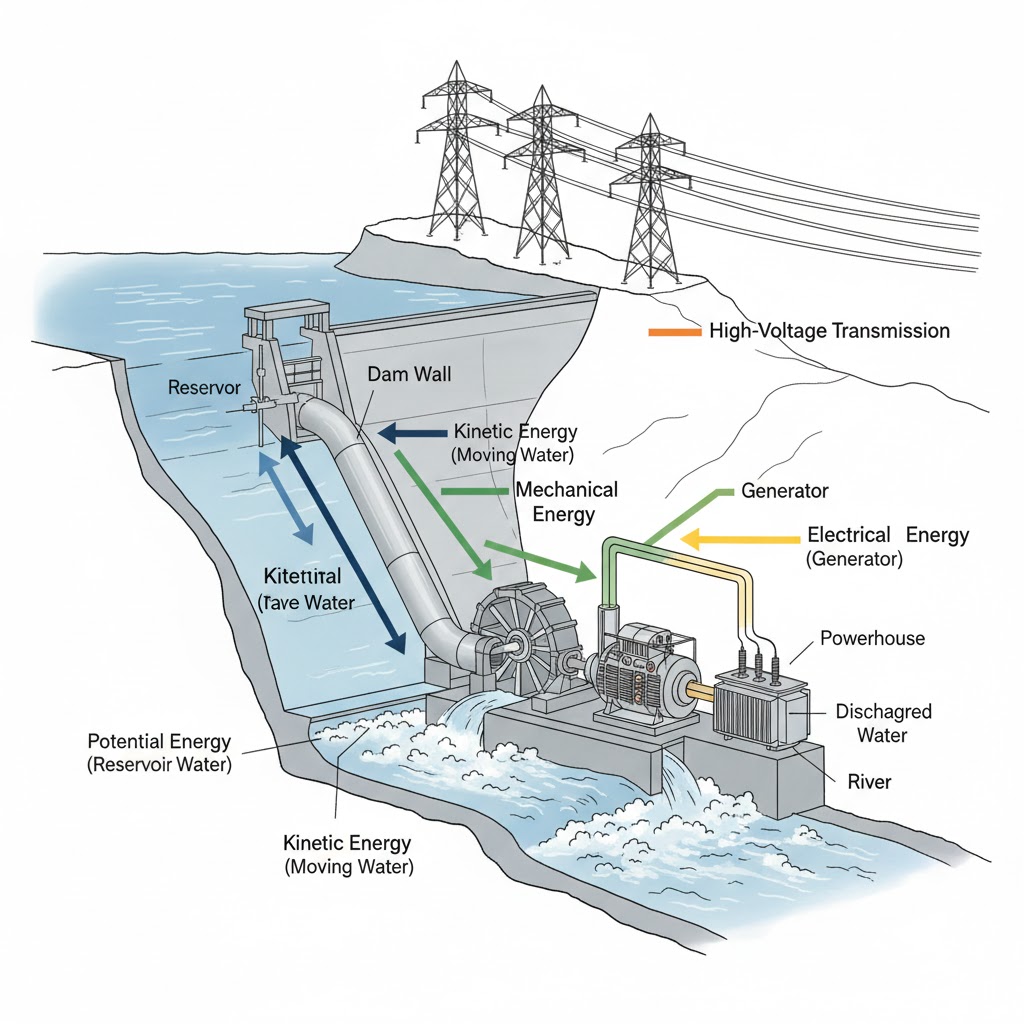
In the context of energy flow through stages (where E1 might be potential energy, E2 kinetic energy, and E3 electrical energy), the efficiency of a specific stage or the whole process is the final desired energy divided by the initial energy source. Usually, for a hydroelectric system, if E2 is the output and E1 is the input, efficiency is E2/E1. Given the options, B or A are common representations depending on which labels represent input and output.
In the context of energy flow through stages (where E1 might be potential energy, E2 kinetic energy, and E3 electrical energy), the efficiency of a specific stage or the whole process is the final desired energy divided by the initial energy source. Usually, for a hydroelectric system, if E2 is the output and E1 is the input, efficiency is E2/E1. Given the options, B or A are common representations depending on which labels represent input and output.
Not clear enough?
Question 76
An object weighs 30N in air and 21N in water. The weight of the object when completely immersed in a liquid of relative density 1.4 is
First, find the upthrust in water (\( U_w \)):\[ U_w = \text{Weight in air} - \text{Weight in water} = 30 - 21 = 9\text{N} \]Upthrust is proportional to the density of the liquid. The upthrust in the new liquid (\( U_l \)) is:\[ U_l = \text{Relative Density} \times U_w = 1.4 \times 9 = 12.6\text{N} \]The weight in the liquid is the weight in air minus the new upthrust:\[ \text{Weight in liquid} = 30 - 12.6 = 17.4\text{N} \]
Not clear enough?
Question 77
Which of the following instruments is most suitable for measuring the outside diameter of a narrow pipe in a few millimeters in diameter?
For measuring very small dimensions accurately (in the range of millimeters), the micrometer screw gauge is the most suitable tool. It has a much higher precision (usually 0.01 mm) compared to a vernier calliper (0.1 mm) or a metre rule (1 mm), making it ideal for narrow pipes or wires.
Not clear enough?
Question 78
Electrical power is transmitted at a high voltage rather than a low voltage because the amount of energy loss is due to
Energy loss in transmission lines occurs primarily due to the resistance of the wires, which converts electrical energy into heat. This is known as Joule heating, calculated as \( P_{loss} = I^{2}R \). By transmitting at high voltage, the current (\( I \)) is reduced for the same amount of power. Since power loss depends on the square of the current, reducing the current significantly decreases the energy lost as heat.
Not clear enough?
Question 79
If the focal length of a camera is 20cm, the distance from the film at which the lens must be set to produce a sharp image of 100cm away is
We use the lens formula:\[ \frac{1}{f} = \frac{1}{u} + \frac{1}{v} \]Where \( f = 20 \; \text{cm} \) and the object distance \( u = 100 \; \text{cm} \). We need to find the image distance \( v \) (distance from lens to film):\[ \frac{1}{v} = \frac{1}{f} - \frac{1}{u} = \frac{1}{20} - \frac{1}{100} \]\[ \frac{1}{v} = \frac{5 - 1}{100} = \frac{4}{100} \]\[ v = \frac{100}{4} = 25 \; \text{cm} \]
Not clear enough?
Question 80
The image of an object is located 6cm behind a convex mirror. If it's magnification is 0.6, calculate the focal length of the mirror
In a mirror, magnification \( M = |v/u| \). For a convex mirror, the image is virtual and behind the mirror, so we use the sign convention \( v = -6 \; \text{cm} \).
From magnification:\[ 0.6 = \frac{-(-6)}{u} \implies 0.6 = \frac{6}{u} \implies u = 10 \; \text{cm} \]Now use the mirror formula:\[ \frac{1}{f} = \frac{1}{u} + \frac{1}{v} \]\[ \frac{1}{f} = \frac{1}{10} + \frac{1}{-6} = \frac{3 - 5}{30} = \frac{-2}{30} \]\[ f = -15 \; \text{cm} \]The negative sign confirms it is a diverging (convex) mirror.
From magnification:\[ 0.6 = \frac{-(-6)}{u} \implies 0.6 = \frac{6}{u} \implies u = 10 \; \text{cm} \]Now use the mirror formula:\[ \frac{1}{f} = \frac{1}{u} + \frac{1}{v} \]\[ \frac{1}{f} = \frac{1}{10} + \frac{1}{-6} = \frac{3 - 5}{30} = \frac{-2}{30} \]\[ f = -15 \; \text{cm} \]The negative sign confirms it is a diverging (convex) mirror.
Not clear enough?
You might like
Which of the following terms is not used to describe the total amount stated in the memorandum of association approved by the Registrar of Companies?
When a few drops of Millon reagent are added to egg-white solution in a test tube, the white precipitate changes to
Kamal can do a work in 15 days. Bimal is 50 per cent more efficient than Kamal in doing the work. In how many days will Bimal do that work ?
5 men can do a piece of work in 6 days while 10 women can do it in 5 days. In how many days can 5 women and 3 men do it ?