
Physics 2021 Jamb Examination
Physics 2021 Jamb Examination

Question 21
A lead bullet of mass 0.05kg is fired with a velocity of 200ms\(^{-1}\) into a block of mass 0.95kg. Given that the lead block can move freely, the final kinetic energy after impact is?
This problem involves a perfectly inelastic collision where the bullet becomes embedded in the block, and the system moves together with a common velocity. First, we must apply the Principle of Conservation of Linear Momentum to find the final velocity (\( v \)) of the combined system.
Let:
\( m_1 = 0.05 \, \text{kg}, u_1 = 200 \, \text{ms}^{-1} \)
\( m_2 = 0.95 \, \text{kg}, u_2 = 0 \, \text{ms}^{-1} \)
\[ m_1u_1 + m_2u_2 = (m_1 + m_2)v \] \[ (0.05 \times 200) + (0.95 \times 0) = (0.05 + 0.95)v \] \[ 10 = 1.0v \Rightarrow v = 10 \, \text{ms}^{-1} \]Now, we calculate the final kinetic energy (K.E.) of the combined mass: \[ \text{K.E.} = \frac{1}{2}(m_1 + m_2)v^2 \] \[ \text{K.E.} = \frac{1}{2}(1.0)(10)^2 \] \[ \text{K.E.} = \frac{1}{2}(100) = 50 \, \text{J} \] The final kinetic energy is 50 Joules, which is significantly lower than the initial energy due to energy being dissipated as heat and work done during the embedding process.
Not clear enough?
Question 22
A ball of mass 0.1kg is thrown vertically upwards with a speed of 10ms\(^{-1}\) from the top of a tower 10m high. Neglecting air resistance, its total energy just before hitting the ground is? (Take g = 10ms\(^{-2}\))
According to the Law of Conservation of Energy, the total mechanical energy of a system remains constant if no external non-conservative forces (like air resistance) act on it. The total energy at any point is the sum of its Kinetic Energy (K.E.) and Gravitational Potential Energy (P.E.).
At the top of the tower (start point):
\( m = 0.1 \, \text{kg}, u = 10 \, \text{ms}^{-1}, h = 10 \, \text{m} \)\[ \text{Total Energy} = \text{K.E.} + \text{P.E.} \] \[ \text{K.E.} = \frac{1}{2}mu^2 = \frac{1}{2}(0.1)(10)^2 = 0.5 \times 100 = 5 \, \text{J} \] \[ \text{P.E.} = mgh = 0.1 \times 10 \times 10 = 10 \, \text{J} \] \[ \text{Total Energy} = 5 + 10 = 15 \, \text{J} \] Since energy is conserved, the total energy just before hitting the ground will still be 15 Joules, although it will have been entirely converted into kinetic energy at that point.
Not clear enough?
Question 23
A car of mass 800kg attains a speed of 25m/s in 20secs. The power developed in the engine is?
Power is defined as the rate at which work is done or energy is transferred. In this case, the engine performs work to increase the kinetic energy of the car from rest to 25 m/s.
Given:
\( m = 800 \, \text{kg}, v = 25 \, \text{ms}^{-1}, t = 20 \, \text{s} \) First, calculate the work done, which is equal to the final kinetic energy gained: \[ W = \Delta \text{K.E.} = \frac{1}{2}mv^2 - 0 \] \[ W = \frac{1}{2} \times 800 \times (25)^2 \] \[ W = 400 \times 625 = 250,000 \, \text{J} \]Now, calculate power using the formula: \[ P = \frac{W}{t} \] \[ P = \frac{250,000}{20} = 12,500 \, \text{W} \] \[ P = 1.25 \times 10^4 \, \text{W} \] This power rating represents the average power developed by the engine over the 20-second interval.
Not clear enough?
Question 24
When the breaks in a car are applied, the frictional force on the tyres is?
Friction is often viewed as a nuisance because it causes wear and tear or energy loss. However, in the context of braking, friction is essential for safety. When the brakes are applied, the brake pads create friction against the discs/drums, and the tyres create friction against the road surface. This frictional force acts in the direction opposite to the car's motion, providing the necessary deceleration to bring the vehicle to a stop. Without this force, the car would continue moving indefinitely. Therefore, it is an advantage in this specific context because it allows the driver to control and stop the vehicle.
Not clear enough?
Question 25
If the stress on a wire is 10\(^7\)Nm\(^{-2}\) and the wire is stretched from its original length of 10.00m to 10.05m. The Young's modulus of the wire is?
Young's modulus (\( E \)) is the ratio of tensile stress to tensile strain. It measures the stiffness of a solid material.
Given:
\( \text{Stress} = 10^7 \, \text{Nm}^{-2} \)
\( L_0 = 10.00 \, \text{m}, L = 10.05 \, \text{m} \)
First, calculate the tensile strain (\( e \)): \[ e = \frac{\Delta L}{L_0} = \frac{10.05 - 10.00}{10.00} \] \[ e = \frac{0.05}{10.00} = 0.005 = 5 \times 10^{-3} \]Now, calculate Young's modulus: \[ E = \frac{\text{Stress}}{\text{Strain}} = \frac{10^7}{5 \times 10^{-3}} \] \[ E = \frac{1}{5} \times 10^{10} = 0.2 \times 10^{10} \] \[ E = 2.0 \times 10^9 \, \text{Nm}^{-2} \] The resulting value indicates the material's resistance to elastic deformation.
Not clear enough?
Question 26
A solid weighs 10.00N in air, 6N when forcefully immersed in water, and 7.0N when fully immersed in a liquid, X. Calculate the relative density of the liquid X.
Relative Density (R.D.) of a liquid can be determined using Archimedes' Principle by comparing the upthrust exerted by the liquid to the upthrust exerted by water on the same solid.
Formula: \[ \text{R.D. of liquid} = \frac{\text{Apparent loss of weight in liquid}}{\text{Apparent loss of weight in water}} \] Given:
Weight in air = 10.00 N
Weight in water = 6.00 N
Weight in liquid X = 7.00 N
1. Loss of weight in liquid X = \( 10.00 - 7.00 = 3.00 \, \text{N} \)
2. Loss of weight in water = \( 10.00 - 6.00 = 4.00 \, \text{N} \)\[ \text{R.D.} = \frac{3.00}{4.00} = \frac{3}{4} \text{ (or 0.75)} \] The relative density of 0.75 indicates that liquid X is less dense than water.
Not clear enough?
Question 27
When the temperature of a liquid increases, its surface tension
Surface tension is caused by cohesive forces between liquid molecules. As the temperature of a liquid rises, the kinetic energy of the molecules increases. This increased molecular motion leads to a decrease in the strength of the intermolecular attractive forces. Because the cohesive forces weaken, the 'skin' effect on the surface of the liquid becomes less pronounced, resulting in a decrease in surface tension. This is why hot water is generally better for cleaning than cold water; its lower surface tension allows it to wet surfaces and penetrate fibers more effectively.
Not clear enough?
Question 28
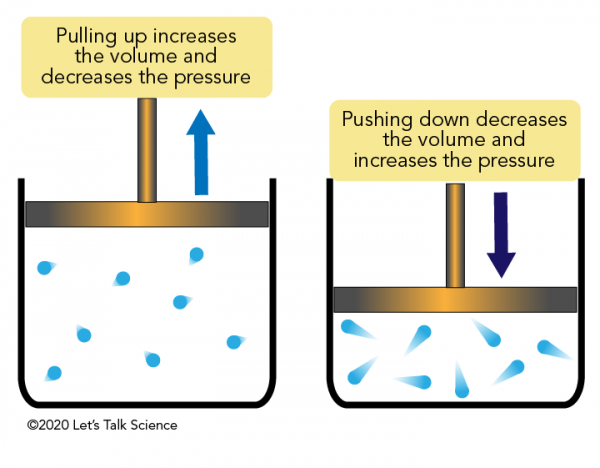
A gas at a volume of V\(_0\) in a container at pressure p\(_0\) is compressed to one-fifth of its volume. What will be its pressure if the magnitude of its original temperature T is constant?
When temperature is kept constant, the relationship between the pressure and volume of a fixed mass of gas is governed by Boyle's Law. Boyle's Law states that pressure is inversely proportional to volume.
\[ P_1V_1 = P_2V_2 \]
Given:
\( P_1 = p_0, V_1 = V_0 \)
\( V_2 = \frac{1}{5}V_0 \)
 \[ p_0 \times V_0 = P_2 \times \left(\frac{1}{5}V_0\right) \]
\[ p_0V_0 = \frac{P_2V_0}{5} \]
\[ P_2 = 5p_0 \]
By compressing the gas to a smaller volume, the molecules are forced into a smaller space, increasing the frequency of collisions with the walls, which results in a five-fold increase in pressure.
\( P_1 = p_0, V_1 = V_0 \)
\( V_2 = \frac{1}{5}V_0 \)
\[ p_0 \times V_0 = P_2 \times \left(\frac{1}{5}V_0\right) \]
\[ p_0V_0 = \frac{P_2V_0}{5} \]
\[ P_2 = 5p_0 \]
By compressing the gas to a smaller volume, the molecules are forced into a smaller space, increasing the frequency of collisions with the walls, which results in a five-fold increase in pressure.Not clear enough?
Question 29
A piece of substance of specific heat capacity 450Jkg\(^{-1}\)K\(^{-1}\) falls through a vertical distance of 20m from rest. Calculate the rise in temperature of the substance on hitting the ground when all its energies are converted into heat. [g = 10ms\(^{-2}\)]
In this problem, the gravitational potential energy of the substance at a height is converted into thermal energy upon impact with the ground.
Potential Energy (P.E.) = \( mgh \)
Heat Energy (Q) = \( mc\Delta\theta \)
Equating the two, as all energy is converted to heat: \[ mgh = mc\Delta\theta \] Notice that the mass (\( m \)) cancels out from both sides: \[ gh = c\Delta\theta \] Given:
\( g = 10 \, \text{ms}^{-2}, h = 20 \, \text{m}, c = 450 \, \text{Jkg}^{-1}\text{K}^{-1} \) \[ 10 \times 20 = 450 \times \Delta\theta \] \[ 200 = 450 \times \Delta\theta \] \[ \Delta\theta = \frac{200}{450} \] \[ \Delta\theta = \frac{20}{45} = \frac{4}{9} \, ^\circ\text{C} \] The rise in temperature is 4/9 ºC.
Not clear enough?
Question 30
I. A liquid boils when its saturated vapor pressure is equal to the external pressure
II. Dissolved substances in pure water lead to an increase in the boiling point.
III. When the external pressure is increased, the boiling point increases.
IV. Dissolved substances in pure water decreases the boiling point
Which of the above combinations are peculiarities of the boiling point of a liquid?
Boiling occurs when the saturated vapour pressure (SVP) of a liquid becomes equal to the atmospheric or external pressure acting on it (Statement I). The temperature at which this happens is called the boiling point. Factors that affect the boiling point include:
1. External Pressure: Increasing the pressure makes it harder for molecules to escape into the vapour phase, thus increasing the boiling point (Statement III). This is the principle behind pressure cookers.
2. Impurities: Dissolving a non-volatile solute in a pure liquid lowers its vapour pressure, meaning a higher temperature is required to reach atmospheric pressure. This increases the boiling point (Statement II).
Statement IV is false because impurities elevate, rather than decrease, the boiling point. Therefore, only statements I, II, and III are correct.
Not clear enough?
You might like
This question is based on Buchi Emecheta's Second Class Citizen.
For her act of child neglect, Adah's mother was forced by the police to
To produce high-quality, professional-looking documents for distribution to customers, which type of printer would be most appropriate?
If 3 men or 4 women can plough a field in 43 days, how long will 7 men and 5 women take to plough it ?