
Physics 2022 Jamb Examination
Physics 2022 Jamb Examination

Question 31
The amount of energy required to change a kilogram of ice block into water without a change in temperature is?
Latent heat is the energy absorbed or released by a substance during a change in its physical state (phase) that occurs without changing its temperature. Specifically, the 'specific latent heat of fusion' is the amount of heat required to convert 1 kg of a substance from the solid state (ice) to the liquid state (water) at its melting point. Since the question specifies a change from ice to water for a unit mass (kilogram) at constant temperature, this corresponds exactly to the definition of the specific latent heat of fusion.
Not clear enough?
Question 32
Which expression gives magnetic flux?
Magnetic flux (\(\phi\)) is a measure of the total magnetic field (\(B\)) passing through a given area (\(A\)). Mathematically, it is defined as the scalar product of the magnetic flux density and the area vector. If the magnetic field is at an angle \(\theta\) to the normal of the area, the formula is:\[ \phi = BA \cos \theta \] Option A represents the magnetic force on a moving charge; Option B relates to the magnetic field around a wire; and Option D represents Faraday's Law of induction (EMF), not the flux itself.
Not clear enough?
Question 33
The graph of pressure (P) against the reciprocal of the volume (1/V) in Boyle's law is a?
Boyle's law states that for a fixed mass of gas at constant temperature, the pressure (\(P\)) is inversely proportional to the volume (\(V\)), which means \(P \propto 1/V\). If we plot \(P\) against \(V\), we get a hyperbola. However, if we plot \(P\) against the reciprocal of the volume (\(1/V\)), the relationship is linear. Therefore, the resulting graph is a straight line passing through the origin.
Not clear enough?
Question 34
What quantity of heat is required to convert 20 g of ice at 0 ºC to water at the same temperature? (Specific latent heat of ice = 336 Jg\(^{-1}\))
To calculate the heat required for a phase change at constant temperature, we use the formula for latent heat:\[ Q = mL_f \]Given:
\( m = 20 \, \text{g} \)
\( L_f = 336 \, \text{Jg}^{-1} \)
Calculation:\[ Q = 20 \times 336 \] \[ Q = 6720 \, \text{J} \] \[ Q = 6.72 \times 10^3 \, \text{J} \]
\( m = 20 \, \text{g} \)
\( L_f = 336 \, \text{Jg}^{-1} \)
Calculation:\[ Q = 20 \times 336 \] \[ Q = 6720 \, \text{J} \] \[ Q = 6.72 \times 10^3 \, \text{J} \]
Not clear enough?
Question 35
A train of mass 1600 kg attains a speed of 25 ms\(^{-1}\) in 20 seconds. The power developed in the engine is?
Power is the rate of doing work, which in this case is the rate of change of kinetic energy.
First, find the work done (Kinetic Energy): \[ K.E. = \frac{1}{2}mv^2 \] \[ K.E. = \frac{1}{2} \times 1600 \times (25)^2 \] \[ K.E. = 800 \times 625 = 500,000 \, \text{J} \]Now, calculate Power: \[ P = \frac{\text{Work}}{\text{time}} \] \[ P = \frac{500,000}{20} = 25,000 \, \text{W} \] \[ P = 25 \, \text{kW} \]
First, find the work done (Kinetic Energy): \[ K.E. = \frac{1}{2}mv^2 \] \[ K.E. = \frac{1}{2} \times 1600 \times (25)^2 \] \[ K.E. = 800 \times 625 = 500,000 \, \text{J} \]Now, calculate Power: \[ P = \frac{\text{Work}}{\text{time}} \] \[ P = \frac{500,000}{20} = 25,000 \, \text{W} \] \[ P = 25 \, \text{kW} \]
Not clear enough?
Question 36
The main factor which affects the speed of sound wave is the?
The speed of sound depends primarily on the medium through which it travels. Specifically, it is determined by the medium's density and elasticity (bulk modulus). For instance, sound travels faster in solids than in liquids, and faster in liquids than in gases, because solids are more elastic and less compressible. Temperature, which is a property of the medium, also affects speed. [Image showing speed of sound in different media] Factors like amplitude, intensity, and loudness affect the energy and perception of the sound, but not its speed.
Not clear enough?
Question 37
A semiconductor is formed by?
Semiconductors like Silicon (Si) and Germanium (Ge) belong to Group IV of the periodic table, meaning they have four valence electrons. To achieve stability, each atom shares its four electrons with four neighbouring atoms through covalent bonding. This structure of shared electron pairs is what defines the crystal lattice of semiconductors.
Not clear enough?
Question 38
One of the following is a scalar quantity?
A scalar quantity is one that has only magnitude but no direction. Potential energy (and all forms of energy/work) is a scalar because it represents a quantity of Joules without a spatial direction.
Conversely, weight is a force (downwards), momentum involves velocity (direction), and displacement is distance in a specific direction, making them all vector quantities.
Conversely, weight is a force (downwards), momentum involves velocity (direction), and displacement is distance in a specific direction, making them all vector quantities.
Not clear enough?
Question 39
The mercury column in the barometer at national atmospheric pressure has a height of?
Standard atmospheric pressure is defined as the pressure exerted by a column of mercury exactly 760 mm high at 0 ºC at sea level. Converting millimetres to centimetres:\[ 760 \, \text{mm} = 76 \, \text{cm} \]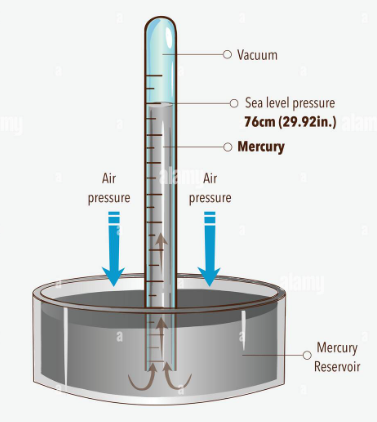
Therefore, the mercury column height is 76 cm at sea level.
Therefore, the mercury column height is 76 cm at sea level.
Not clear enough?
Question 40
If an object just begins to slide on a surface inclined at 30º to the horizontal, the coefficient of friction is?
When an object is on the verge of sliding down an inclined plane, the coefficient of static friction (\(\mu\)) is equal to the tangent of the angle of inclination (\(\theta\)), often called the angle of repose. \[ \mu = \tan \theta \]
Given \( \theta = 30^\circ \):
\[ \mu = \tan 30^\circ \]
From trigonometric identities:
\[ \tan 30^\circ = \frac{1}{\sqrt{3}} \]
(Note: This is also equivalent to \(\frac{\sqrt{3}}{3}\)).
Not clear enough?
You might like
By default, when you open the Print dialogue box in most applications, how many copies of the document are set to be printed?
Select the option that best explains the information conveyed in the sentence.
In those days in this school, everyone who spoke in a language other than English paid a fine of ten naira?
The average weight of 15 iron bars is 1000 kg. If the heaviest iron bar is removed, the average weight is reduced by 5 kg. Find the weight in kg of the heaviest iron bar.