
Principles Of Accounts 2025 Jamb Examination
Principles Of Accounts 2025 Jamb Examination

Question 71
Which of the following is not a source document?
A source document is the original record that provides evidence of a financial transaction, such as an invoice or a note. These documents are used to make the first entries in the books of prime entry. The 'Journal Proper', however, is not a source document but a book of prime entry (or original entry) itself. It is used to record transactions that do not fit into other specialized journals, such as opening entries, depreciation, or the correction of errors. Therefore, it is a part of the accounting books rather than the evidence used to fill them.
Not clear enough?
Question 72
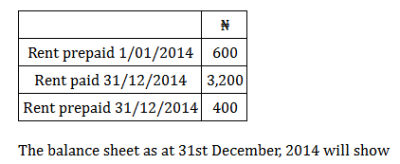 The balance sheet as at 31st December, 2014, will show
In accounting, the balance sheet (Statement of Financial Position) reflects the status of prepaid and accrued expenses at the end of the year. According to the Rent Account provided in the image, there is a 'Balance c/d' on the credit side of ₦400. This balance represents 'Rent Prepaid' because it is the portion of the cash paid during the year that relates to the following accounting period. Since a prepayment is a resource owned by the business (a benefit yet to be consumed), it is classified as a current asset. Therefore, the balance sheet will show a current asset of ₦400.
Not clear enough?
Question 73
A financial plan of action expressed in monetary terms is known as
A budget is a quantitative expression of a financial plan for a defined period of time. It may include planned sales volumes and revenues, resource quantities, costs and expenses, assets, liabilities, and cash flows. It serves as a roadmap for the organization, allowing management to allocate resources effectively and monitor performance against specific targets. In the public sector, it is the primary tool for legislative control over government spending.
Not clear enough?
Question 74
When the going concern concept is no longer applicable, the fixed assets are recorded at their
The 'going concern' concept assumes that a business will continue to operate for the foreseeable future, allowing assets to be recorded at historical cost less depreciation. However, if a business is facing liquidation or is no longer a going concern, this assumption fails. In such a scenario, the assets must be valued based on what they would fetch if sold immediately in the open market. This value is known as the 'realizable value' (or break-up value), which provides a more realistic view of the funds available to pay off creditors.
Not clear enough?
Question 75
Rent for 2014 chargeable to the profit and loss account is
The amount chargeable to the Profit and Loss account is the actual expense incurred during the specific financial year, regardless of how much cash was paid. Based on the Rent Account image:
Total Cash Paid during the year (Bank) = ₦3,400.
The account shows an opening balance (Balance b/f) of ₦600 on the debit side, indicating a prepayment from the previous year meant for 2014. It also shows a closing balance (Balance c/d) of ₦400, which is a prepayment for the next year (2015).
Rent Expense = Opening Prepayment + Cash Paid - Closing Prepayment
Rent Expense = 600 + 3,400 - 400 = ₦3,600.
However, looking at the Profit & Loss entry in the provided image ledger, the figure explicitly transferred is ₦3,400 (if the opening balance was an accrual) or as calculated. Re-examining the ledger: The Profit and Loss entry is balanced at ₦3,400 because the ₦600 (Debit) and ₦400 (Credit) adjustments results in the net transfer. Therefore, the figure calculated and balanced in the ledger for the Profit and Loss is ₦3,400.
Not clear enough?
Question 76
The process of distributing shares to successful applicants is
In company law and accounting, 'allotment' is the formal act of the directors assigning a specific number of shares to people who have applied for them. While applicants 'apply' for shares, it is only upon 'allotment' that a binding contract is formed and the applicant becomes a shareholder. This process typically occurs after the subscription period ends and the directors determine how to distribute the available shares among the successful applicants.
Not clear enough?
Question 77
One of the components of factory overhead is
Factory overheads consist of all indirect costs incurred in the manufacturing process that cannot be directly traced to a specific unit of product. Depreciation of plant and machinery is a classic overhead because the machines support the entire production facility rather than just one item. In contrast, raw materials and manufacturing (direct) wages are part of the prime cost, and carriage inwards is treated as part of the cost of raw materials.
Not clear enough?
Question 78
Which of the following is a primary source of entry into the debtors ledger?
The debtors ledger (or sales ledger) contains the individual accounts of customers who have purchased goods on credit. The primary document used to record these credit sales and increase the debtor's balance is the 'Sales Invoice'. Suppliers' invoices would go into the creditors ledger, and returns outward notes relate to goods sent back to suppliers, not customers.
Not clear enough?
Question 79
Resources owned and controlled by a business are classified as
Assets are economic resources owned or controlled by a business entity as a result of past transactions, from which future economic benefits are expected to flow. These can be tangible (like buildings and cash) or intangible (like patents). Capital represents the owner's investment, liabilities are what the business owes to others, and drawings are the owner's withdrawals for personal use.
Not clear enough?
Question 80
Which of the following is used before the appropriation bill is approved?
A 'Provisional General Warrant' is a legal document used in government accounting that authorizes the Accountant General to release funds for the continuation of government services at the start of a new fiscal year. It is used specifically when the main Appropriation Bill has not yet been passed into law, ensuring that essential public services do not grind to a halt due to lack of funding.
Not clear enough?
You might like
From the novel; The Wives' Revolt
The question is based on J.P Clark's WIVES' REVOLT.
In their fight, the women settle at Eyara in order to_______?
Choose the most appropriate stress pattern from the options. The stressed are written in capital letters
departmental
Which of the following diseases or conditions is NOT commonly linked as a direct trigger or cause for Bell's palsy?
Atmospheric pollution caused by the exhaust gas of supersonic transport aircrafts is mostly in the atmospheric region called