
Numerical Reasoning Test 1 Nlng Job
Numerical Reasoning Test 1 Nlng Job

Question 11
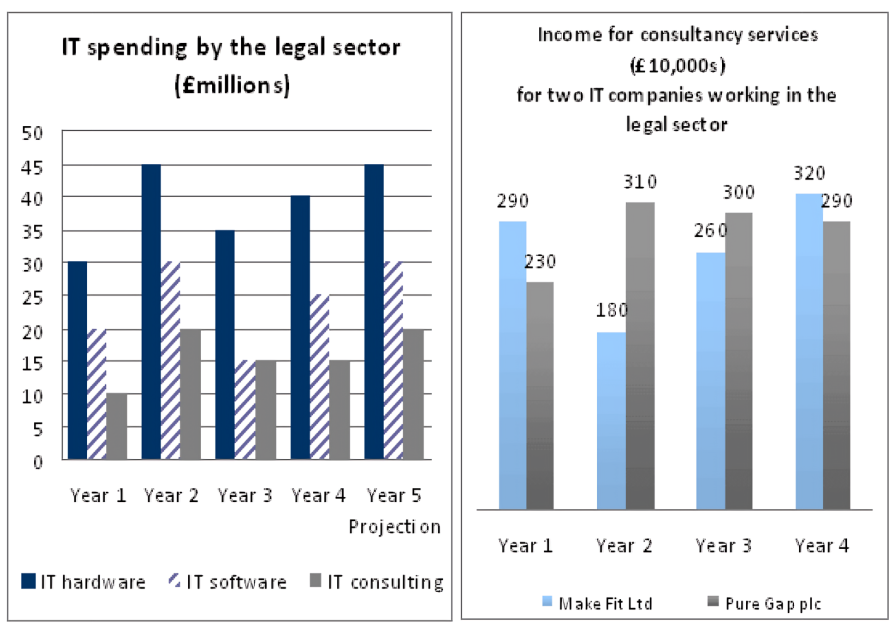
The projection for Year 6 is the same absolute increase in spending by legal services on IT hardware, software and consulting as there was in Year 5. What is the total spending projection for IT hardware, software and consulting by legal services in Year 6?
From the chart, the total IT spending in Year 4 increases to a higher value in Year 5 by a fixed absolute amount of 5 million.
The increase from Year 4 to Year 5 is £15 million when the spending on hardware, software and consulting are added together.
Applying the same absolute increase to the Year 5 total gives the Year 6 projection.
Year 5 total spending = 45 + 30 + 20 = 95.
Adding the total increase of 15 million leads to a projected total of:
£95 + £15 = 110 million for Year 6.
Not clear enough?
Question 12
How much did Make Fit Ltd’s income from consultancy services for Years 1 to Year 3 inclusive differ from Pure Gap plc’s income over the same period?
Make Fit Ltd’s consultancy income for Years 1, 2 and 3 = 290 + 180 + 260 = £730
Pure Gap plc consultancy income for Years 1, 2 and 3 = 230 + 310 + 300 = £840
Difference = £840 - £730 = £110 * £10,000 = £1,100,000
Pure Gap plc consultancy income for Years 1, 2 and 3 = 230 + 310 + 300 = £840
Difference = £840 - £730 = £110 * £10,000 = £1,100,000
Not clear enough?
Question 13
Which of the following statements is false regarding legal sector spending between Year 4 and projected Year 5.
From the chart, IT consulting increases by £5 million between Year 4 and Year 5, so statement A is true.
IT consulting in Year 5 match the value in Year 2, making statement B the true.
IT software clearly exceeds IT consulting in Year 5, making statement C true.
IT hardware shows a slight decline over this period, so statement D is also true.
Therefore D. None of these
IT consulting in Year 5 match the value in Year 2, making statement B the true.
IT software clearly exceeds IT consulting in Year 5, making statement C true.
IT hardware shows a slight decline over this period, so statement D is also true.
Therefore D. None of these
Not clear enough?
Question 14
In which year(s) did Make Fit Ltd and Pure Gap plc’s combined IT consultancy income exceed £6 million?
Year 1: 290 + 230 = 520 * 10,000 = 5,200,000
Year 2: 180 + 310 = 490 * 10,000 = 4,900,000
Year 3: 260 + 300 = 560 * 10,000 = 5,600,000
Year 4: 320 + 290 = 610 * 10,000 = 6,100,000
Only Year 4 satisfy the condition given in the question.
Year 2: 180 + 310 = 490 * 10,000 = 4,900,000
Year 3: 260 + 300 = 560 * 10,000 = 5,600,000
Year 4: 320 + 290 = 610 * 10,000 = 6,100,000
Only Year 4 satisfy the condition given in the question.
Not clear enough?
Question 15
If there had been double the number of Pure Gap plc sales in Year 2, what fraction would Make Fit Ltd sales have been of combined Pure Gap plc and Make Fit Ltd sales in Year 2?
From the chart, Pure Gap sale was 310.
A double of this would be 620.
Combining with Make Fit would give 620 + 180 = 800.
So we look for what fraction of make profit in Year 2 would result in the combined profit of 800.
Let the fraction be x,
Such that 180x = 800.
x $ = \dfrac{800}{180} = \dfrac{40}{9}$
A double of this would be 620.
Combining with Make Fit would give 620 + 180 = 800.
So we look for what fraction of make profit in Year 2 would result in the combined profit of 800.
Let the fraction be x,
Such that 180x = 800.
x $ = \dfrac{800}{180} = \dfrac{40}{9}$
Not clear enough?
Question 16
If actual labour costs rise so as to halve their discrepancy against the target, what will be the change in Gross Profit?
The target labour cost is £175,000 while the actual labour cost is £166,000.
The discrepancy is therefore £9,000.
Halving this discrepancy means labour costs will increase by:
\(\dfrac{9,000}{2} = 4,500\).
An increase in labour costs directly reduces gross profit by the same amount, since all other factors remain unchanged.
Therefore, gross profit will fall by £4,500.
The discrepancy is therefore £9,000.
Halving this discrepancy means labour costs will increase by:
\(\dfrac{9,000}{2} = 4,500\).
An increase in labour costs directly reduces gross profit by the same amount, since all other factors remain unchanged.
Therefore, gross profit will fall by £4,500.
Not clear enough?
Question 17
IKE Computers aim to grow monthly profits by 1.5%, starting in February. If monthly costs are kept constant what will the sales turnover need to be in February?
January’s actual gross profit is £36,521.
A 1.5% increase gives February’s target gross profit as:\[36,521 \times 1.015 = 37,069\]Total monthly costs remain constant at:\[166,000 + 36,000 = 202,000\]Required net turnover is therefore:\[37,069 + 202,000 = 239,069\]Since sales tax is 14%, net turnover represents 86% of sales turnover:\[\text{Sales turnover} = \frac{239,069}{0.86} \approx 277,987\]This is the required sales turnover for February.
A 1.5% increase gives February’s target gross profit as:\[36,521 \times 1.015 = 37,069\]Total monthly costs remain constant at:\[166,000 + 36,000 = 202,000\]Required net turnover is therefore:\[37,069 + 202,000 = 239,069\]Since sales tax is 14%, net turnover represents 86% of sales turnover:\[\text{Sales turnover} = \frac{239,069}{0.86} \approx 277,987\]This is the required sales turnover for February.
Not clear enough?
Question 18
If the American operations of IKE Computers had a January sales turnover in the ratio of 4:5 (American:UK) then what was the January sales turnover for American operations in \$ (at an exchange rate of 1.6\$ to the £)?
The UK January sales turnover is £277,350.
Using the ratio American:UK = 4:5, American sales are:\[\frac{4}{5} \times 277,350 = 221,880\; (£)\]Converting to dollars at an exchange rate of 1.6\$ to the £ gives:\[221,880 \times 1.6 = 355,008\]\$
This is the January sales turnover for American operations.
Using the ratio American:UK = 4:5, American sales are:\[\frac{4}{5} \times 277,350 = 221,880\; (£)\]Converting to dollars at an exchange rate of 1.6\$ to the £ gives:\[221,880 \times 1.6 = 355,008\]\$
This is the January sales turnover for American operations.
Not clear enough?
Question 19
If IKE Computers in the UK employed eighty permanent employees in January who were on the same salary, what would be the effect on February’s labour costs of replacing twenty permanent employees with interim staff on £36,000 average annual salaries?
January labour costs are £166,000 for 80 employees.
The monthly cost per permanent employee is:\[\frac{166,000}{80} = 2,075\]This corresponds to an annual salary of £24,900 per permanent employee.
The interim staff earn £36,000 per year, which is £3,000 per month.
The increase per replaced employee is therefore:\[3,000 - 2,075 = 925\]For 20 employees, the total increase in monthly labour costs is:\[20 \times 925 = 18,500\]Hence, labour costs will rise by £18,500 in February.
Not clear enough?
Question 20
If February’s gross profit target is set as a 40% increase on January’s gross profit target, to be followed by a 25% decrease in March, what is March’s gross profit target (in £1,000s)?
January’s gross profit target is £63,500.
A 40% increase in February gives:\[63,500 \times 1.40 = 88,900\]A 25% decrease in March gives:\[88,900 \times 0.75 = 66,675\]Expressed in thousands of pounds:\[66,675 \approx 66.7\]This is the March gross profit target in £1,000s.
A 40% increase in February gives:\[63,500 \times 1.40 = 88,900\]A 25% decrease in March gives:\[88,900 \times 0.75 = 66,675\]Expressed in thousands of pounds:\[66,675 \approx 66.7\]This is the March gross profit target in £1,000s.
Not clear enough?
You might like
When computer networks are interconnected across an entire city or a large campus, the network type is called a:
A beam of light travelling in water is incident on a glass which is immersed in the water. The incident beam makes an angle of 40° with the normal. Calculate the angle of refraction in the glass.
[Refractive index of water = 1.33, Refractive index of glass = 1.5]
Demolishing of the temple and rebinding it in three days was to signify the death of Jesus for how many days?
One pipe can fill a tank three times as fast as another pipe. If together the two pipes can fill the tank in 36 min, then the slower alone will be able to fill the tank in ?