Agricultural Economics Test 1 Nddc Scholarship
Agricultural Economics Test 1 Nddc Scholarship

Question 71
The economy of a developing country is typically characterized by which of the following features?
Developing countries often have an agrarian-based economy where a large majority of the population is employed in farming. Agriculture in these nations typically contributes a significant portion of the Gross Domestic Product (GDP). As a country develops, its economic structure usually shifts toward industrial manufacturing and eventually toward the service sector.
Not clear enough?
Question 72
Enterprise budgeting specifically focuses on the input-output relationship and profitability of __________.
An enterprise budget provides a detailed statement of the expected costs and returns for a specific production activity on the farm, such as a single hectare of corn or one hundred laying hens. This allows the farmer to evaluate the efficiency and economic viability of that individual enterprise in isolation before deciding how it fits into the broader farm plan.
Not clear enough?
Question 73
In agricultural accounting, expenditure on items like fertilizers, seeds, and fuel is classified as a __________.
Variable costs (also known as operating costs) are expenses that change in direct proportion to the volume of production. If a farmer decides to plant more hectares or increase their yield, they will need to purchase more fertilizer. If they do not plant anything, the cost of fertilizer drops to zero. This is in contrast to fixed costs, like land rent, which remain constant regardless of the production level.
Not clear enough?
Question 74
In a broad economic sense, which of the following statements correctly describes a 'market'?
A market is not just a physical location (like a village square). In modern economics, it refers to the entire mechanism or arrangement that brings together buyers and sellers to exchange goods and services. This includes physical shops, digital platforms (online markets), and the social or institutional organizations that facilitate trade and determine prices.
Not clear enough?
Question 75
In economic terminology, an 'extension in demand' refers to a __________.
An 'extension in demand' (also called an expansion) is a movement along a fixed demand curve specifically caused by a decrease in the price of the commodity. When the price falls, the quantity demanded increases. If the increase in demand were caused by a rise in consumer income, it would be referred to as an 'increase in demand' (a shift of the curve), not an extension.
Not clear enough?
Question 76
Which of the following formulae is used to correctly measure the 'Rate of Capital Turnover' in a farm business?
The rate of capital turnover measures how efficiently a farm uses its total assets to generate revenue. It is calculated by dividing the Gross Income (Total Revenue) by the Total Farm Assets and multiplying by 100 to get a percentage. A higher turnover rate indicates that the farm is generating more volume relative to the capital invested in land, machinery, and livestock.
\[ \text{Rate of Capital Turnover} = \left( \frac{\text{Gross Income}}{\text{Total Farm Assets}} \right) \times 100 \]
\[ \text{Rate of Capital Turnover} = \left( \frac{\text{Gross Income}}{\text{Total Farm Assets}} \right) \times 100 \]
Not clear enough?
Question 77
Farm management pulls together facts and findings from various sciences (like agronomy, animal science, and economics) to solve individual farmers' problems. Therefore, it is best described as an __________.
Farm management acts as an 'integrating science' because it bridges the gap between technical sciences and economic theory. It takes the biological and physical data from other fields and applies economic principles to help a farmer make decisions that achieve their specific goals, such as maximizing profit or minimizing risk. It synthesizes diverse information into a single, cohesive management strategy.
Not clear enough?
Question 78
In farm management, farm budgets are primarily used to __________.
Farm budgeting is a comprehensive tool used for planning and decision-making. It allows a farmer to estimate potential profits before committing resources, compare different crop or livestock choices, and perform 'what-if' analyses to see how changes in prices or technology might affect the bottom line. It is the primary method for evaluating the financial consequences of management decisions.
Not clear enough?
Question 79
In a broad economic sense, farm credit may be defined as the process of lending funds specifically for __________.
Farm credit refers to the various financial services and loan facilities provided to farmers to support agricultural production. This includes credit for purchasing inputs (seeds, fertilisers), investing in machinery, or improving land infrastructure. While it specifically aids sectors like poultry or forestry, the most comprehensive definition is that it is intended for the overall development and sustainability of the agricultural sector as a whole.
Not clear enough?
Question 80
As a study of resource allocation within a single farm unit, farm management is primarily classified as __________.
Farm management is considered an 'intra-farm' science because it focuses on the internal allocation of resources (land, labour, and capital) within the boundaries of an individual farm. It aims to optimise the performance of that specific unit. 'Inter-farm' management would involve comparing or coordinating between different farms, which is typically the domain of broader agricultural economics or policy.
Not clear enough?
You might like
Use the information below to answer question .
A company's authorized share capital was one million ordinary shares at N1 each. Issued 80% of its shares at N1.10 per share. 70k was payable on application, 25k on allotment, 10k due on first call and the balance on second call.
What would be the total amount received on second call?
If MASTER is coded as 26138402536 and GOVIND is coded as 142254481288, then how will BACKSPACE be coded ?
Use the diagram shown to answer the question.
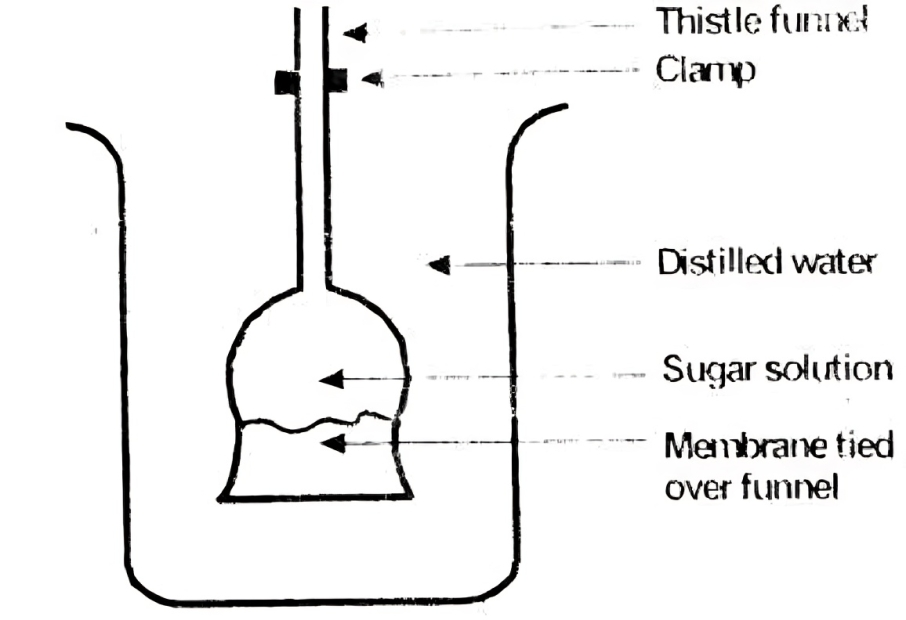
After an hour, the level of water in the thistle funnel will