
Agricultural Economics Test 3 Nddc Scholarship
Agricultural Economics Test 3 Nddc Scholarship

Question 51
The law, which is very useful in determining the best use of limited resources, is:
Opportunity cost is a fundamental concept in economics that refers to the value of the next best alternative foregone when a choice is made. Since resources are limited (scarce) and human wants are insatiable, individuals, firms, and governments must make choices. The law of opportunity cost helps in determining the most efficient and best use of these limited resources by evaluating what is being sacrificed to attain a specific good or service. By choosing the option with the lowest opportunity cost or the highest relative benefit, decision-makers can ensure that resources are allocated to their most productive and useful ends.
Not clear enough?
Question 52
The main cause of inflation is in money supply and decrease in production:
Inflation is generally defined as a persistent increase in the general price level of goods and services in an economy over a period of time. One of the primary drivers of inflation is an increase in the money supply that outpaces the rate of economic growth. When there is more money chasing fewer goods (due to a decrease in production), the purchasing power of the currency falls, and prices rise. This is often explained by the Quantity Theory of Money, which suggests a direct relationship between the amount of money in circulation and the price levels of products sold.
Not clear enough?
Question 53
The term oligopoly means:
An oligopoly is a market structure characterized by a small number of large sellers or producers who dominate the industry. Unlike monopoly, where there is only one seller, or perfect competition, where there are many, an oligopoly consists of a few firms that have significant market power. Because there are only a few sellers, the actions of one firm (such as changing prices or launching a new advertising campaign) significantly affect the others, leading to mutual interdependence. This market type often features high barriers to entry and may involve branded products or homogeneous commodities.
Not clear enough?
Question 54
The main objective of land reform measures undertaken after independence was removal of institutional and _____ obstacles:
Land reform involves the changing of laws, regulations, or customs regarding land ownership and the distribution of land. After independence in many developing nations, land reform was aimed at restructuring the agricultural sector to ensure social justice and increase productivity. The primary goal was to remove institutional obstacles—such as exploitative land tenure systems and intermediary interests—and motivational obstacles that prevented tenant farmers from investing in the land. By providing security of tenure or ownership to the actual tillers of the soil, the reforms intended to provide the necessary motivation for farmers to adopt modern techniques and increase agricultural output.
Not clear enough?
Question 55
The meanings of the word 'Economics' is most closely associated with the word:
Economics is fundamentally the study of how society manages its scarce resources. The core economic problem is the conflict between limited resources and unlimited human wants. Without scarcity, there would be no need to make choices, and therefore no need for the study of economics. The concept of scarcity dictates that because we cannot have everything we want, we must decide how to allocate what we have efficiently. Therefore, the essence of economics is deeply rooted in the reality that resources are scarce relative to the demand for them.
Not clear enough?
Question 56
Which of the following definitions of economics includes the economic concept of 'Scales of Preferences'?
The scarcity definition of economics, most notably advanced by Lionel Robbins, defines economics as the science which studies human behaviour as a relationship between ends and scarce means which have alternative uses. This definition inherently requires a 'Scale of Preference.' Since resources are scarce and wants are numerous, individuals must rank their needs and wants in order of importance. This ranking is what economists refer to as a scale of preference, allowing individuals to satisfy their most pressing needs first using the limited resources available to them.
Not clear enough?
Question 57
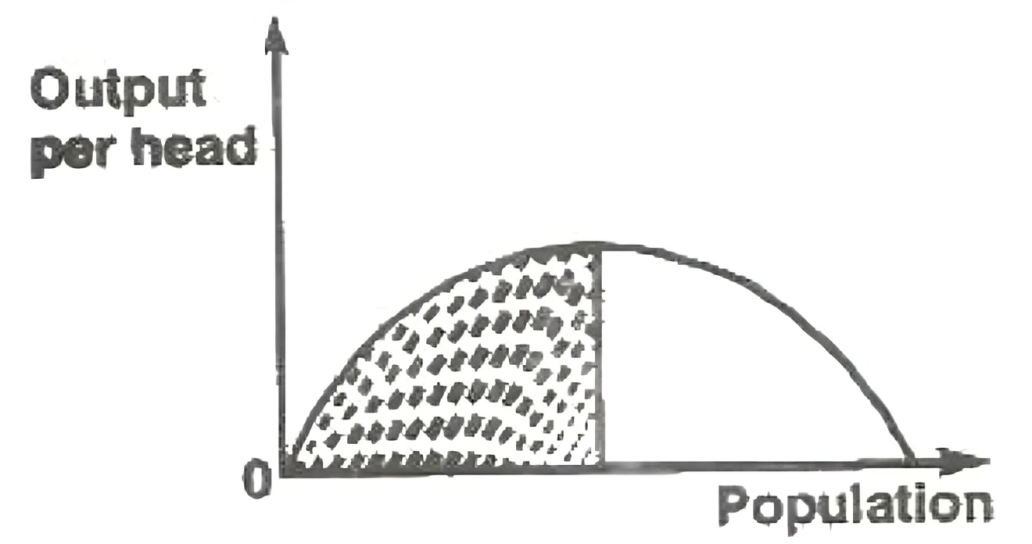
The modern theory of population is called:
The Optimum Theory of Population is considered the modern approach to population studies, succeeding the Malthusian (Classical) theory. While Malthus focused on the fear of overpopulation and food shortages, the Optimum Theory focuses on the relationship between the population size and the maximisation of per capita income. It suggests that there is a specific 'optimum' population level for any country given its resources and technology. At this level, the per capita income is at its highest. If the population exceeds or falls below this point, the average income will be lower than the potential maximum.
Not clear enough?
Question 58
The Money paid for the use of money borrowed is nothing but:
In economics, interest is defined as the price paid for the use of capital or borrowed money. When a borrower takes a loan from a lender, the borrower pays interest as compensation to the lender for the loss of liquidity and the risk taken. It is essentially the cost of borrowing or the reward for saving. Profit is the return to an entrepreneur for risk-taking, rent is the payment for the use of land, and a premium usually refers to insurance payments or an extra amount paid above a standard value, whereas interest specifically relates to credit and debt transactions.
Not clear enough?
Question 59
The more we have of a thing, the desire for addditional units of it will be:
This question refers to the Law of Diminishing Marginal Utility. According to this economic principle, as a consumer increases the consumption of a specific good or service, the marginal utility (the extra satisfaction or desire) derived from each additional unit decreases, provided all other factors remain constant. For example, the first glass of water for a thirsty person provides immense satisfaction, but the fourth or fifth glass provides much less, eventually reaching a point where the person no longer desires more. Thus, as the quantity possessed increases, the intensity of desire for an additional unit diminishes.
Not clear enough?
Question 60
The most common method exist in regulated markets is:
In regulated markets, especially in agricultural marketing, the open auction system is the most transparent and common method used for price discovery. In this system, the potential buyers gather at a specific time and place to bid openly for the produce. The auctioneer facilitates the process, and the commodity is sold to the highest bidder. This method ensures that the farmer gets a fair price based on current demand and supply conditions, preventing the exploitation that often occurs in secretive or 'under-the-cloth' (Dara/Moghum) sale methods where prices are negotiated privately.
Not clear enough?
You might like
An image in a convex lens is upright and magnified 3 times. If the focal length of the lens is 15 cm, what is the object distance?
A galvanometer with full-scale deflection of 10 mA is to be converted to a voltmeter with full-scale deflection of 5V. The resistance of the galvanometer is
Tulsiram’s salary is 20% more than that of Kashyap. If Tulsiram saves 720 which is 4% of his salary, then Kashyap’s salary is ?
Which of the following indicates the maximum number of entities that can be involved in a relationship?