
Time And Work All Competence Aptitude

Question 61
A and B can do a piece of work in 45 and 40 days respectively. They began the work together but A left after some days and B finished the remaining work in 23 days. A left after ?
Let's denote the number of days A worked before leaving as \(x\).
A's rate of work is \( \dfrac{1}{45} \) of the work per day, and B's rate of work is \( \dfrac{1}{40} \) of the work per day.
Together, their combined rate of work is \( \dfrac{1}{45} + \dfrac{1}{40} = \dfrac{8}{360} + \dfrac{9}{360} = \dfrac{17}{360} \) of the work per day.
Since they worked together for \(x\) days, the amount of work done by both A and B in \(x\) days is \( \dfrac{17}{360} \times x \).
Now, A left after \(x\) days, so the remaining work is \(1 - \dfrac{17}{360} \times x\).
We're given that B finished the remaining work in 23 days, so we can write:
\[\dfrac{17}{360} \times x + \dfrac{1}{40} \times 23 = 1\]
Let's solve this equation for \(x\).
\[ \dfrac{17}{360} \times x + \dfrac{23}{40} = 1\]\[ \dfrac{17x}{360} = 1 - \dfrac{23}{40} = \dfrac{40}{40} - \dfrac{23}{40} = \dfrac{17}{40}\]
Now, let's find \(x\):\[ \dfrac{17x}{360} = \dfrac{17}{40} \]\[ x = \dfrac{17 \times 360}{17 \times 40} \]\[ x = \dfrac{360}{40} \]\[ x = 9\]
So, A left after \( \boxed{9} \) days.
Not clear enough?
Question 62
20 men can do a piece of work in 18 days, They worked together for 3 days, then 5 men joined them. In how many more days is the work completed ?
Let's first find the rate of work for each man.
If 20 men can complete the work in 18 days, then the rate of each man is:
\[ \text{Rate of each man} = \dfrac{1}{(20 \times 18)} = \dfrac{1}{360} \]
Now, let's calculate the work done by 20 men in 3 days:
\[ \text{Work done by 20 men in 3 days} = \text{Rate of each man} \times \text{Number of men} \times \text{Number of days} \]\[ \text{Work done by 20 men in 3 days} = \dfrac{1}{360} \times 20 \times 3 = \dfrac{60}{360} = \dfrac{1}{6} \]
So, after 3 days, 20 men complete \( \dfrac{1}{6} \) of the work. This means \( \dfrac{5}{6} \) of the work is left.
Now, 5 more men join them. So, the total number of men working together becomes 25.
Now, let's find out how many more days it will take for 25 men to complete \( \dfrac{5}{6} \) of the work.
\[ \text{Number of days} = \dfrac{\text{Total work remaining}}{\text{Work done per day}} \]\[ \text{Number of days} = \dfrac{\dfrac{5}{6}}{\dfrac{1}{360} \times 25} \]\[ \text{Number of days} = \dfrac{\dfrac{5}{6}}{\dfrac{25}{360}} \]\[ \text{Number of days} = \dfrac{\dfrac{5}{6}}{\dfrac{5}{72}} \]\[ \text{Number of days} = \dfrac{5}{6} \times \dfrac{72}{5} \]\[ \text{Number of days} = \dfrac{5 \times 72}{6 \times 5} \]\[ \text{Number of days} = \dfrac{360}{30} = 12 \]
Therefore, it will take \( \boxed{12} \) more days for the remaining men to complete the work.
Not clear enough?
Question 63
X can do a piece of work in 24 days. When he had worked for 4 days, Y joined him. If complete work was finished in 16 days, Y can alone finish that work in ?
Let's denote the rate of work for X as \(X_r\) and the rate of work for Y as \(Y_r\).
Given that X can complete the work in 24 days, we have:
\[ X_r = \dfrac{1}{24} \] (work per day)
Now, let's denote the total work as \(W\).
If X worked alone for 4 days, then the amount of work completed by X in 4 days is:
\[ \text{Work done by X in 4 days} = X_r \times \text{Number of days} = \dfrac{1}{24} \times 4 = \dfrac{1}{6} \]
Now, let's denote the number of days Y worked as \(D_y\). Since Y joined X after 4 days, Y worked for \(16 - 4 = 12\) days.
So, the total work done by Y is \(D_y \times Y_r = 12 \times Y_r\).
Given that the complete work was finished in 16 days, we have:
\[ \text{Work done by X} + \text{Work done by Y} = W \]\[ \dfrac{1}{6} + 12 \times Y_r = W \]
Now, since we know that X alone can finish the work in 24 days, we can set up an equation:
\[ 24 \times X_r = W \]\[ \dfrac{1}{24} = W \]
Now, we have two equations:
\[ \dfrac{1}{6} + 12 \times Y_r = \dfrac{1}{24} \]
Solving this equation, we get:
\[ 12 \times Y_r = \dfrac{1}{24} - \dfrac{1}{6} \]\[ 12 \times Y_r = \dfrac{1}{24} - \dfrac{4}{24} \]\[ 12 \times Y_r = \dfrac{-3}{24} \]\[ Y_r = \dfrac{-3}{24 \times 12} \]\[ Y_r = -\dfrac{1}{96} \]
Now, since the rate of work cannot be negative, we must have made an error in our calculations. Let's recheck our work.
If X worked for 4 days and completed \( \dfrac{1}{6} \) of the work, then \( \dfrac{5}{6} \) of the work remains.
Given that the total work was finished in 16 days, and X worked for 4 days, Y worked for 12 days.
So, Y's rate of work should be \( \dfrac{5}{6} \) of the remaining work divided by the number of days Y worked:
\[ Y_r = \dfrac{\dfrac{5}{6}}{12} = \dfrac{5}{72} \]
Now, we know Y's rate of work, and we can find the number of days Y would take to complete the work alone:
\[ 24 \times \dfrac{1}{24} + 12 \times \dfrac{5}{72} = 1 \]\[ 1 + \dfrac{5}{6} = 1 \]\[ \dfrac{6}{6} = 1 \]
So, Y can complete the work alone in \( \boxed{36} \) days.
Not clear enough?
Question 64
A certain number of men can do a piece of work in 60 days. If there were 6 men more, the work can be finished 20 days earlier. The number of men working is ?
Let's denote the original number of men as \(x\).
The rate of work for the original group of men is \( \dfrac{1}{60} \) of the work per day.
If there were 6 men more, the total number of men becomes \(x + 6\).
According to the given information, when there are \(x + 6\) men, the work can be finished 20 days earlier, which means in 40 days.
So, the rate of work for \(x + 6\) men is \( \dfrac{1}{40} \) of the work per day.
Now, using the rate of work formula (work = rate * time), we can set up an equation for each scenario:
For the original group of men:\[ x \times \dfrac{1}{60} = 1 \]
For the group with \(x + 6\) men:\[ (x + 6) \times \dfrac{1}{40} = 1 \]
Let's solve these equations:
For the original group of men:\[ x \times \dfrac{1}{60} = 1 \]\[ x = 60 \]
For the group with \(x + 6\) men:\[ (x + 6) \times \dfrac{1}{40} = 1 \]\[ (60 + 6) \times \dfrac{1}{40} = 1 \]\[ 66 \times \dfrac{1}{40} = 1 \]\[ \dfrac{66}{40} = 1 \]
Now, the number of men working is \( \boxed{12} \).
Not clear enough?
Question 65
A can do a piece of work in 20 days and B in 15 days. With the help of C, they finish the work in 5 days. C can alone do the work in ?
Let's denote the rate of work for A as \(A_r\), the rate of work for B as \(B_r\), and the rate of work for C as \(C_r\).
Given that A can complete the work in 20 days and B in 15 days, we have:
\[ A_r = \dfrac{1}{20} \] (work per day for A)\[ B_r = \dfrac{1}{15} \] (work per day for B)
With the help of C, they finish the work in 5 days. So, the combined rate of work when A, B, and C work together is:
\[ A_r + B_r + C_r = \dfrac{1}{5} \] (work per day when A, B, and C work together)
We need to find the rate of work for C. Since we know the rates of work for A and B, we can rewrite the equation as:
\[ \dfrac{1}{20} + \dfrac{1}{15} + C_r = \dfrac{1}{5} \]
Now, let's solve for \(C_r\):
\[ \dfrac{1}{20} + \dfrac{1}{15} + C_r = \dfrac{1}{5} \]\[ \dfrac{3}{60} + \dfrac{4}{60} + C_r = \dfrac{12}{60} \]\[ \dfrac{7}{60} + C_r = \dfrac{12}{60} \]\[ C_r = \dfrac{12}{60} - \dfrac{7}{60} \]\[ C_r = \dfrac{5}{60} \]\[ C_r = \dfrac{1}{12} \]
So, the rate of work for C is \( \dfrac{1}{12} \) of the work per day.
Therefore, C can alone do the work in \( \boxed{12} \) days.
Not clear enough?
Question 66
6 men or 12 women can do a piece of work in 20 days. In how many days can 8 men and 16 women do twice as big as this work ?
Let's first find the rates of work for men and women.
If 6 men can do the work in 20 days, then the rate of work for each man is:\[ \text{Rate of work for each man} = \dfrac{1}{(6 \times 20)} = \dfrac{1}{120} \]
Similarly, if 12 women can do the work in 20 days, then the rate of work for each woman is:\[ \text{Rate of work for each woman} = \dfrac{1}{(12 \times 20)} = \dfrac{1}{240} \]
Now, let's find the combined rate of work when 8 men and 16 women work together.
The combined rate of work for 8 men is \(8 \times \dfrac{1}{120} = \dfrac{1}{15}\).
The combined rate of work for 16 women is \(16 \times \dfrac{1}{240} = \dfrac{1}{15}\).
So, the combined rate of work for 8 men and 16 women is \( \dfrac{1}{15} + \dfrac{1}{15} = \dfrac{2}{15}\).
Now, let's find out how many days it will take for 8 men and 16 women to do twice as big as this work.
Since the combined rate of work for 8 men and 16 women is \( \dfrac{2}{15} \) of the work per day, the number of days required to do twice as big as this work is:
\[ \text{Number of days} = \dfrac{\text{Total work}}{\text{Rate of work}} = \dfrac{2}{(\dfrac{2}{15})} = 15 \]
So, \(8\) men and \(16\) women can do twice as big as this work in \(\boxed{15}\) days.
Not clear enough?
Question 67
If 10 men or 20 boys can make 260 mats in 20 days, then how many mats will be made by 8 men and 4 boys in 20 days ?
Let's first find the rate of work for one man and one boy.
If 10 men can make 260 mats in 20 days, then the rate of work for one man is:\[ \text{Rate of work for one man} = \dfrac{260}{(10 \times 20)} = \dfrac{260}{200} = \dfrac{13}{10} \] mats per day.
Similarly, if 20 boys can make 260 mats in 20 days, then the rate of work for one boy is:\[ \text{Rate of work for one boy} = \dfrac{260}{(20 \times 20)} = \dfrac{260}{400} = \dfrac{13}{20} \] mats per day.
Now, let's find the combined rate of work for 8 men and 4 boys.
The combined rate of work for 8 men is \(8 \times \dfrac{13}{10} = \dfrac{104}{10} = \dfrac{52}{5}\) mats per day.
The combined rate of work for 4 boys is \(4 \times \dfrac{13}{20} = \dfrac{52}{20} = \dfrac{13}{5}\) mats per day.
So, the combined rate of work for 8 men and 4 boys is \( \dfrac{52}{5} + \dfrac{13}{5} = \dfrac{65}{5} = 13\) mats per day.
Now, let's find out how many mats will be made by 8 men and 4 boys in 20 days.
\[ \text{Number of mats} = \text{Rate of work} \times \text{Number of days} = 13 \times 20 = \boxed{260} \]
So, 8 men and 4 boys will make \(260\) mats in 20 days.
Not clear enough?
Question 68
If 1 man or 2 women or 3 boys can complete a piece of work in 88 days, then 1 man, 1 woman and 1 boy together will complete it in ?
Let's first find the rates of work for each man, woman, and boy.
If 1 man can complete the work in 88 days, then the rate of work for one man is:\[ \text{Rate of work for one man} = \dfrac{1}{88} \]
If 2 women can complete the work in 88 days, then the rate of work for one woman is:\[ \text{Rate of work for one woman} = \dfrac{1}{(2 \times 88)} = \dfrac{1}{176} \]
If 3 boys can complete the work in 88 days, then the rate of work for one boy is:\[ \text{Rate of work for one boy} = \dfrac{1}{(3 \times 88)} = \dfrac{1}{264} \]
Now, let's find the combined rate of work for 1 man, 1 woman, and 1 boy.
The combined rate of work for 1 man, 1 woman, and 1 boy is:\[ \text{Rate of work for one man, one woman, and one boy} = \dfrac{1}{88} + \dfrac{1}{176} + \dfrac{1}{264} \]
Now, let's find a common denominator for these fractions, which is \( 88 \times 2 \times 3 = 528 \).
\[ \text{Rate of work for one man, one woman, and one boy} = \dfrac{6}{528} + \dfrac{3}{528} + \dfrac{2}{528} \]\[ \text{Rate of work for one man, one woman, and one boy} = \dfrac{11}{528} \]
Now, let's find out how many days it will take for 1 man, 1 woman, and 1 boy to complete the work.
\[ \text{Number of days} = \dfrac{\text{Total work}}{\text{Rate of work}} = \dfrac{1}{\dfrac{11}{528}} = \boxed{48} \]
So, 1 man, 1 woman, and 1 boy together will complete the work in 48 days.
Not clear enough?
Question 69
6 men and 8 women can do a work in 10 days, Then 3 men and 4 women can do the same work in ?
Let's first find the rate of work for each man and each woman.
If 6 men and 8 women can do the work in 10 days, then the combined rate of work for 6 men and 8 women is the total work done in 10 days.
Let's denote the rate of work for each man as \(M_r\) and for each woman as \(W_r\).
The total work done by 6 men and 8 women in 10 days is the sum of the work done by each man and each woman:
\[6 \times M_r \times 10 + 8 \times W_r \times 10 = 1\] (since the work is completed)
Let's denote the rate of work for each man as \(M_r\) and for each woman as \(W_r\).
If we simplify this equation, we get:
\[60M_r + 80W_r = 1\]
Divide both sides by 10:
\[6M_r + 8W_r = \dfrac{1}{10}\]
Now, let's find the rate of work for 1 man and 1 woman:
\[6M_r = \dfrac{1}{10} - 8W_r\]\[M_r = \dfrac{1}{60} - \dfrac{4}{15}W_r\]
Now, let's find the rate of work for 3 men and 4 women:
\[3M_r + 4W_r = 3\left(\dfrac{1}{60} - \dfrac{4}{15}W_r\right) + 4W_r\]\[= \dfrac{1}{20} - \dfrac{4}{5}W_r + 4W_r\]\[= \dfrac{1}{20} + \dfrac{16}{5}W_r\]
Now, let's find out how many days it will take for 3 men and 4 women to complete the work:
\[\text{Number of days} = \dfrac{1}{\dfrac{1}{20} + \dfrac{16}{5}W_r}\]\[= \dfrac{20}{1 + 32W_r}\]
Now, to find the value of \(W_r\), we can use the equation \(6M_r + 8W_r = \dfrac{1}{10}\):
\[6 \times \dfrac{1}{60} + 8W_r = \dfrac{1}{10}\]\[W_r = \dfrac{1}{10} - \dfrac{1}{60} \times 6 \times 10\]\[W_r = \dfrac{1}{10} - \dfrac{1}{10}\]\[W_r = 0\]
Substituting this value back into the equation for the number of days:
\[\text{Number of days} = \dfrac{20}{1 + 32 \times 0}\]\[= \dfrac{20}{1}\]\[= 20\]
So, 3 men and 4 women can do the same work in \(\boxed{20}\) days.
Not clear enough?
Question 70
A man is twice as fast as a woman and a woman is twice as fast as a boy in doing a work. If all of them, a man, a woman and a boy can finish the work in 7 days, in how many days a boy will do it alone ?
Let's denote the speed of the boy as \(B\), the speed of the woman as \(W\), and the speed of the man as \(M\).
Given that:
1. The man is twice as fast as the woman, so \(M = 2W\).
2. The woman is twice as fast as the boy, so \(W = 2B\).
3. Together, the man, woman, and boy can finish the work in 7 days.
Let's assume that in one day, the boy completes \(x\) of the work. Then the woman completes \(2x\) of the work, and the man completes \(4x\) of the work.
So, the combined work done by the man, woman, and boy in one day is \(4x + 2x + x = 7x\).
Since they complete the work in 7 days, the total work done in one day is \(1/7\), so we have:
\[7x = \dfrac{1}{7}\]
Solving this equation for \(x\):
\[x = \dfrac{1}{49}\]
This means the boy completes \(1/49\) of the work in one day.
Now, if the boy works alone, he will complete the whole work in \(49\) days.
So, the boy will do it alone in \(\boxed{49}\) days.
Not clear enough?
You might like
The distance between two successive crests of a wave is 15cm and the velocity 300ms\(^{-1}\). Calculate the frequency.
This question is based on General Literary Appreciation.
".....They do not see the funeral piles
At home eating up the forests..."
J.P. Clark: Casualties
The imagery created in the above excerpt is achieved through
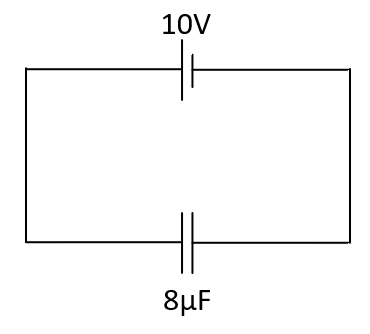 From the diagram above, calculate the energy stored in the capacitor
Choose the option that best explains the information conveyed in the sentence.
In all ramifications, Chief Adeyemi was a successful principal of the school.