
Biology 2004 Jamb Examination

Question 11
The two key cations involved in the action potential of nervous transmissions are
The correct answer is D. Na+ and K+.
The action potential in nervous transmissions primarily involves the movement of sodium ions (Na+) and potassium ions (K+). During an action potential, Na+ ions rush into the neuron, causing depolarization, and then K+ ions exit the neuron, causing repolarization. This exchange of ions across the neuron's membrane is crucial for the propagation of electrical signals along nerves.
Not clear enough?
Question 12
Use the diagram below to answer question below
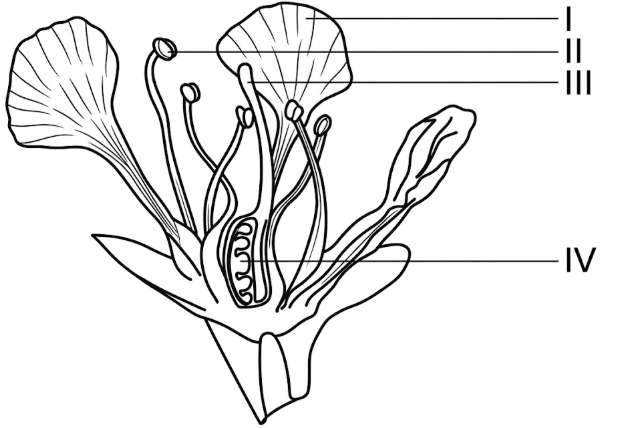
The part labelled II is the
The anther is the part of the stamen (the male reproductive organ of a flower) that produces and releases pollen. It is usually located at the top of the filament.
Not clear enough?
Question 13
The process of pollination involves the transfer of pollens from
C. II to III
Not clear enough?
Question 14
The anaerobic fermentation of a glucose molecule
yields
The correct answer is D. 2 ATP molecules and alcohol.
During anaerobic fermentation (specifically alcohol fermentation), one glucose molecule is converted into ethanol (alcohol), carbon dioxide, and 2 ATP molecules. Pyruvic acid is an intermediate, but it's not the final product, and the process does not yield 38 ATP molecules or water and carbon dioxide, which are products of aerobic respiration.
Not clear enough?
Question 15
Use the diagram below to answer question below

The function of the part labelled III is to
The part labelled III is the hair follicle. Hair follicles are dynamic, tube-like structures in the dermis that generate hair, anchor it, and regulate its growth cycle (anagen, catagen, telogen). They are essential for skin repair (healing wounds), producing sebum, acting as sensory receptors for touch, and contributing to thermoregulation.
Not clear enough?
Question 16
Use the diagram below to answer question below
The sweat gland is the structure labelled
In the diagram, the structure labeled IV is the sweat gland. It is responsible for producing sweat, which helps regulate body temperature through evaporative cooling
Not clear enough?
Question 17
The type of reproduction that is common to both Hydra and yeast is
The correct option is B. budding.
Explanation: Both Hydra and yeast reproduce through a process called budding. In this type of asexual reproduction, a new organism develops from an outgrowth or bud on the parent organism. The bud eventually detaches to become an independent organism.
Not clear enough?
Question 18
Epigeal germination of a seed is characterized by
The correct option is B. more rapid elongation of the hypocotyls than the epicotyl.
In epigeal germination, the hypocotyl (the part of the stem below the seed leaves) elongates rapidly, pushing the cotyledons above the soil surface. This is a characteristic feature of epigeal germination, as opposed to hypogeal germination, where the epicotyl (the part of the stem above the seed leaves) elongates more rapidly, leaving the cotyledons underground.
Not clear enough?
Question 19
All living cells require water because it
The correct option is D. is a medium for all metabolic reactions.
Explanation: Water is essential for all living cells because it acts as a medium in which various metabolic reactions occur. It facilitates the transport of nutrients and waste products, helps maintain cell structure, and participates directly in many biochemical processes.
Not clear enough?
Question 20
The surface of an alveolus in a mammals is well supplied with tiny blood vessels known as
The correct option is A. capillaries.
Explanation: The surface of an alveolus in mammals is richly supplied with capillaries. These tiny blood vessels allow for the exchange of gases (oxygen and carbon dioxide) between the air in the alveoli and the blood in the capillaries.
Not clear enough?
You might like
A businessman must widen his horizons; a ____ attitude will get you nowhere in this age of global communications.
| Category | Total N | P N | Q N |
|---|---|---|---|
| Stock | 3,000 | 2,000 | 1,000 |
| Purchases | 4,000 | 2,500 | 1,500 |
| Sales | 10,000 | 6,000 | 4,000 |
| Closing Stock | 2,000 | 1,500 | 500 |
Department P's net profit was?
Two pipes A and B can fill a tank in 15 minutes and 20 minutes respectively. Both the pipes are opened together but after 4 minutes, pipe A is turned off. What is the total time required to fill the tank ?