
Biology 2004 Jamb Examination

Question 31
The most common characteristic of the fungal hyphae is the possession of
D. cell walls that are both rigid and chitinous
Fungal hyphae are characterized by having cell walls that are rigid and made of chitin. This provides structural support and is a distinctive feature of fungi. The other options describe features that may be present in some fungi, but chitinous cell walls are the most common and defining characteristic.
Not clear enough?
Question 32
Use the diagram below to answer the question.
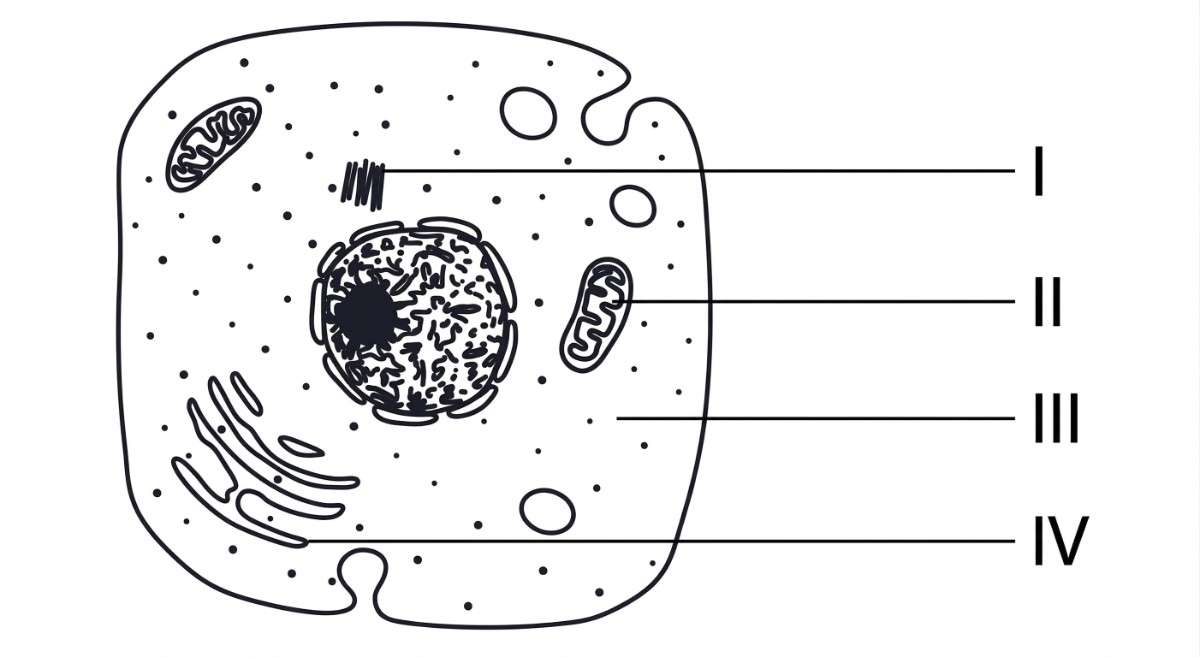
The part labeled II is responsible for
The part labeled II in the diagram appears to be a mitochondrion, which is responsible for cellular respiration. Therefore, the correct answer is:
Not clear enough?
Question 33
Use the diagram below to answer the question.
The endoplasmic reticulum is represented by the part labelled
The endoplasmic reticulum (ER) is represented by the part labelled IV. The endoplasmic reticulum is a network of membrane-enclosed tubules and flattened sacs (cisternae) that extend from the nuclear membrane throughout the cytoplasm. It is typically depicted as a series of folded, "maze-like" membranes located near the nucleus.
Not clear enough?
Question 34
The function of the long-winged reproductives in a termite colony is to
B. Participate in swarming
The long-winged reproductives in a termite colony, also known as alates, are primarily responsible for participating in swarming to start new colonies. During swarming, these winged termites leave the parent colony to mate and establish new colonies elsewhere.
Therefore, the correct answer is:
B. Participate in swarming
Not clear enough?
Question 35
A plant-like feature in Euglena is the
The plant-like feature in Euglena is the pigment spot (also known as the eyespot). This structure is involved in detecting light, which helps the Euglena orient itself towards light sources for photosynthesis, a plant-like characteristic.
Therefore, the correct answer is:
D. Pigment spot
Not clear enough?
Question 36
Which of the following is an example of intraspecific competition?
The correct answer is C. A worker termite and a soldier in a limited space.
Intraspecific competition occurs when members of the same species compete for the same resources, such as food, space, or mates. In this case, both the worker termite and the soldier termite are members of the same species (termites) and are competing for limited space.
Not clear enough?
Question 37
The spots and stripes of the leopard and tiger are examples of
The correct answer is D. disruptive coloration.
The spots on a leopard and the stripes on a tiger are examples of disruptive coloration. This type of coloration breaks up the outline of the animal's body, making it harder for predators or prey to detect them in their natural habitat. The patterns help the animals blend into their surroundings, such as the dappled light of a forest or the tall grass, by creating an optical illusion that disguises their true shape.
Not clear enough?
Question 38
Rodents gnaw on food with their
The correct answer is C. chisel-like front teeth.
Rodents gnaw on food using their chisel-like front teeth, also known as incisors. These teeth are specially adapted for gnawing, being sharp and strong, allowing rodents to break through hard materials like seeds, nuts, and wood. The incisors continuously grow throughout the rodent's life, which is why they need to gnaw regularly to keep them from becoming too long.
Not clear enough?
Question 39
An evidence of the relationship between living organisms and their extinct relatives can best be obtained from
The correct answer is A. palaeontology.
Palaeontology is the study of fossils and ancient life forms. It provides evidence of the relationship between living organisms and their extinct relatives by analyzing the fossil record. Through palaeontology, scientists can trace the evolution of species over millions of years and understand how current species are related to those that have become extinct.
Not clear enough?
Question 40
Plants survive hot dry conditions by
The correct answer is D. storing water in large parenchyma cells.
Plants that survive in hot, dry conditions often do so by storing water in large parenchyma cells, which are found in tissues such as the succulent leaves and stems of desert plants like cacti. This water storage allows the plants to maintain hydration during long periods of drought.
Not clear enough?
You might like
Five articles K,L,P,R and T, are kept one above the other(not necessarily in the same order). K is just above T and just below R. L is just above P and just below T. Which article is at the second position from the bottom ?
This question is based on UNEXPECTED JOY AT DAWN.
Which of these characters is at the center of the impact of the xenophobic attack in the novel?
This question is based on William Shakespeare's Othello.
"...Fathers, from hence trust not your daughters' minds. By what you see them act. Is there not charms. By which the property of youth and maidhood May be abused?..."
The speaker in the excerpt above addresses
Choose the option opposite in meaning to the underlined word.
The testimony of the witness was vague.