
Biology 2006 Jamb Examination

Question 31
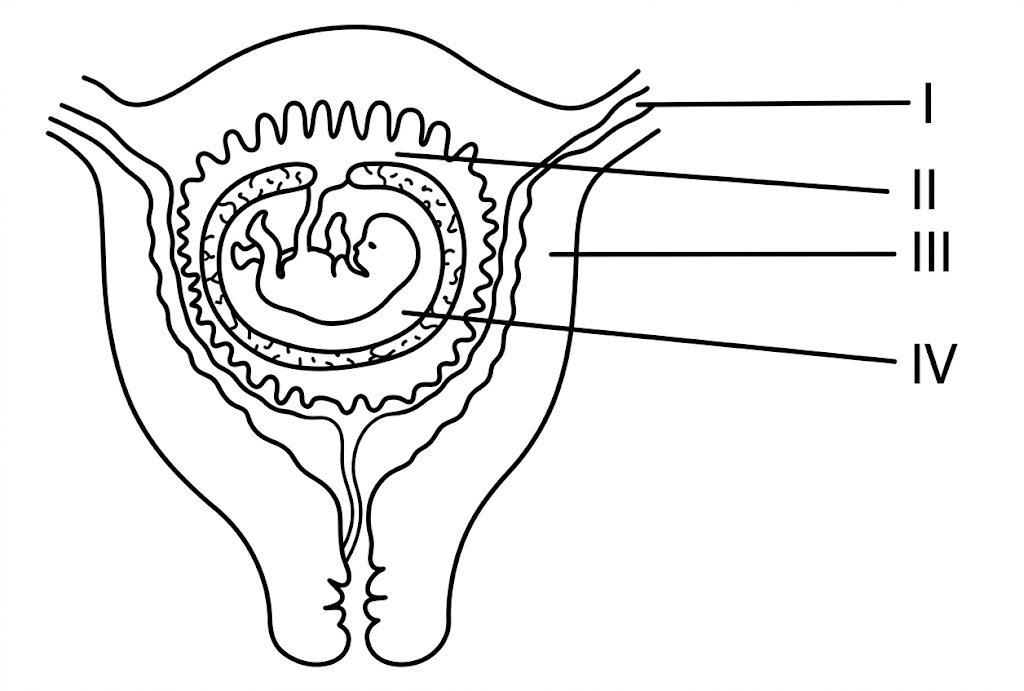
The organ through which the embryo receives food, water and oxygen is labelled
C. II
The structure labelled II in the diagram represents the placenta. The placenta is the organ through which the developing embryo receives nutrients, water, and oxygen from the mother, while also removing waste products. It is essential for fetal development and forms a direct connection with maternal blood vessels.
Not clear enough?
Question 32
D. Loop of Henle
The Loop of Henle, present in the nephron of mammalian kidneys, is responsible for the counter-current multiplier system that concentrates urine. Water and salts are reabsorbed selectively along the descending and ascending limbs, allowing mammals to conserve water and produce hypertonic urine to survive in varied environments.
Not clear enough?
Question 33
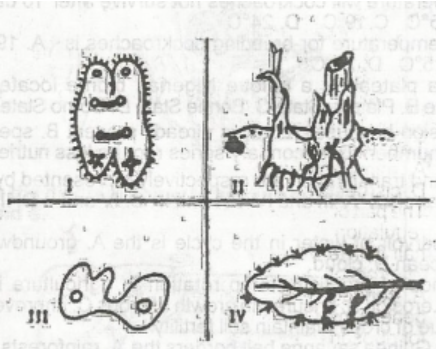
Using the diagram, sexual reproduction is illustrated in
B. I
Paramecia can undergo sexual reproduction, specifically through a process called conjugation, although their primary mode of reproduction is asexual binary fission, where a single cell divides into two identical daughter cells.
Sexual Reproduction (Conjugation): Under certain conditions, like nutrient scarcity, paramecia can engage in sexual reproduction through conjugation. It involves two paramecia temporarily fusing, exchanging genetic material (specifically micronuclear elements), and then separating. This process leads to genetic recombination and nuclear reorganization within the cell, which can increase genetic diversity and potentially help the paramecia adapt to changing environments. Paramecia also exhibit autogamy, a form of self-fertilization, where two nuclei fuse within the same cell.
Not clear enough?
Question 34
C. Bryophyllum
Structure IV represents asexual reproduction via vegetative propagation, where new plantlets grow from leaves. Bryophyllum exhibits this method by forming buds along leaf margins that develop into independent plants, unlike cola or sugar cane which reproduce by seeds or stem cuttings.
Not clear enough?
Question 35

In the diagram, Which of the following can be decided from the distribution?
species I thrives under conditions of moderate to high rainfall
Species I thrives in areas with moderate to high rainfall, as its population grows proportionally with increasing rainfall.
Species II is found even in regions with minimal or no rainfall, maintaining a density of 200 organisms per km², indicating it is not restricted to areas of constant rainfall.
Species III shows a decline in numbers as rainfall increases, suggesting that higher rainfall does not favor its growth.
Species IV initially increases in population with rising rainfall, reaches a peak, and then declines, showing that its distribution is influenced by rainfall levels.
Thus, the correct answer is D.
Not clear enough?
Question 36
In the diagram, the species whose distribution is not affected by rainfall is
ii
The distribution of Species II is not affected by rainfall because as the rate of rainfall increases, the number of organisms remained constant at 200. Hence, the distribution of species II are not affected by rainfall.
Not clear enough?
Question 37
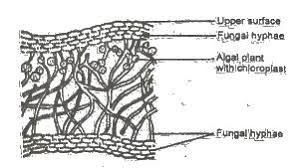
In the diagram, the importance of the association to the fungus is that it obtains
oxygen and carbohydrates from the algae
In the symbiotic relationship between fungal hyphae and algae, fungi benefit from the algae's photosynthetic activity, gaining access to sugars (food) produced by the algae, while the algae are protected and can access nutrients from the fungal hyphae. The algae provides the fungus with carbohydrates (energy) and oxygen, while the fungus provides the algae with water and minerals.
Not clear enough?
Question 38
D. Mutualism
The association between fungus and algae in a lichen is mutualistic. The alga provides photosynthates (carbohydrates), while the fungus provides protection, anchorage, and access to water and minerals, benefiting both partners.
Not clear enough?
Question 39
A. Check desert encroachment
Shelter belts are planted in the Sahel to reduce wind erosion, conserve soil moisture, and prevent the spread of deserts. They act as windbreaks and help stabilize the fragile semi-arid ecosystem.
Not clear enough?
Question 40
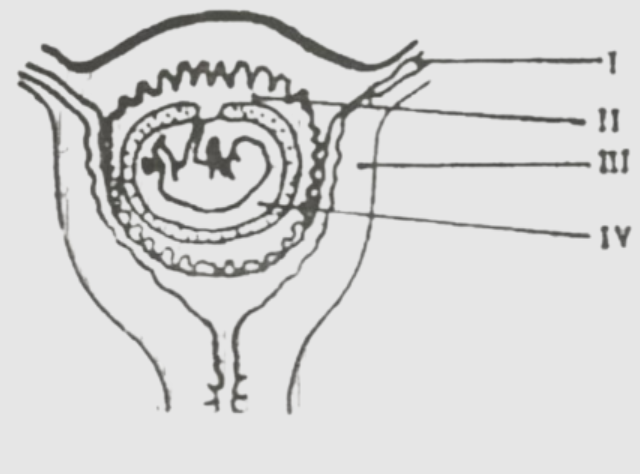
Using the diagram, the part labelled IV is for
B. Nourishment
The structure labelled IV represents the umbilical cord or yolk sac, responsible for delivering nutrients to the developing embryo. This ensures proper growth and development throughout gestation.
Not clear enough?
You might like
What should you do first if the mouse pointer is not moving smoothly or correctly across the screen?
The goals scored by 40 football teams from three league divisions are recorded below
| No of goals | 0 | 1 | 2 | 3 | 4 | 5 | 6 |
|---|---|---|---|---|---|---|---|
| Frequency | 4 | 3 | 15 | 16 | 1 | 0 | 1 |
What is the total number of goals scored by all the teams?