Biology 2007 Jamb Examination

Question 41
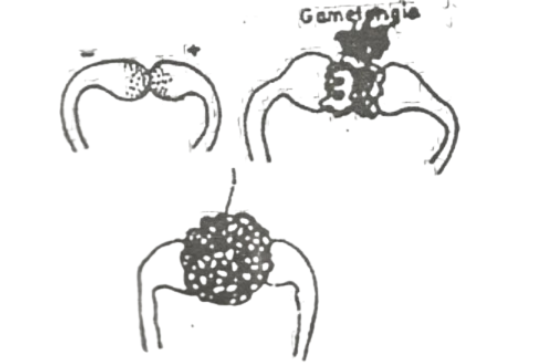
Use the diagram above to answer this question. The process illustrated is
Rhizopus, also known as bread mold, reproduces sexually when two compatible hyphae fuse. This process produces diploid zygospores, which germinate into new mycelia.
Steps in sexual reproduction
- Compatible hyphae come into contact
- Small outgrowths called progametangia form
- The progametangia mature and the common wall disappears
- The contents of the progametangia mix, fusing (+) and (-) strains
- Diploid nuclei form
- The zygospore enlarges and secretes a five-layered structure
- The zygospore enters a resting period
- The zygospore germinates, producing germ sporangiophores or promycelium
- The promycelium develops a germ sporangium at the tip, releasing spores
- Each spore germinates to form a new mycelium.
Not clear enough?
Question 42
Use the diagram above to answer this question. The structure labelled I is the
C. The structure labelled I is a zygospore, which forms during sexual reproduction in Spirogyra when filaments conjugate to exchange genetic material.
Not clear enough?
Question 43
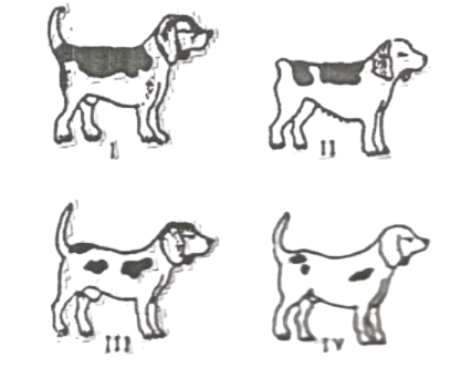
Use the diagram above to answer this question. If the dogs are offspring of a monohybrid cross and the gene G for grey head is dominant over its allele g, the individual whose genotype is likely to be gg is
C. Dog IV shows the recessive phenotype (gg) for grey head. Only individuals with two recessive alleles express the gg genotype in a monohybrid cross.
Not clear enough?
Question 44
Use the diagram above to answer this question. Which of the following will be true of dog II which lost its tail in an accident if it mates with dog III
A. Since the tail loss in dog II is due to an accident and not genetic, none of the offspring will inherit this acquired trait. Genetic inheritance only involves heritable alleles.
Not clear enough?
Question 45
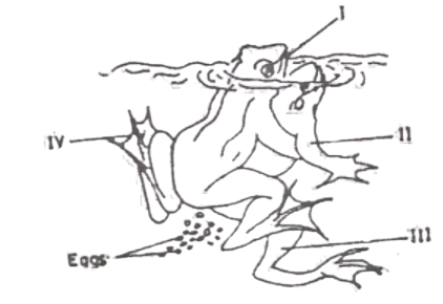
In the diagram, it shows that the organisms are?
C. The diagram shows egg-laying organisms, characteristic of oviparous reproduction, where embryos develop outside the mother's body.
Not clear enough?
Question 46
The breeding posture illustrated in the diagram is known as
B. Amplexus is a typical breeding posture in amphibians like frogs, where the male clasps the female to externally fertilize the eggs.
Not clear enough?
Question 47
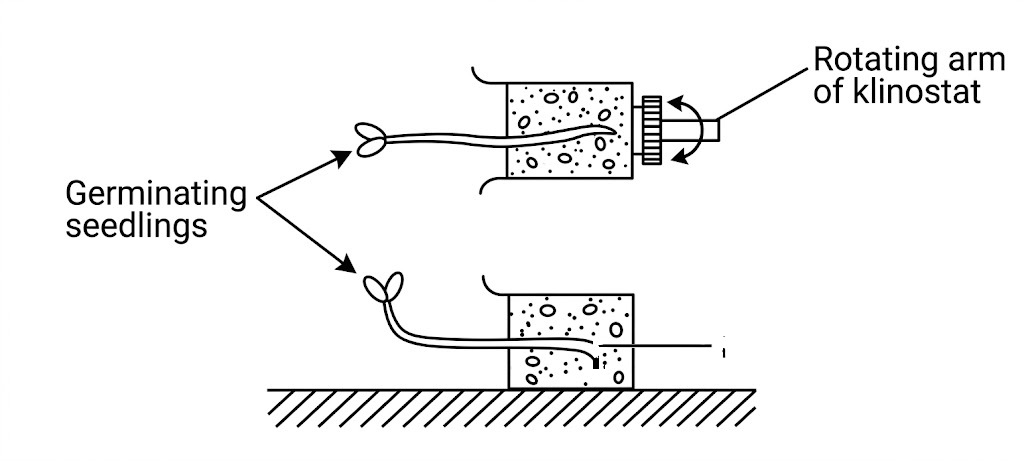
In the diagram, the experiment demonstrates
A. geotropism
Charles Darwin was one of the first to scientifically document that roots show positive gravitropism and stems show negative gravitropism. That is, roots grow in the direction of gravitational pull (i.e., downward) and stems grow in the opposite direction (i.e., upwards).
Not clear enough?
Question 48

In the diagram, the part marked I will contain a high concentration of
D. Auxin is concentrated on the shaded side of the stem, causing elongation and bending towards the light source in phototropism.
Not clear enough?
Question 49
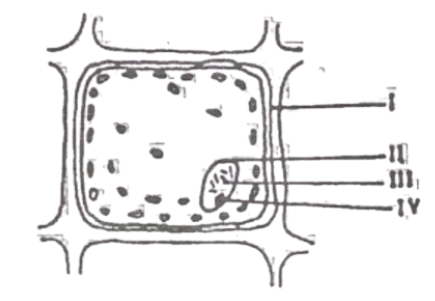
In the diagram, the organelle responsible for heredity is
A. The organelle labelled III is the nucleus, which contains genetic material (DNA) responsible for heredity.
Not clear enough?
Question 50
In the diagram, the part labelled I is the
A. Part I is the nuclear membrane, which encloses the nucleus and separates it from the cytoplasm.
Not clear enough?
You might like
If a chain is used at a temperature ............. the temperature at which it was calibrated, the error in measured length is negative. ?
In a class of 150 students, the sector in a pie chart representing the students offering physics has angle 12o. How many students are offering physics?
Given \( \dfrac{\text{index of export price}}{\text{index of import price}} × \dfrac{100}{1}\), the formula above can be used to determine the