
Biology 2009 Jamb Examination
Biology 2009 Jamb Examination

Question 41
A health condition that is known to have resulted from gene mutation is?
Sickle-cell anaemia is caused by a mutation in the gene responsible for producing haemoglobin. This mutation changes the shape of red blood cells from round to sickle-shaped, reducing their ability to carry oxygen efficiently.
The abnormal cells also have a shorter lifespan, leading to anaemia and complications like blocked blood vessels. Unlike infectious diseases such as typhoid and rabies, sickle-cell anaemia is hereditary and directly linked to gene mutation.
Not clear enough?
Question 42
Plants that grow in an area that is neither too wet nor too dry are
Mesophytes are plants adapted to moderate environments where water is available in sufficient amounts but not in excess. They represent the majority of land plants we see around us, such as crops and garden plants.
They differ from xerophytes that survive in arid conditions, hydrophytes that live in waterlogged areas, and epiphytes that grow on other plants without deriving nutrients from them.
Not clear enough?
Question 43
The part of a domestic fowl responsible for preventing heat loss is the?
Down feathers are soft and fluffy, lying beneath the contour feathers of birds. They act as an insulating layer, trapping air close to the body and preventing heat loss.
This adaptation is especially important for maintaining body temperature in cold conditions. Other feathers like contour feathers provide shape and aerodynamics, but insulation is mainly the function of down feathers.
Not clear enough?
Question 44
Which of the following animals is most adapted for water conservation?
Insects are highly adapted for conserving water because of their exoskeleton covered with a waxy cuticle, which reduces water loss. They also excrete uric acid, which conserves water compared to urea or ammonia.
Other animals like mammals and earthworms require more water for excretion and are less efficient in water conservation compared to insects, which thrive in dry and harsh environments.
Not clear enough?
Question 45
The specialized pigment cells that are involved in colouration and colour change in animals?
Chromatophores are pigment-containing and light-reflecting cells found in animals like fish, reptiles, and amphibians. They are responsible for coloration and can expand or contract to cause rapid colour changes.
This colour change plays roles in camouflage, communication, and protection from predators. Unlike chlorophyll in plants or melanin in humans, chromatophores are specialized for dynamic coloration in animals.
Not clear enough?
Question 46
During the dry season in the tropics, the body metabolism of some animals slow to a minimal level in a process referred to as?
Aestivation is a state of inactivity and slowed metabolism that occurs during hot or dry seasons, helping animals like snails and lungfish survive until conditions improve.
It is similar to hibernation, but hibernation occurs in cold conditions. Aestivation conserves water and energy, ensuring survival during harsh tropical dry seasons.
Not clear enough?
Question 47
According to Darwin, the driving force behind evolutionary change is
Darwin proposed natural selection as the key mechanism driving evolution. Organisms with advantageous traits survive, reproduce, and pass those traits to offspring, while less adapted ones are eliminated.
Over many generations, this gradual process leads to significant changes in populations, ensuring that only the fittest organisms survive in a given environment.
Not clear enough?
Question 48
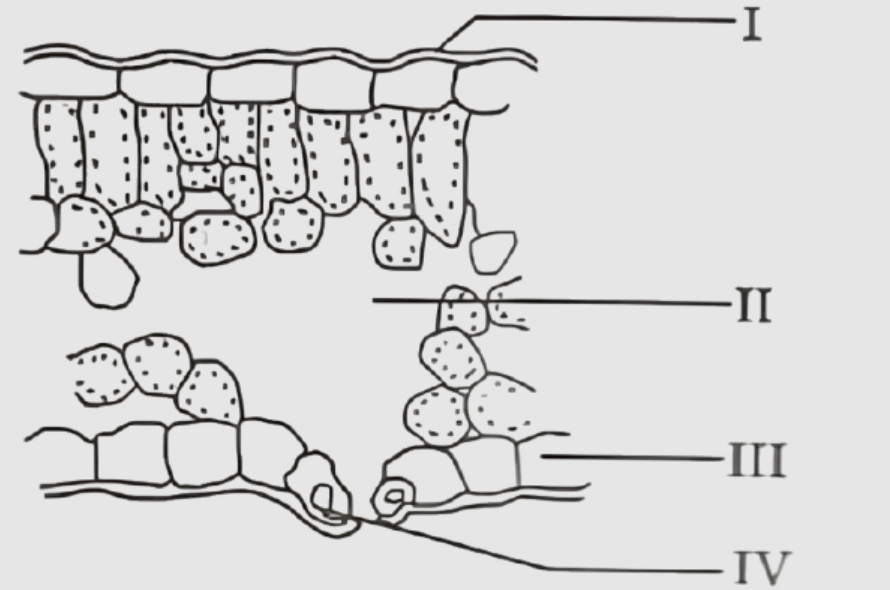
Use the diagram above to answer this question. The structure that controls loss of water vapour during transpiration is labelled
Stomata regulate gas exchange between the plant and environment and control of water loss by changing the size of the stomatal pore.
Guard cells are cells surrounding each stoma. They help to regulate the rate of transpiration by opening and closing the stomata.
Not clear enough?
Question 49
Use the diagram above to answer this question. The part labelled l is the
The part labelled I in a leaf cross-section diagram is usually the cuticle. The cuticle is a waxy, protective layer covering the epidermis that minimizes water loss. This adaptation is especially important for terrestrial plants, helping them survive in environments where water conservation is critical.
Not clear enough?
Question 50
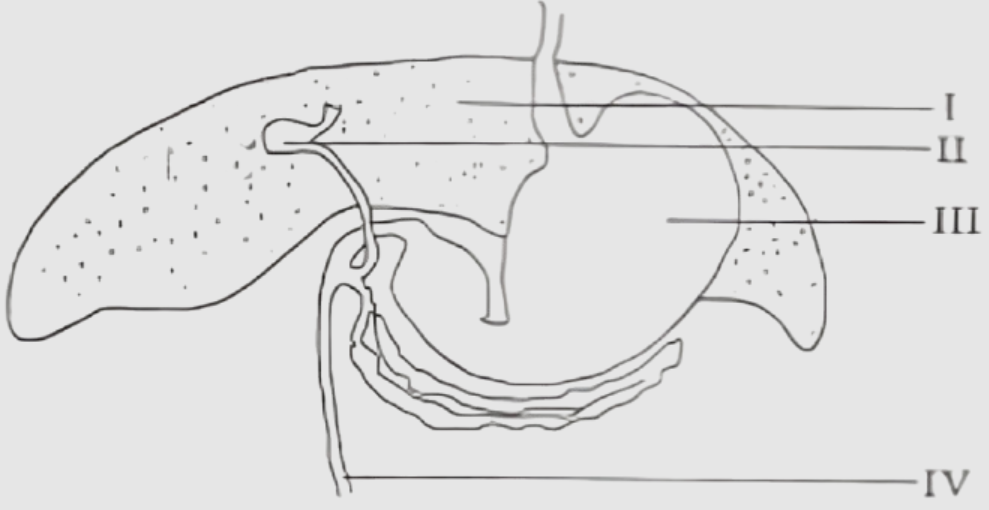
Use the diagram above to answer this question. Emulsification of fats takes place in the part labelled?
Fat emulsification is the breakdown of large fat droplets into smaller ones in the small intestine, which increases their surface area for digestion.
This process is carried out by bile, a fluid produced in the liver and stored in the gallbladder. The actual chemical digestion of fats is then completed by lipase, an enzyme secreted by the pancreas.