Biology 2017 Jamb Examination

Biology 2017 Jamb Examination

Available Sections
2. Career
4. Job
1234...6

Question 1

The appendicular skeleton is made up of the
Show explanation Expand Question
The appendicular skeleton consists of the limbs and the girdles (pectoral and pelvic) that attach the limbs to the axial skeleton. It includes bones of the arms, legs, shoulders, and hips.
Not clear enough?

Question 2

Which of the following factors can reduce the population of a community?
Show explanation Expand Question
Predation reduces the population size by removing individuals from the prey population. Unlike immigration or mutualistic interactions, predation has a direct negative effect, influencing population dynamics and ecological balance.
Not clear enough?

Question 3

In mosses the structure which performs the function of water absorption is the _________?
Show explanation Expand Question
Rhizoids in mosses anchor the plant and absorb water and minerals from the surrounding environment. Unlike roots in higher plants, rhizoids are simple filamentous structures that perform absorption without true vascular tissues.
Not clear enough?

Question 4

How does an enzyme affect the rate of a reaction?
Show explanation Expand Question
Enzymes act as biological catalysts, lowering the activation energy required for reactions. By doing so, they accelerate metabolic processes without being consumed themselves, ensuring reactions occur efficiently under physiological conditions.
Not clear enough?

Question 5

Insects that go through adult stage without becoming pupa are except ________
Show explanation Expand Question
Crickets, cockroaches, and grasshoppers undergo incomplete metamorphosis, skipping the pupal stage. Bees undergo complete metamorphosis with egg, larva, pupa, and adult stages, differentiating them from insects with direct development.
Not clear enough?

Question 6

Gregor Mendel is regarded as the father of ______
Show explanation Expand Question
Gregor Mendel is recognized as the father of genetics for his work on inheritance patterns in pea plants. His experiments established the principles of segregation and independent assortment, forming the foundation of modern genetics.
Not clear enough?

Question 7

The most efficient respiratory structure used by free-living protozoan is ________
Show explanation Expand Question
Free-living protozoans rely on diffusion across their body surface to exchange gases. Their small size and high surface area to volume ratio allow efficient gas exchange without specialized respiratory organs.
Not clear enough?

Question 8

Carbon (IV) oxide is added to the atmosphere when ________?
Show explanation Expand Question
Carbon dioxide ($CO_2$) is released into the atmosphere when organic compounds are oxidized during cellular respiration in animals. Plants also release some $CO_2$ during respiration, contributing to the carbon cycle.
Not clear enough?

Question 9

The host of liver fluke are ______?
Show explanation Expand Question
Liver flukes are parasitic flatworms with a life cycle that involves snails as intermediate hosts and mammals such as pigs and sheep as definitive hosts, where adult flukes reproduce and release eggs.
Not clear enough?

Question 10

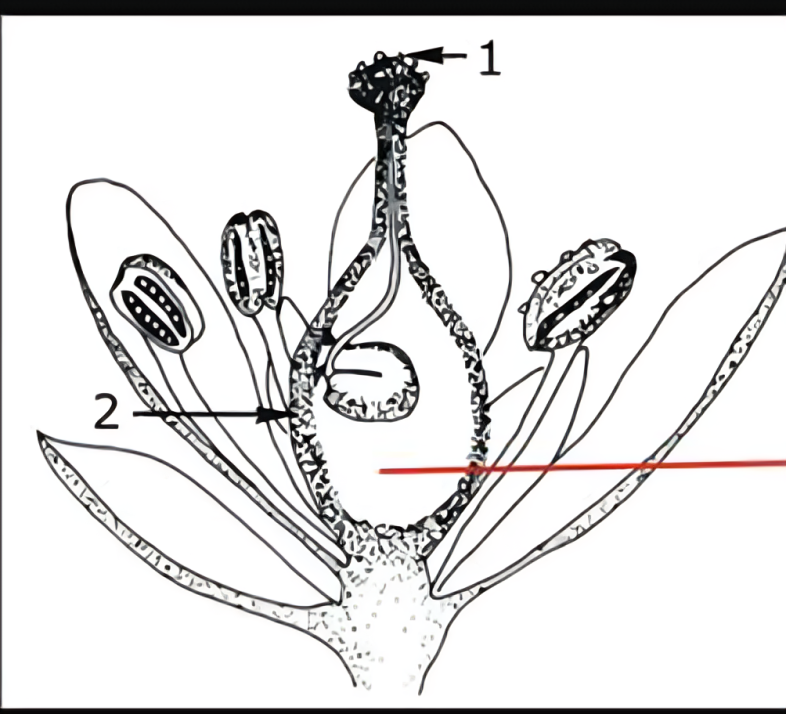
Use the diagram to answer the question that follows:
The part labelled I is the ________
Flower diagram
Show explanation Expand Question
The part labelled I in the diagram represents the stamen, which is the male reproductive organ of a flower responsible for producing pollen.
Not clear enough?

1234...6
In this page
Biology 2017 Jamb Examination
Open Model!