
Biology 2018 Jamb Examination
Biology 2018 Jamb Examination

Question 1
The yellowish colored liquid component of blood that normally holds the blood cells in suspension is
Plasma is the yellowish liquid component of blood that serves as a medium for transporting blood cells, nutrients, hormones, and waste products throughout the body. It is about 55% of total blood volume and helps maintain blood pressure and volume.
Not clear enough?
Question 2
The function of pith in plant is
The pith of a plant, located at the center of the stem, primarily functions to store nutrients and facilitate their transport throughout the plant. It also contributes to structural support and may store water in some species.
Not clear enough?
Question 3
A pollutant that is mostly associated with acid rain is
Nitrogen (IV) oxide, also known as nitrogen dioxide, reacts with water in the atmosphere to form nitric acid, which contributes to acid rain. Acid rain can damage vegetation, aquatic life, and infrastructure over time.
Not clear enough?
Question 4
What is the function of contractile vacuole in paramecium?
The contractile vacuole in paramecium is responsible for regulating water balance by expelling excess water from the cell. This is essential for preventing the cell from bursting in hypotonic environments.
Not clear enough?
Question 5
An organism which exhibit extracellular digestion is
Rhizopus, a type of fungus, performs extracellular digestion by secreting enzymes outside its body to break down complex organic matter into simpler substances that can be absorbed. This allows fungi to feed on decaying matter.
Not clear enough?
Question 6
How many days does it take for incubation of an egg to release chick?
The incubation period for a chicken egg is typically 21 days. During this period, the embryo develops fully inside the egg, after which the chick hatches. Temperature and humidity are critical factors for successful incubation.
Not clear enough?
Question 7
The four classes of cnidarian include the following except
Turbellaria are not cnidarians but belong to the phylum Platyhelminthes (flatworms). The four main classes of cnidarians are Anthozoa, Scyphozoa, Cubozoa, and Hydrozoa, which include corals, jellyfish, and box jellyfish.
Not clear enough?
Question 8
What would happen if solution Y is more concentrated than solution X?
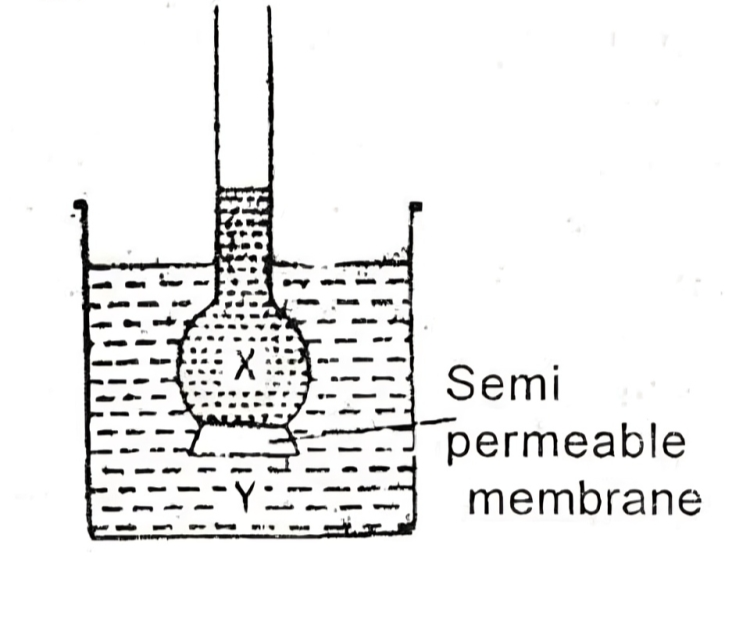
If solution Y is more concentrated than solution X, water will move from X to Y through osmosis. This causes the level of Y to rise and X to fall as water moves to dilute the concentrated solution.
Not clear enough?
Question 9
Physiological adaptation to very dry conditions in animal demonstrates
Aestivation is a physiological adaptation where animals reduce their metabolic activity and remain inactive during hot and dry conditions to conserve water and energy. This behavior is commonly observed in desert animals.
Not clear enough?
Question 10
The hormones secreted by pancreas serves to
The pancreas secretes insulin, which lowers blood glucose levels by promoting the uptake of glucose into cells and storage as glycogen in the liver. This regulation is essential for maintaining energy balance in the body.