
Biology 2018 Jamb Examination
Biology 2018 Jamb Examination

Question 21
Cold blooded animals are referred to as
Cold-blooded animals, or poikilotherms, are those whose internal body temperature varies with the temperature of the environment. They cannot internally regulate their body heat and depend on external sources, such as sunlight, to maintain optimal activity levels.
Not clear enough?
Question 22
The vessel carrying oxygenated blood to the tissues is
Arteries are blood vessels that carry oxygenated blood away from the heart to various tissues of the body. The aorta, as the largest artery, distributes oxygen-rich blood to systemic circulation, ensuring that all organs receive the necessary oxygen for cellular respiration.
Not clear enough?
Question 23
Which of the following is a mixed gland?
The pancreas is a mixed gland because it has both endocrine and exocrine functions. The endocrine part secretes insulin and glucagon into the blood to regulate blood glucose, while the exocrine part produces digestive enzymes released into the small intestine.
Not clear enough?
Question 24
A group of organism of the same species living together in a particular area is described as
A population refers to a group of organisms of the same species living in a defined geographical area at the same time. Populations are essential for studying ecology, as they allow understanding of reproduction rates, resource use, and interactions within a species.
Not clear enough?
Question 25
Tikka disease is related with the crop
Tikka disease affects groundnut crops and is caused by a fungal pathogen. It leads to leaf spots, reduced photosynthesis, and ultimately lower yield. Effective crop management and resistant varieties are essential to control this disease.
Not clear enough?
Question 26
At which stage in this cycle can a man be infected?
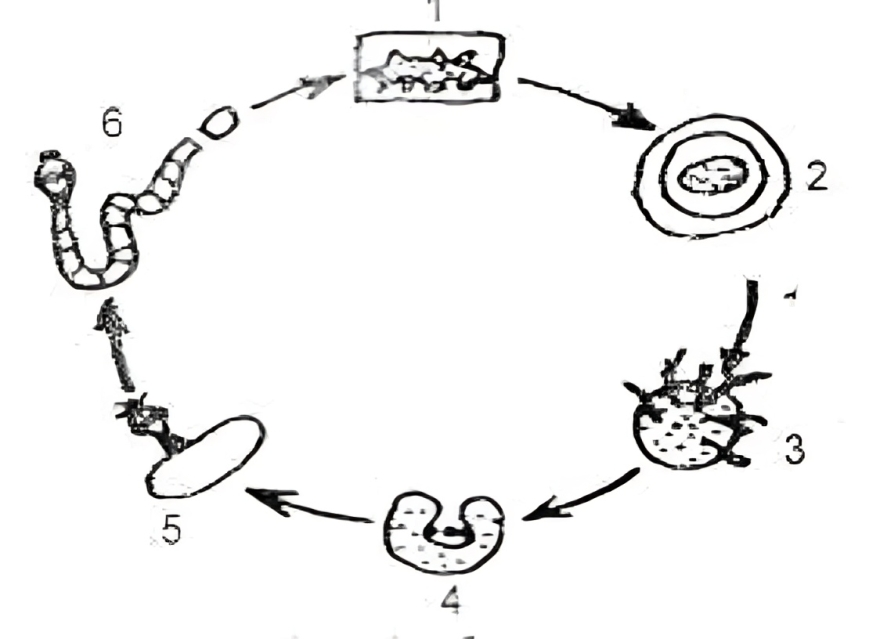
Humans can be infected at stage 2 of the depicted life cycle, which represents the infective stage of the parasite. Infection usually occurs through direct contact, ingestion, or vectors, depending on the parasite’s transmission mode, leading to disease manifestation in humans.
Not clear enough?
Question 27
Total salt content in blood is about
The total salt content in human blood is approximately 0.85 to 0.9%, mainly consisting of sodium chloride along with small amounts of potassium, calcium, and magnesium salts. This concentration is essential for maintaining osmotic balance and proper physiological functions.
Not clear enough?
Question 28
The role of scolex in tapeworm is to
The scolex is the anterior end of a tapeworm and serves as the attachment organ. It typically has suckers and hooks that enable the parasite to anchor itself to the intestinal wall of the host, ensuring it remains in place to absorb nutrients.
Not clear enough?
Question 29
Which of the following animals is cold blooded?
Lizards are cold-blooded, or poikilothermic, animals. Their body temperature fluctuates with the surrounding environment, and they rely on external heat sources, such as sunlight, to regulate their physiological activity and metabolism.
Not clear enough?
Question 30
The energy released by 1 gram of glucose is
The oxidation of 1 gram of glucose releases approximately 4 kilocalories of energy. This energy is used in cellular processes such as metabolism, growth, and movement, and forms the basis for understanding caloric content in nutrition.
Not clear enough?
You might like
Choose the option nearest in meaning to the posterity.
We have every need to preserve some of our national monuments for posterity?
A basic concept of advertising that reveals the essential message an advertiser wishes to communicate is referred to as the
The focal length of a concave mirror is 2.0cm. If an object is placed 8.0cm from it, the image is at