
Biology 2024 Jamb Examination
Biology 2024 Jamb Examination

Question 21
One of the following is an example of discontinuous variation
Blood group is an example of discontinuous variation because it falls into distinct categories (A, B, AB, and O) without intermediate forms. Traits like shape of the head, complexion, and nose type show continuous variation with a range of possibilities, unlike blood group which is clear-cut.
Not clear enough?
Question 22
The type of variation where there are no remarkable differences between the two extreme individuals is called
Continuous variation refers to characteristics that show a gradual range with no sharp differences between individuals, such as height, weight, or skin color. Extremes blend smoothly into each other. Discontinuous variation, in contrast, has distinct categories without intermediates.
Not clear enough?
Question 23
The transmission of diseases through contamination of food is an economic importance of
Cockroaches are pests that contaminate food and utensils with pathogens, leading to the transmission of diseases such as food poisoning and dysentery. Mosquitoes transmit malaria and yellow fever, butterflies are harmless, and bees are beneficial pollinators.
Not clear enough?
Question 24
Bryophyte is an intermediate group between higher algae and
Bryophytes are considered an intermediate group between higher algae and pteridophytes. They are non-vascular plants that show a transition from simple algae to more complex vascular plants, as they have multicellular structures but lack true vascular tissues.
Not clear enough?
Question 25
Ecological succession can result from
Ecological succession begins when organisms colonize a newly formed habitat, such as bare rock after a volcanic eruption or a newly exposed sand dune. Over time, pioneer species modify the environment, making it suitable for other species, leading to gradual ecosystem development.
Not clear enough?
Question 26
The first organism evolved from which of the following habitat?
The earliest organisms are believed to have originated in aquatic habitats. Water provided a stable environment, protection from harsh solar radiation, and a medium for essential biochemical reactions. Terrestrial and desert environments came much later in evolutionary history, while arboreal habitats are associated with advanced land animals.
Not clear enough?
Question 27
Which of these pair of substances must be present for a seed to germinate in a laboratory set-up?
For germination to occur, seeds require water to activate enzymes and initiate metabolism, and heat (a suitable temperature) to support enzymatic activity. Soil, manure, and microbes are not necessary in a controlled laboratory experiment, though they may influence natural germination.
Not clear enough?
Question 28
A fruit formed from one flower with many carpels is referred to as
An aggregate fruit develops from a single flower that has many free carpels. Each carpel forms a small fruitlet, and together they make up the aggregate fruit, as seen in strawberries and raspberries. Simple fruits come from one carpel, multiple fruits from many flowers, and false fruits involve additional floral parts.
Not clear enough?
Question 29
Which of the following plant is found in the ground layer of a tropical rainforest in Nigeria?
Liverworts are small, non-vascular plants commonly found in the moist ground layer of tropical rainforests. Obeche, mahogany, and oil palm are large trees or taller plants that occupy the canopy and understory layers of the forest rather than the ground layer.
Not clear enough?
Question 30
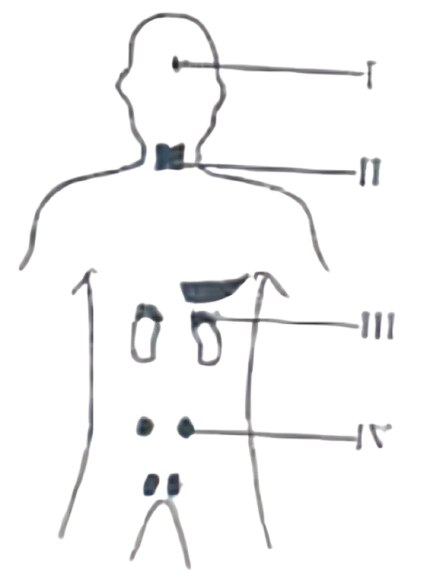
Use the diagram above to answer the question that follows The endocrine gland that is located in the part labelled I is
The gland located in the part labelled I of the diagram is the pituitary gland, often called the 'master gland.' It is located at the base of the brain and controls other endocrine glands such as the thyroid, adrenal glands, and reproductive glands through hormone secretion.
Not clear enough?
You might like
According to the kinetic theory, an absence in temperature causes the kinetic energy of particles to
Two resistors 5Ω and 10Ω are arranged first in series and later in parallel to a 24V source, the ratio of total power dissipated in the series and parallel arrangements respectively is
Which African country experienced a violent resistance movement against British colonial rule known as the Mau Mau rebellion?
Choose the option nearest in meaning to the underlined. Ayodeji is an ardent supporter of education for the child