
Biology 2025 Jamb Examination
Biology 2025 Jamb Examination

Question 21
Which of the following statements about poliomyelitis is correct?
Poliomyelitis, commonly known as polio, is a highly infectious disease caused by a virus (not bacteria). It primarily invades the nervous system and is capable of causing total paralysis in the limbs within a matter of hours, particularly affecting the legs. While it can affect people of any age, it mainly strikes children under five years of age. Fortunately, the disease is preventable through the administration of the polio vaccine (OPV or IPV).
Not clear enough?
Question 22
What is the phenotype of the offspring produced in F\(_1\)?
In a typical Mendelian cross between a pure-breeding (homozygous) tall plant and a pure-breeding short plant, all the offspring in the first filial (F\(_1\)) generation will inherit one dominant allele for tallness and one recessive allele for shortness. This results in a heterozygous tall genotype. Phenotypically, because the tall allele is dominant over the short allele, 100% of the plants will appear tall.
Not clear enough?
Question 23
The cortex of a herbaceous stem is made up of
The cortex is the region of the stem located between the epidermis and the vascular bundles. In herbaceous plants, the cortex is primarily composed of parenchyma cells, which function in food storage and photosynthesis, and collenchyma cells, which provide flexible mechanical support to the growing stem. Xylem is part of the vascular tissue, not the cortex, and sclerenchyma is more typically associated with older, woody structures or specific fibers.
Not clear enough?
Question 24
The most advanced spermatophyte that forms the largest group of plant kingdom is the
Spermatophytes are seed-bearing plants. The angiosperms (flowering plants) are the most advanced and diverse group within this category. Unlike gymnosperms, which produce 'naked seeds' often in cones, angiosperms produce seeds enclosed within a fruit. They have dominated the Earth's flora for millions of years and encompass the vast majority of all known living plant species, ranging from grasses to massive hardwood trees.
Not clear enough?
Question 25
Which of the following is a medium of transportation in animal cells?
Within the microscopic environment of a single animal cell, the cytoplasm serves as the primary medium for the transportation of materials. It is a jelly-like substance where nutrients, enzymes, and organelles move to different parts of the cell for metabolic processes. While blood is a major transport medium for a multi-cellular organism, cell sap is found in plant vacuoles, and latex is a milky fluid produced by certain plants.
Not clear enough?
Question 26
Use the diagram below to answer the question that follows
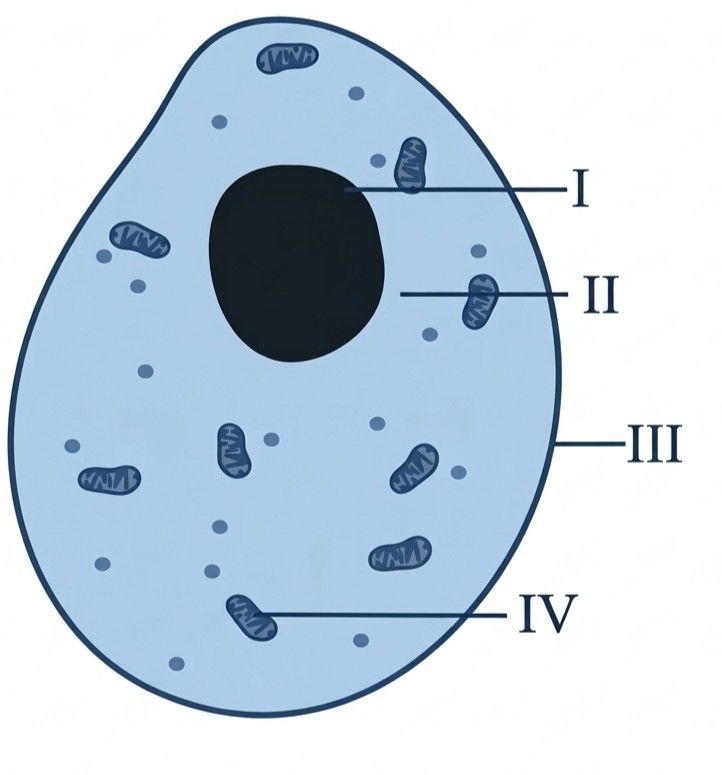
The part labelled I is the
The part labelled I is the
In most generalized cell diagrams, the largest and most prominent organelle, often positioned centrally in animal cells, is the nucleus. It serves as the control center of the cell, housing the genetic material (DNA) and coordinating activities like growth, metabolism, and reproduction. If the label I points to this large spherical body, it is identifying the nucleus. This is distinct from the vacuole, which is usually larger and more central in plant cells, or the mitochondrion, which would be represented as a smaller, bean-shaped structure with internal folds.
Not clear enough?
Question 27
Which of these is an estuarine habitat?
An estuary is a coastal body of water where fresh water from rivers and streams meets and mixes with salt water from the ocean, creating a 'brackish' environment. A lagoon is a prime example of an estuarine habitat, as it is often partially enclosed by a barrier and receives both terrestrial runoff and oceanic inflow. Rivers are fresh water, oceans are purely salt water, and lakes are typically enclosed inland fresh water bodies (though some are salty, they lack the specific river-ocean mixing characteristic of estuaries).
Not clear enough?
Question 28
The mouth parts of a grasshopper are adapted for
Grasshoppers are herbivorous insects that consume tough plant materials like leaves and stems. To process this food, they possess 'mandibulate' mouthparts designed for biting and chewing. These include strong mandibles (jaws) that cut and grind the vegetation. This is in contrast to insects like mosquitoes (piercing and sucking), butterflies (siphoning/sucking), or houseflies (sponging).
Not clear enough?
Question 29
The following are factors that affect the population growth of an organism except
Population growth is determined by the balance between 'plus' factors (natality and immigration) and 'minus' factors (mortality and emigration). Natality refers to the birth rate, which is a fundamental component used to calculate growth. However, in the context of environmental 'limiting factors' that restrain or affect the growth potential of a population, predators, food shortages, and diseases are external pressures. While the phrasing can be tricky, if the question asks for an external factor that limits growth, natality is the internal biological process of growth itself rather than an environmental constraint.
Not clear enough?
Question 30
In ecological succession, the final stable community is called
Ecological succession is the process by which the structure of a biological community evolves over time. It begins with pioneer species (the first to colonize bare area). Through various seral (intermediate) stages, the ecosystem eventually reaches a steady state where the species composition remains relatively stable and in equilibrium with the environment. This final stage is known as the climax community. For example, in a forest succession, the climax community might be a dense forest of mature hardwood trees.
Not clear enough?
You might like
The Marginal Physical Product (M.P.P.) is mathematically defined as which of the following (where P represents total Production and X represents the quantity of input used)?
What is the mass of a particle with speed 2.7 x 10\(^8\) m/s and wavelength 4.0 x 10\(^{-7}\) mm? (h = 6.63 x 10\(^{-34}\) Js)
Choose the option opposite in meaning to the word(s) or phrase in italics.
He is loved for his altruism
This question is based on General Literary Appreciation.
"I cannot rest from travel: I will
Drink
Life to the lees, all times I have
Enjoyed
Greatly, have suffered greatly"
A.L. Tennyson: Ulysses
The lines above inform the reader that the poet