
Chemistry 2007 Jamb Examination

Question 41
The IUPAC nomenclature of compound CH3CH2COOCH2CH3 is
The given compound is an ester, RCOOR' type. Identify the alkyl group attached to oxygen and the acyl group:
CH3CH2COOCH2CH3 → acyl = CH3CH2CO- (propanoate), alkyl = CH2CH3 (ethyl)
Thus the IUPAC name is ethyl propanoate.
Not clear enough?
Question 42
When temporary hard water is boiled for sometime in a kettle, the inner surface of the kettle becomes coated with a deposit of
Temporary hard water contains soluble calcium hydrogencarbonate, Ca(HCO3)2.
Upon boiling: Ca(HCO3)2 → CaCO3(s) + CO2(g) + H2O(l)
The insoluble CaCO3 (calcium carbonate) precipitates and forms a scale on the kettle surface. In IUPAC naming, it is calcium hydrogentrioxocarbonate (IV).
Not clear enough?
Question 43
A supersaturated solution contains more solute than the equilibrium solubility at that temperature.
Unlike saturated solutions, supersaturated solutions are unstable, and addition of a seed crystal can trigger precipitation.
Not clear enough?
Question 44
Nitrogen is chemically inert and dilutes oxygen in air (~21%).
This reduces the rate of oxidation reactions, thus slowing down combustion and corrosion processes. It does not prevent respiration but moderates the availability of O2 for combustion.
Not clear enough?
Question 45
A drying agent absorbs moisture from gases or liquids.
Hygroscopic substances readily absorb water from the surroundings, making them effective drying agents. Examples include CaCl2 and P2O5.
Not clear enough?
Question 46
Smog forms when smoke and fog combine, especially in cities with high combustion of fossil fuels. These pollutants accumulate in the air, causing haze and respiratory hazards.
Not clear enough?
Question 47
What weight of NaCl is needed to make 2.0 dm³ of a 1.5M solution? [Na = 23, Cl = 35.5]
Calculate moles of NaCl: n = C × V = 1.5 × 2.0 = 3.0 mol.
Calculate mass: m = n × M = 3.0 × (23 + 35.5) = 3 × 58.5 = 175.5 g.
Check: The closest correct option considering rounding is 175 g.
Not clear enough?
Question 48
A. CH3 — CH2 — CH — CH2 — OH
|
CH3
B. CH3 — CH — CH2 — CH2 — OH
|
CH3
CH3
|
C. CH — C — CH2 — CH3
|
OH
H
|
D. CH2 — C — CH3
|
OH
Which of the compounds above is a tertiary alkanol?
In order to identify the different types of alcohol
- Identify the Carbon with the OH Group: Find the carbon atom that has the hydroxyl group (OH) attached to it.
- Count the Carbon Bonds: Count how many carbon atoms are directly bonded to that carbon atom.
- Classify the Alcohol:
- If the carbon with the OH group is bonded to one other carbon, it's a primary alcohol.
- If the carbon with the OH group is bonded to two other carbons, it's a secondary alcohol.
- If the carbon with the OH group is bonded to three other carbons, it's a tertiary alcohol.
Not clear enough?
Question 49
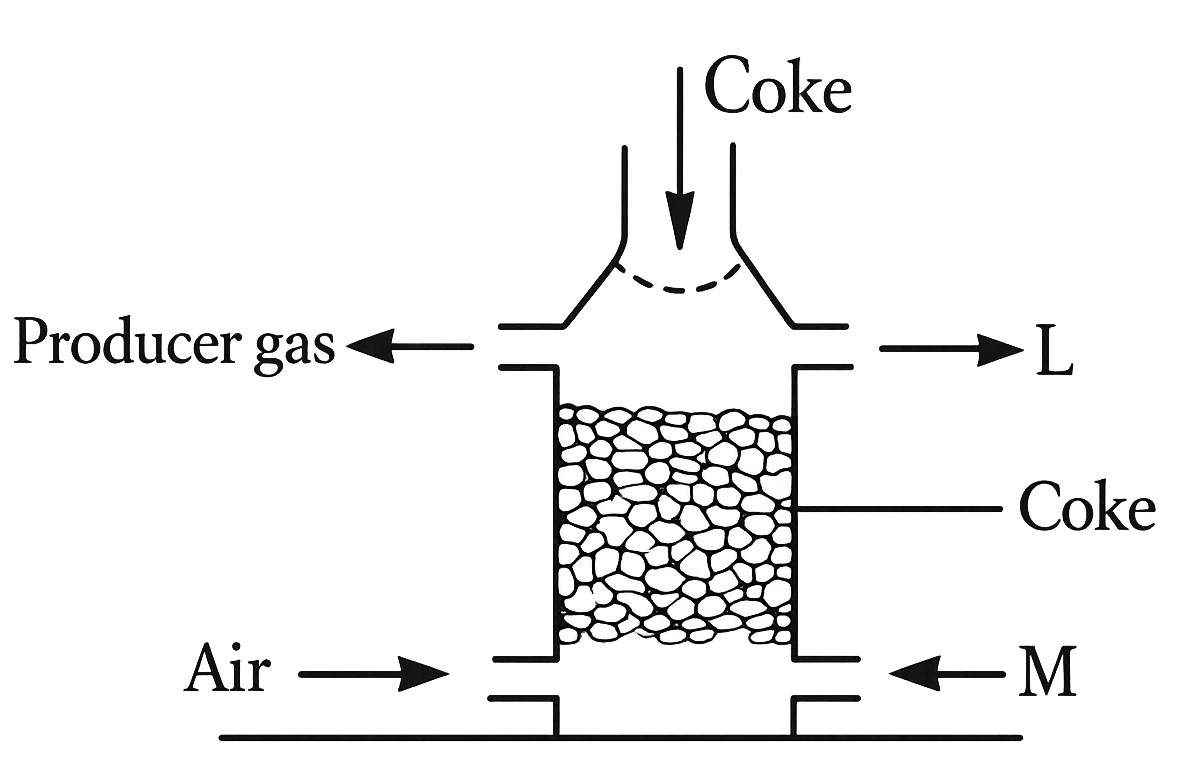
Use the diagram above to answer the question: The fuel gas labelled L is
The diagram shows the producer gas setup, where fuel gas L is a mixture of CO and H₂, commonly referred to as water gas.
Not clear enough?
Question 50
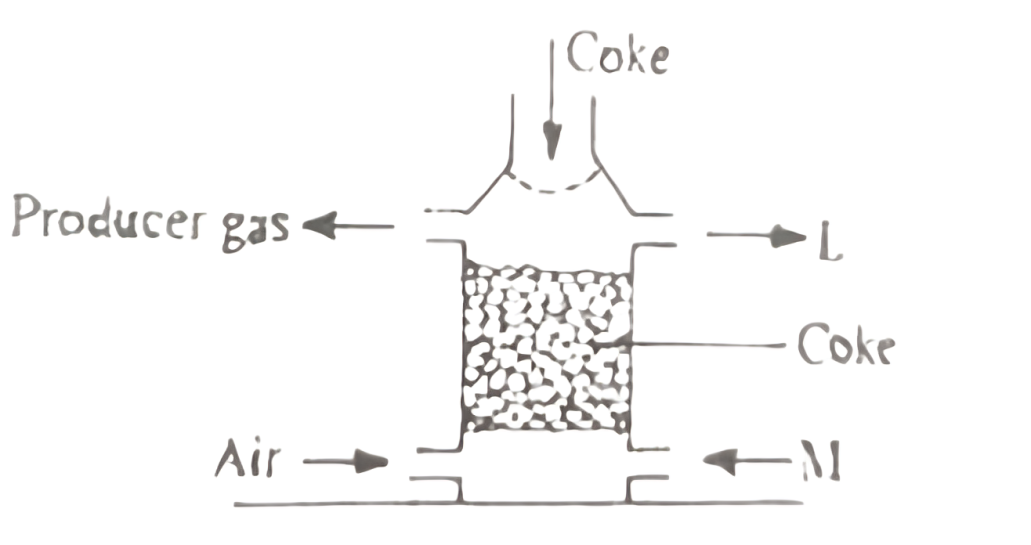
Use the diagram above to answer the question:
The alternative raw material labelled M is
The raw material M in the producer gas diagram is solid carbon (coke), which reacts with steam and air to produce the fuel gas. Option A is correct.
Not clear enough?
You might like
The tangential force acting on an object that opposes it from sliding freely on the adjacent surface is called
Given:
Net profit b/d.....................N10,000
Interest on capital: M...........N2, 000
....................K...........N1, 000
Partners' salary: K...........N800
Interest on drawings: M...........N500
Profit sharing ratio M and K 3:2
Determine M's share of profit?
An organic compound has an empirical formula CH2O and vapour density of 45.
What is the molecular formula?
[C = 12, H = 1, O = 16]
Balance sheet (Extract)
Creditors: #7,940
Prepaid expenses: #290
Accrual expenses: #323
Stock: #4,500
Cash balance: #4,956
Debtors: #905
Determine the current liabilities
Which of the following processes is required to successfully execute a Mail Merge project in Microsoft Word?