Chemistry 2008 Jamb Examination

Chemistry 2008 Jamb Examination

Available Sections
2. Career
4. Job
12345

Question 1

Chlorophyll obtained from green leaves of plant can be shown to be composed of more than one coloured component by the technique of
Show explanation Expand Question
The chlorophyll from the green leaves of plant being a mixture can be separated by Chromatography into its different components. Chromatography has to do with the separation of coloured components. chromatography is used in industrial processes to purify materials, test trace amounts of contaminants, isolate chiral compounds, and quality control test products
Not clear enough?

Question 2

In countries where the temperature falls below 273K, salt is always sprinkled on the icy road in order to
Show explanation Expand Question
The presence of impurities in a substance lowers the melting point. Salt is added on icy roads to cause the ice to melt on time.
Not clear enough?

Question 3

2Na(s) + 2H2O(l) → 2NaOH(aq) + H2(g)  
From the equation above, calculate the mass of sodium hydroxide produced by 2.3g of sodium. [H = 1, O = 16, Na = 23]
Show explanation Expand Question
2Na(s) + 2H2O(l) → 2NaOH(aq) + H2(g)
Relative molecular mass of NaOH = 23 + 16 + 1 = 40gmol-1
2 * 23g of sodium react with water to produce
2 * 40g of NaOH
∴ 2.3g of sodium will react with water to produce
(2.3 * 40 * 2)/(23 * 2) = 4.00g
Not clear enough?

Question 4

16.8g of sodium hydrogen trioxocarbonate (IV) is completely decomposed by heat. Calculate the volume of carbon(IV) oxide given off at s.t.p.}
[Na = 23, C = 12, O = 16, H = 1, Molar volume of a gas at s.t.p } = 22.4$dm^3$
Show explanation Expand Question

The decomposition reaction:
NaHCO3 → Na2CO3 + CO2 + H2O
Molar mass of NaHCO3:
M = 23 + 1 + 12 + (3 $\times$ 16) = 84g/mol
Number of moles of $NaHCO_3$:
n = $\dfrac{16.8}{84} = 0.2 mol$

From the equation, 2 moles of $NaHCO_3$ produce 1 mole of $CO_2$, so 0.2 mol $NaHCO_3$ produces:
$n_{CO_2}$ = 0.2 $\times \dfrac{1}{2} = 0.1 mol$

Volume of $CO_2$ at s.t.p: V =
$n_{CO_2} \times 22.4 = 0.1 \times 22.4 = 2.24 dm^3$

Not clear enough?

Question 5

300cm$^3$ of gas has a pressure of 800mmHg. If the pressure is reduced to 650mmHg, find its volume.
Show explanation Expand Question
Using Boyle's Law: P1V1 = P2V2
P1 = 800 mmHg, V1 = 300 cm3, P2 = 650 mmHg$$V_2 = \dfrac{P_1 V_1}{P_2} $$$$= \dfrac{800 \times 300}{650} \approx 369.23\,\text{cm}^3$$$$\therefore \text{The new volume is } 369.23\,\text{cm}^3$$
Not clear enough?

Question 6

Diffusion is slowest in solid particles than in particles of liquid and gases because
Show explanation Expand Question
In solids, particles are closely packed in fixed positions with very strong intermolecular forces. This restricts their movement, giving them very low kinetic energy compared to particles in liquids and gases. Since diffusion is driven by particle motion, solids diffuse the slowest because their particles vibrate about fixed points and cannot move freely.
Therefore Diffusion is slowest in solids because they have less kinetic energy.
Not clear enough?

Question 7

The experiment that showed that atoms have tiny positively charged nucleus was first carried out by
Show explanation Expand Question
Rutherford’s gold foil experiment involved bombarding thin gold foil with alpha particles. Most passed through, but a few were deflected, indicating a small, dense, positively charged center in the atom (the nucleus). This overturned Thomson’s plum pudding model and led to the nuclear model of the atom.
Not clear enough?

Question 8

The atom of an element X is represented as yzX. The basic chemical properties of X depends on the value of
Show explanation Expand Question
An atom is represented as: \[ ^{Y}_{Z}X \] Here, \(Y\) is the mass number (protons + neutrons), \(Z\) is the atomic number (protons/electrons). The chemical properties of an element are determined by the number of electrons, which equals the atomic number, \(Z\). \[ \therefore \; \text{Chemical properties depend on } Z. \]
Not clear enough?

Question 9

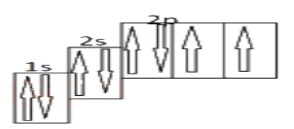
Electronic Configuration of Oxygen
The diagram above represent the electron sub-level for
Show explanation Expand Question
The diagram shows the electron sub-levels. For Oxygen (atomic number 8), the configuration is: \[ 1s^2 \, 2s^2 \, 2p^4 \] 
Not clear enough?

Question 10

In the periodic table, the electrical and thermal conductivities are properties of elements that
Show explanation Expand Question
Metals conduct heat and electricity due to delocalized electrons. Across a period, metallic character decreases (left to right), so conductivity decreases. Down a group of metals, atomic size increases but metallic character strengthens, so conductivity increases. 
Not clear enough?

12345
In this page
Chemistry 2008 Jamb Examination
Open Model!