
Chemistry 2011 Jamb Examination
Chemistry 2011 Jamb Examination

Question 1
MnO4-(aq) + Y + 5Fe2+(aq) → Mn2+(aq) + 5Fe3+(aq) + 4H2O(l)
In the equation above, Y is
In the equation above, Y is
The reaction is a redox reaction in acidic medium. To balance, hydrogen ions must be supplied to account for the four water molecules on the product side.
Balance oxygen and hydrogen:
MnO4- contains 4 O atoms. On the product side, there are 4H2O, i.e., 4 oxygen atoms. These 4 O atoms require 8 H atoms, which must come from 8H+ ions.
Thus, Y = 8H+(aq).
Balance oxygen and hydrogen:
MnO4- contains 4 O atoms. On the product side, there are 4H2O, i.e., 4 oxygen atoms. These 4 O atoms require 8 H atoms, which must come from 8H+ ions.
Thus, Y = 8H+(aq).
Not clear enough?
Question 2
H H H H
| | | |
H — C — C — C — C — Cl
| | | |
H OH H Cl
The functional groups present in the compound above are
The compound contains an -OH group (hydroxyl) and a -Cl substituent (chloro/halo group). There is no double bond (alkene).
Not clear enough?
Question 3
A chemical reaction in which the hydration energy is greater than the lattice energy is referred to as
When hydration energy (released on solvation) exceeds lattice energy (required to separate ions), the process is exothermic since overall heat is released.
Not clear enough?
Question 4
H
|
CH3 — C — COOH
|
OH
The compound above exhibits
The compound is lactic acid, CH3-CHOH-COOH. The central carbon is asymmetric (bonded to -H, -OH, -CH3, -COOH), so it exhibits optical isomerism.
Not clear enough?
Question 5
An isotope has an atomic number of 15 and a mass number of 31. The number of protons it contains is
Atomic number equals the number of protons. Here, atomic number = 15, so the isotope contains 15 protons.
Not clear enough?
Question 6
Which of the following properties is not peculiar to matter?
Statement B is incorrect: random motion decreases when moving from gas to solid, not increases.
Not clear enough?
Question 7
What is the concentration of a solution containing 2 g of NaOH in 100 cm3 of solution?
[Na = 23, O = 16, H = 1]
[Na = 23, O = 16, H = 1]
Calculate molar mass of NaOH:\[ M = 23 + 16 + 1 = 40 \; \text{g mol}^{-1} \]
Calculate moles in 2 g: \[ n = \dfrac{2}{40} = 0.05 \; \text{mol} \]
Convert solution volume to dm3: \[ 100 \; \text{cm}^3 = 0.100 \; \text{dm}^3 \]
Calculate concentration:\[ C = \dfrac{n}{V} = \dfrac{0.05}{0.100} = 0.50 \; \text{mol dm}^{-3} \]
Not clear enough?
Question 8
The ability of carbon to form long chains is referred to as
Catenation is the property of carbon to link to itself forming long chains and rings.
Not clear enough?
Question 9
The principle of column chromatography is based on the ability of the constituents to
Column chromatography separates components because different molecules move at different speeds through the stationary phase.
Not clear enough?
Question 10
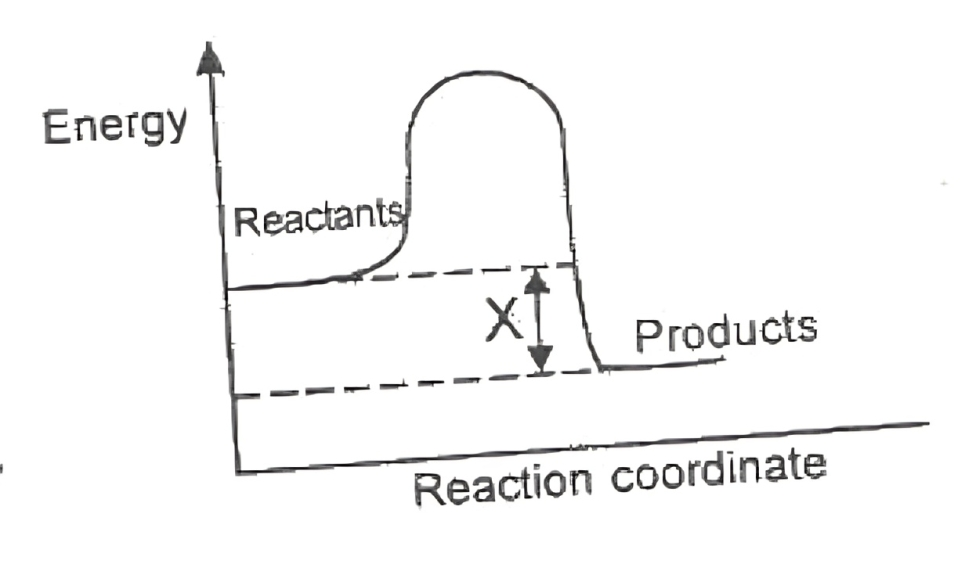
In the diagram above, X is the ``
In an energy profile diagram, the vertical difference between reactants and products is enthalpy change (ΔH). Thus, X = enthalpy change.
Not clear enough?
You might like
The limit of functions, activities and personnel that a supervisor can effectively manage in a business organization is?
A man made a profit of 5% when he sold an article for N60,000.00. How much would he have sell the article to make a profit of 26%
A train, 150 m long, takes 30 seconds to cross a bridge 500 m long. How much time will the train take to cross a platform 370 m long ?
From the novel; Othello
The question is based on William Shakespeare's Othello
Othello kills Desdemona because the_______