
Chemistry 2025 Jamb Examination
Chemistry 2025 Jamb Examination

Question 31
If a gold bar and a silver bar are tied together firmly and left for years, some of the gold particles will be found in the silver bar due to
Diffusion is the net movement of particles from a region of higher concentration to a region of lower concentration. While we usually observe this in gases and liquids, it also occurs in solids, albeit at an extremely slow rate.
When two metals are in close contact for a long period, the atoms at the interface vibrate and occasionally jump into the adjacent crystal lattice of the other metal. This process of intermingling at the atomic level over time is known as solid-state diffusion.
When two metals are in close contact for a long period, the atoms at the interface vibrate and occasionally jump into the adjacent crystal lattice of the other metal. This process of intermingling at the atomic level over time is known as solid-state diffusion.
Not clear enough?
Question 32
A metal that can be found in the free state in nature is
Metals that are found in the free (native) state in nature are those that are chemically unreactive and do not easily form compounds with oxygen, sulphur, or other elements. These are typically found at the bottom of the reactivity series.
While silver and copper are sometimes found in the free state, gold is the most classic example. However, among the provided options, silver is the most likely intended answer as it is much less reactive than zinc or iron. (Note: Gold is often the standard answer for this question, but silver is the correct choice from this specific list).
While silver and copper are sometimes found in the free state, gold is the most classic example. However, among the provided options, silver is the most likely intended answer as it is much less reactive than zinc or iron. (Note: Gold is often the standard answer for this question, but silver is the correct choice from this specific list).
Not clear enough?
Question 33
Which of the following has the highest boiling point?
The boiling point of an organic compound depends on the strength of its intermolecular forces and its molecular mass.
Options A and D are alkanols, which possess hydrogen bonding—the strongest type of intermolecular force. Between ethanol (A) and propan-1-ol (D), propan-1-ol has a larger molecular mass and a longer carbon chain, leading to stronger Van der Waals forces in addition to the hydrogen bonding. Therefore, \(CH_3CH_2CH_2OH\) has the highest boiling point.
Options A and D are alkanols, which possess hydrogen bonding—the strongest type of intermolecular force. Between ethanol (A) and propan-1-ol (D), propan-1-ol has a larger molecular mass and a longer carbon chain, leading to stronger Van der Waals forces in addition to the hydrogen bonding. Therefore, \(CH_3CH_2CH_2OH\) has the highest boiling point.
Not clear enough?
Question 34
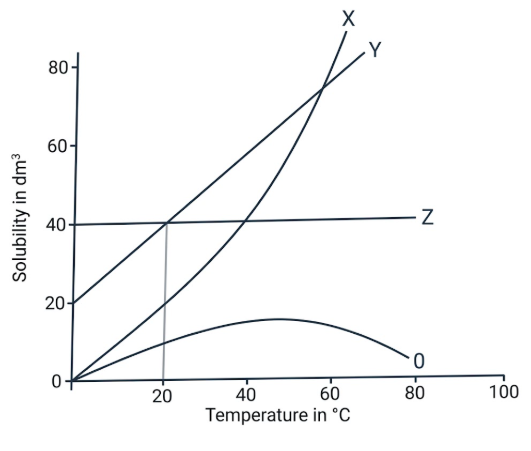
From the graph, it can be inferred that
A solubility curve shows how the solubility of various substances changes with temperature.
In the provided graph, the lines for X, Y, and Z all show a gradient (slope) as temperature changes. This indicates that their solubility is not constant but varies with temperature. Specifically, X and Y show an increase in solubility with temperature, while Z shows a decrease. Therefore, the most accurate general inference is that the solubility of all three substances is temperature dependent.
In the provided graph, the lines for X, Y, and Z all show a gradient (slope) as temperature changes. This indicates that their solubility is not constant but varies with temperature. Specifically, X and Y show an increase in solubility with temperature, while Z shows a decrease. Therefore, the most accurate general inference is that the solubility of all three substances is temperature dependent.
Not clear enough?
Question 35
The gas that is commonly used to demonstrate the fountain experiment is
The fountain experiment is used to demonstrate the high solubility of certain gases in water.
Ammonia (\(NH_3\)) and hydrogen chloride (\(HCl\)) are the two primary gases used for this experiment because they are extremely soluble. When a small amount of water is introduced into a flask filled with \(HCl\) gas, the gas dissolves rapidly, creating a vacuum that sucks more water up through a tube, creating a 'fountain'.
Ammonia (\(NH_3\)) and hydrogen chloride (\(HCl\)) are the two primary gases used for this experiment because they are extremely soluble. When a small amount of water is introduced into a flask filled with \(HCl\) gas, the gas dissolves rapidly, creating a vacuum that sucks more water up through a tube, creating a 'fountain'.
Not clear enough?
Question 36
Which of the following statements is false about hard water?
Hard water contains dissolved minerals like calcium and magnesium ions. These minerals are beneficial for building strong bones and teeth, and many people prefer the taste of hard water over soft water. However, the statement that it 'cannot be supplied in pipes made of lead' is false in the context of it being a disadvantage of hard water; actually, hard water is *safer* in lead pipes because it forms a protective layer of calcium carbonate (limescale) that prevents lead from leaching into the water. It is soft water that is more dangerous in lead pipes.
Not clear enough?
Question 37
The empirical mass of C6H12O6 is [H = 1, C = 12, O = 16]
The empirical formula is the simplest whole-number ratio of atoms in a compound. For glucose (\(C_6H_{12}O_6\)), dividing the subscripts by their greatest common divisor (6) gives the empirical formula: \(CH_2O\).
The empirical mass is calculated from this formula:\[(1 \times C) + (2 \times H) + (1 \times O)\]\[(1 \times 12) + (2 \times 1) + (1 \times 16) = 12 + 2 + 16 = 30\]The empirical mass is 30.
The empirical mass is calculated from this formula:\[(1 \times C) + (2 \times H) + (1 \times O)\]\[(1 \times 12) + (2 \times 1) + (1 \times 16) = 12 + 2 + 16 = 30\]The empirical mass is 30.
Not clear enough?
Question 38
The nitrogenous compound in dead materials in the soil is converted to
In the nitrogen cycle, the process of decomposition converts organic nitrogen from dead plants and animals into inorganic forms.
Bacteria and fungi break down proteins and amino acids, releasing nitrogen in the form of ammonia (\(NH_3\)) or ammonium ions (\(NH_4^+\)). This specific step is called ammonification. These products are later converted into nitrites and nitrates by nitrifying bacteria.
Bacteria and fungi break down proteins and amino acids, releasing nitrogen in the form of ammonia (\(NH_3\)) or ammonium ions (\(NH_4^+\)). This specific step is called ammonification. These products are later converted into nitrites and nitrates by nitrifying bacteria.
Not clear enough?
Question 39
What is the IUPAC nomenclature of the compound CH3C ≡ CCH(CH3)2?
To name the compound, we first identify the longest continuous carbon chain containing the triple bond.
1. The chain has 5 carbons, so the parent name is 'pentyne'.
2. Number the chain from the end closest to the triple bond: \(C_1(H_3) - C_2 \equiv C_3 - C_4H(CH_3) - C_5(H_3)\). The triple bond starts at carbon 2, making it 'pent-2-yne'.
3. There is a methyl group attached to carbon 4. Combining these, the name is 4-methylpent-2-yne.
Not clear enough?
Question 40
In the laboratory preparation of oxygen using potassium trioxochlorate(V), tetraoxomanganate(VII) is usually not recommended in modern laboratories because
Potassium trioxochlorate(V) (\(KClO_3\)) is a powerful oxidising agent. While \(MnO_2\) is the standard catalyst used to decompose it into oxygen, using \(KMnO_4\) or having carbon-based impurities present is extremely dangerous. \(KClO_3\) can form highly sensitive and explosive mixtures when in contact with organic or carbonaceous materials (like dust, paper, or rubber), which can lead to violent explosions during heating.
Not clear enough?
You might like
The table below gives the scores of a group of students. Find the mode of the distribution. \[ \begin{array}{|l|c|c|c|c|c|c|c|} \hline \text{Score} & 1 & 2 & 3 & 4 & 5 & 6 & 7 \\ \hline \text{Freq} & 4 & 6 & 8 & 4 & 10 & 6 & 2 \\ \hline \end{array} \]
Choose the option that best complete the gap(s).
If you are confused_______anything, phone my office.