
Economics 2015 Jamb Examination
Economics 2015 Jamb Examination

Question 61
The quantity theory of money states that a reduction in the quantity of money in circulation would bring about
According to the quantity theory of money, there is a direct relationship between the quantity of money in circulation and the general price level. When the amount of money in circulation is reduced, people have less money to spend, which lowers aggregate demand and leads to a proportional fall in prices.
Therefore, the fall in money supply leads to a corresponding decrease in the price level, maintaining equilibrium in the economy.
Therefore, the fall in money supply leads to a corresponding decrease in the price level, maintaining equilibrium in the economy.
Not clear enough?
Question 62
The tax levied on locally produced goods is
Excise duty is a tax imposed on goods produced within a country. It is typically paid by manufacturers but passed on to consumers in the form of higher prices.
In contrast, import duty applies to goods brought from abroad, while value added tax (VAT) is levied on the value added at each stage of production and distribution.
Hence, excise duty is specifically a tax on locally produced goods.
In contrast, import duty applies to goods brought from abroad, while value added tax (VAT) is levied on the value added at each stage of production and distribution.
Hence, excise duty is specifically a tax on locally produced goods.
Not clear enough?
Question 63
Revenue can be expressed as
Revenue refers to the total amount of money a firm receives from selling its goods or services before any expenses are deducted. It is mathematically represented as:
\( \text{Revenue} = \text{Price} \times \text{Quantity Sold} \).
It differs from profit, which is the revenue remaining after deducting all costs and expenses.
\( \text{Revenue} = \text{Price} \times \text{Quantity Sold} \).
It differs from profit, which is the revenue remaining after deducting all costs and expenses.
Not clear enough?
Question 64
All the following are factors that would bring about a change in supply except
A change in supply is caused by non-price factors such as technology, production costs, government policies, and number of firms in the market.
However, the price of the commodity itself does not shift the supply curve — it only causes movement along the supply curve.
Therefore, price of the commodity does not cause a change in supply.
However, the price of the commodity itself does not shift the supply curve — it only causes movement along the supply curve.
Therefore, price of the commodity does not cause a change in supply.
Not clear enough?
Question 65
The combination of two commodities each yielding the same level of satisfaction to the consumer is
An indifference curve represents various combinations of two goods that give a consumer equal satisfaction or utility.
Each point on the curve indicates that the consumer is indifferent between the two combinations.
Consumer surplus, on the other hand, is the difference between what a consumer is willing to pay and what they actually pay.
Each point on the curve indicates that the consumer is indifferent between the two combinations.
Consumer surplus, on the other hand, is the difference between what a consumer is willing to pay and what they actually pay.
Not clear enough?
Question 66
In which situation is it likely that the demand for labour would be inelastic?
The demand for labour is inelastic when changes in wages do not lead to significant changes in the quantity of labour demanded.
This happens when labour costs form only a small part of total costs, as employers are less sensitive to wage changes.
Hence, even if wages rise or fall, the overall cost impact is minimal, and firms continue employing nearly the same number of workers.
This happens when labour costs form only a small part of total costs, as employers are less sensitive to wage changes.
Hence, even if wages rise or fall, the overall cost impact is minimal, and firms continue employing nearly the same number of workers.
Not clear enough?
Question 67
The headquarter of the Organization Of Petroleum Exporting Countries (OPEC) is in
The Organisation of Petroleum Exporting Countries (OPEC) was founded in 1960 to coordinate and unify petroleum policies among member countries.
Its headquarters is located in Vienna, Austria, where major decisions on oil production and pricing are made.
The city was chosen for its neutrality and accessibility to member states.
Its headquarters is located in Vienna, Austria, where major decisions on oil production and pricing are made.
The city was chosen for its neutrality and accessibility to member states.
Not clear enough?
Question 68
The law of variable proportions is also known as
The law of variable proportions, also called the law of diminishing returns, states that as more units of a variable factor (like labour) are added to a fixed factor (like land or machinery), total output increases at a decreasing rate beyond a certain point.
This law applies in the short run when at least one factor of production remains constant.
This law applies in the short run when at least one factor of production remains constant.
Not clear enough?
Question 69
All the following are problems identified with agriculture in West Africa except
Agriculture in West Africa faces challenges such as poor land tenure systems, low education levels among farmers, and the use of crude implements.
However, provision of food for the teeming population is a positive outcome of agriculture, not a problem.
Therefore, it is the correct exception among the listed options.
However, provision of food for the teeming population is a positive outcome of agriculture, not a problem.
Therefore, it is the correct exception among the listed options.
Not clear enough?
Question 70
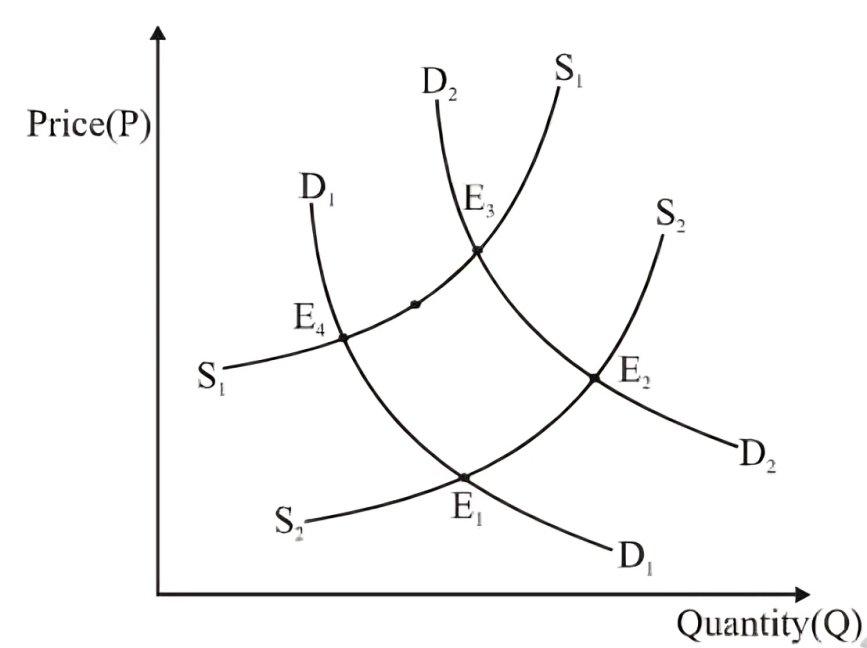
The diagram above shows the shifts in both demand and supply curves. What is the new equilibrium point after the shifts?
When both demand and supply curves shift, the new equilibrium is determined by their new intersection point.
From the diagram, after both curves shift, they intersect at point E2, indicating the new equilibrium price and quantity.
This reflects the balance between the new demand and supply conditions in the market.
From the diagram, after both curves shift, they intersect at point E2, indicating the new equilibrium price and quantity.
This reflects the balance between the new demand and supply conditions in the market.
Not clear enough?
You might like
If the value of XYZ Company stock drops from \$25 per share to \$21 per share, what is the percent of the decrease?
An object weighs 22 N in water and 30 N in air. What is the upthrust exerted by the liquid on the object?
[g = 10 m/s²]
Stock of material 1/1: N10 000 Purchase of raw material: N160 000 Manufacturing wages: N420 000 Royalties: N3 000 Stock of raw materials 31/12: N14 000 Calculate the prime cost?