
Economics 2015 Jamb Examination
Economics 2015 Jamb Examination

Question 1
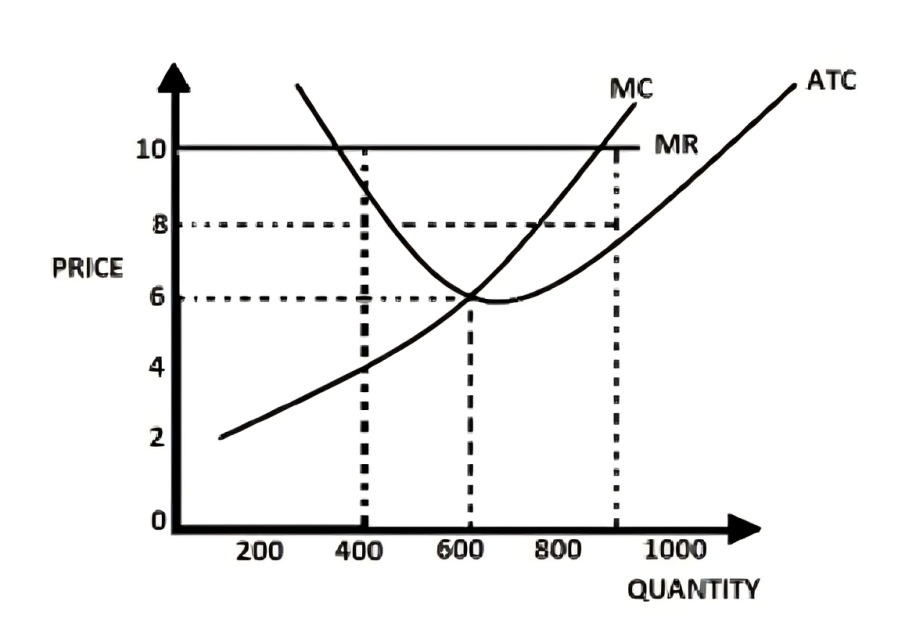
From the diagram, determine the profit-maximising output.
The profit-maximising output occurs where marginal cost equals marginal revenue (MC = MR).
From the diagram, this condition is satisfied at the point corresponding to 900 units.
Producing beyond or below this point would result in lower profit since costs would exceed revenues or potential revenue would be unexploited.
Therefore, 900 units is the equilibrium output for maximum profit.
From the diagram, this condition is satisfied at the point corresponding to 900 units.
Producing beyond or below this point would result in lower profit since costs would exceed revenues or potential revenue would be unexploited.
Therefore, 900 units is the equilibrium output for maximum profit.
Not clear enough?
Question 2
Given that the prices and quantities supplied in litres of petrol is expressed as \( Q_s = 25 + 0.25P \).
\( Q_s \) is the quantity supplied and \( P \) is price.
Determine the quantity supplied when price per litre is ₦30.
\( Q_s \) is the quantity supplied and \( P \) is price.
Determine the quantity supplied when price per litre is ₦30.
Using the supply function: \( Q_s = 25 + 0.25P \).
Substituting \( P = 30 \):\[ Q_s = 25 + 0.25(30) = 25 + 7.5 = 32.5 \text{ litres} \]Thus, the quantity supplied at ₦30 per litre is 32.5 litres.
Substituting \( P = 30 \):\[ Q_s = 25 + 0.25(30) = 25 + 7.5 = 32.5 \text{ litres} \]Thus, the quantity supplied at ₦30 per litre is 32.5 litres.
Not clear enough?
Question 3
What would encourage the growth of international division of labour?
International division of labour thrives when trade between nations becomes easier and more efficient.
Improved transportation systems reduce costs and facilitate movement of goods and services across borders.
Therefore, better transport networks encourage countries to specialise in the production of goods where they have a comparative advantage.
Improved transportation systems reduce costs and facilitate movement of goods and services across borders.
Therefore, better transport networks encourage countries to specialise in the production of goods where they have a comparative advantage.
Not clear enough?
Question 4
The demand and supply functions of commodity X are given as follows:
\( Q_d = 20 - 2P \), \( Q_s = 6P - 12 \)
where \( P \) = price, \( Q_d \) = quantity demanded, and \( Q_s \) = quantity supplied.
Determine the equilibrium price.
\( Q_d = 20 - 2P \), \( Q_s = 6P - 12 \)
where \( P \) = price, \( Q_d \) = quantity demanded, and \( Q_s \) = quantity supplied.
Determine the equilibrium price.
At equilibrium, \( Q_d = Q_s \).
Hence, \( 20 - 2P = 6P - 12 \).
Solving for \( P \):\[ 20 + 12 = 8P \Rightarrow 32 = 8P \Rightarrow P = 4 \]Therefore, the equilibrium price is ₦4.
Hence, \( 20 - 2P = 6P - 12 \).
Solving for \( P \):\[ 20 + 12 = 8P \Rightarrow 32 = 8P \Rightarrow P = 4 \]Therefore, the equilibrium price is ₦4.
Not clear enough?
Question 5
The practice of selling goods overseas and often below the cost of production is known as
Dumping occurs when a country or firm sells goods abroad at prices lower than their domestic selling price or production cost.
This is often done to gain market share or eliminate competition in the foreign market.
It can lead to trade disputes and the imposition of anti-dumping duties.
This is often done to gain market share or eliminate competition in the foreign market.
It can lead to trade disputes and the imposition of anti-dumping duties.
Not clear enough?
Question 6
In a situation when a firm is operating in a perfectly competitive market and the total cost is given as ₦75.00.
If the market price is ₦7.00, determine the profit when 25 units are produced.
If the market price is ₦7.00, determine the profit when 25 units are produced.
In a perfectly competitive market, total revenue (TR) is given by \( P \times Q \).
Given \( P = 7 \) and \( Q = 25 \):\[ TR = 7 \times 25 = 175 \] Profit = TR - TC = 175 - 75 = ₦100 .
Therefore, the firm’s profit is ₦100.
Given \( P = 7 \) and \( Q = 25 \):\[ TR = 7 \times 25 = 175 \] Profit = TR - TC = 175 - 75 = ₦100 .
Therefore, the firm’s profit is ₦100.
Not clear enough?
Question 7
The theory of comparative cost advantage is associated with
The theory of comparative cost advantage was developed by David Ricardo.
It explains that countries should specialise in producing goods where they have the lowest opportunity cost relative to others.
This leads to increased global efficiency and mutual gains from trade.
It explains that countries should specialise in producing goods where they have the lowest opportunity cost relative to others.
This leads to increased global efficiency and mutual gains from trade.
Not clear enough?
Question 8
In a situation where \( MU_x \) represents the marginal utility of product X while \( P_x \) represents its price respectively.
Utility can be maximised when
Utility can be maximised when
Utility maximisation occurs when the ratio of marginal utility to price is equal across all goods, i.e. \( \dfrac{MU_x}{P_x} = \dfrac{MU_y}{P_y} \).
For one good, equilibrium is achieved when the marginal utility of X equals its price (\( MU_X = P_X \)), meaning that the consumer gains equal satisfaction per naira spent on the product.
For one good, equilibrium is achieved when the marginal utility of X equals its price (\( MU_X = P_X \)), meaning that the consumer gains equal satisfaction per naira spent on the product.
Not clear enough?
Question 9
Which of the following could be used to measure the efficiency of labour?
The efficiency of labour is determined by how effectively input is converted into output.
The input-output ratio compares the quantity of output produced to the input used, showing how productive workers are.
Higher efficiency is reflected in a lower input requirement for a given output.
The input-output ratio compares the quantity of output produced to the input used, showing how productive workers are.
Higher efficiency is reflected in a lower input requirement for a given output.
Not clear enough?
Question 10
How can a firm benefit from external economies?
External economies of scale are benefits a firm receives from the growth of the entire industry rather than from its own expansion.
By locating in an area where the industry is already developed, the firm can take advantage of shared infrastructure, skilled labour, and supplier networks, thereby reducing production costs and improving efficiency.
By locating in an area where the industry is already developed, the firm can take advantage of shared infrastructure, skilled labour, and supplier networks, thereby reducing production costs and improving efficiency.
Not clear enough?
You might like
Select the option that best explains the information conveyed in the sentence.
The government warns that drink-driving is punishable under the law.
This question is based on Thomas Hardy's Tess of the d'Urbervilles.
One thing that Angel Clare hates most is:
Activities such as keeping a few birds, some fruit trees, and a small garden on a farm, which use resources that might otherwise go to waste without reducing the main crop production, are examples of __________.
Which of the following kings said, 'Behold your gods, O Israel, who brought you up out of the land of Egypt?'