
Economics 2015 Jamb Examination
Economics 2015 Jamb Examination

Question 21
Disposable income is total income
Disposable income refers to the portion of an individual's total income that remains after deducting direct taxes such as income tax.
It represents the amount available for spending and saving.
Hence, disposable income = total income − tax.
It represents the amount available for spending and saving.
Hence, disposable income = total income − tax.
Not clear enough?
Question 22
In which of the following economic systems do we have the means of production and exchange controlled by private individuals
In a capitalist economic system, the means of production and exchange are owned and controlled by private individuals or enterprises.
The major motivation is profit, and decisions are driven by market forces of demand and supply rather than government directives.
The major motivation is profit, and decisions are driven by market forces of demand and supply rather than government directives.
Not clear enough?
Question 23
Isocost and isoquant can be attributed to
Isoquant and isocost lines are concepts from the theory of production.
An isoquant shows all combinations of factors of production that yield the same level of output, while an isocost line shows all combinations of inputs that cost the same total amount.
Their intersection helps determine the least-cost combination of inputs for a given level of output.
An isoquant shows all combinations of factors of production that yield the same level of output, while an isocost line shows all combinations of inputs that cost the same total amount.
Their intersection helps determine the least-cost combination of inputs for a given level of output.
Not clear enough?
Question 24
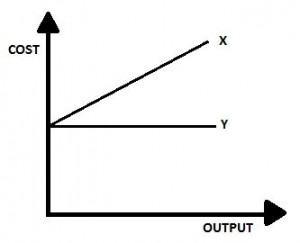
The line Y in the diagram represents
A fixed cost line is horizontal because fixed costs remain constant regardless of the level of output produced.
The diagram indicates that line Y does not change with output, signifying that it represents fixed cost.
The diagram indicates that line Y does not change with output, signifying that it represents fixed cost.
Not clear enough?
Question 25

The curve labeled II illustrates a system of taxation
A proportional tax system maintains a constant tax rate regardless of income level.
The diagram for curve II shows a straight line through the origin, indicating that as income increases, the same proportion of income is paid as tax.
The diagram for curve II shows a straight line through the origin, indicating that as income increases, the same proportion of income is paid as tax.
Not clear enough?
Question 26
The curve labeled III illustrate a system of taxation
A regressive tax system is one in which the tax rate decreases as income increases.
This means individuals with lower incomes pay a higher percentage of their income as tax than those with higher incomes.
The curve labeled III shows this inverse relationship, hence it represents a regressive tax.
This means individuals with lower incomes pay a higher percentage of their income as tax than those with higher incomes.
The curve labeled III shows this inverse relationship, hence it represents a regressive tax.
Not clear enough?
Question 27
What would be likely to increase inflation in any economy?
Inflation is often caused by demand-pull factors such as an increase in overall demand for goods and services that exceeds supply.
When demand rises without a corresponding increase in supply, prices tend to rise, leading to inflation.
Hence, an increase in demand is a major cause of inflationary pressure.
When demand rises without a corresponding increase in supply, prices tend to rise, leading to inflation.
Hence, an increase in demand is a major cause of inflationary pressure.
Not clear enough?
Question 28
All the following are types of specialisation except
Types of specialisation include product specialisation (focus on a particular good), geographical specialisation (focus by region), and specialisation by sex (division of labour by gender).
'Manager specialisation' is not a recognised type in economics, making it the incorrect option.
'Manager specialisation' is not a recognised type in economics, making it the incorrect option.
Not clear enough?
Question 29
A market will be at equilibrium when
Market equilibrium occurs when the quantity demanded equals the quantity supplied.
At this point, there is no tendency for the price to change, and the market is said to be in balance.
If demand or supply shifts, the equilibrium price and quantity will adjust accordingly.
At this point, there is no tendency for the price to change, and the market is said to be in balance.
If demand or supply shifts, the equilibrium price and quantity will adjust accordingly.
Not clear enough?
Question 30
Which of the following will shift the demand curve for Bournvita to the right
A rightward shift in the demand curve means an increase in demand at every price level.
For a normal good like Bournvita, an increase in consumers’ income leads to higher purchasing power and greater demand.
Therefore, higher income shifts the demand curve to the right.
For a normal good like Bournvita, an increase in consumers’ income leads to higher purchasing power and greater demand.
Therefore, higher income shifts the demand curve to the right.