Economics 2018 Jamb Examination
Economics 2018 Jamb Examination

Question 51
The study of Economics becomes necessary because of the______________
Economics studies how societies allocate scarce resources among competing uses.
Human wants are unlimited, but the resources available to satisfy them are limited. This fundamental imbalance creates the need for choice and prioritisation, which is the basis of economic analysis.
Scarcity therefore explains why individuals, firms, and governments must make decisions about production, distribution, and consumption.
Not clear enough?
Question 52
The formula (index of export prices)/(index of import prices) × 100 is used to measure the____________
The ratio of export price index to import price index multiplied by 100 shows how many units of imports a country can obtain per unit of exports.
This measure reflects the purchasing power of a country's exports in relation to its imports and is known as the commodity terms of trade. A rise indicates an improvement, while a fall indicates deterioration.
This measure reflects the purchasing power of a country's exports in relation to its imports and is known as the commodity terms of trade. A rise indicates an improvement, while a fall indicates deterioration.
Not clear enough?
Question 53
| X | F |
|---|---|
| 8 | 2 |
| 10 | 1 |
| 12 | 4 |
| 16 | 3 |
| 18 | 3 |
| 20 | 1 |
| 24 | 6 |
From the table, Calculate the mean?
To obtain the mean of grouped data, multiply each value by its frequency and divide the total of these products by the total frequency.\[ \text{Mean} = \dfrac{\sum (X \times F)}{\sum F} \](8 x 2) + (10 x 1) + (12 x 4) + (16 x 3) + (18 x 3) + (20 x 1) + (24 x 6) = 272
Total frequency: 2 + 1+ 4 + 3 + 3 + 1 + 6 = 20\[ \text{Mean} = \dfrac{272}{20} = 17.0 \]The average value is therefore 17.
Total frequency: 2 + 1+ 4 + 3 + 3 + 1 + 6 = 20\[ \text{Mean} = \dfrac{272}{20} = 17.0 \]The average value is therefore 17.
Not clear enough?
Question 54
The number of people who are qualified to work and who offer themselves for employment is called____________?
The term describes individuals of working age who are both able and willing to work. This group forms the labour force available for productive activities within the economy.
It excludes those who are not seeking work or are not qualified due to age or health. Hence, it refers to the working population.
It excludes those who are not seeking work or are not qualified due to age or health. Hence, it refers to the working population.
Not clear enough?
Question 55
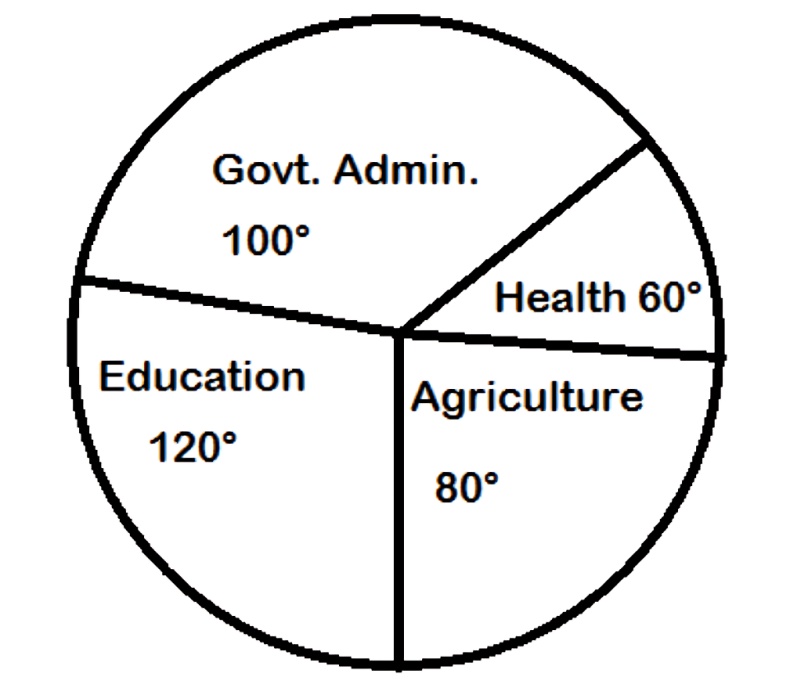
A country's budget allocation to various sectors of the economy is shown in the pie chart.
What is the ratio of expenditure of health to Agriculture?
Agriculture makes 80o
Health makes 60o
Health : Agriculture = 60 : 80 = 3 : 4
Health makes 60o
Health : Agriculture = 60 : 80 = 3 : 4
Not clear enough?
Question 56
Which of the following is an invisible item?
Invisible items are non-tangible goods and services traded internationally. They do not involve physical commodities crossing borders.
Banking services fall under this category because they are intangible financial services provided across countries. Processed goods such as rice or milk are visible items because they are physical products.
Banking services fall under this category because they are intangible financial services provided across countries. Processed goods such as rice or milk are visible items because they are physical products.
Not clear enough?
Question 57
The population density of a town made up of 50 square kilometre land area and 100 million people is________
Population density is calculated by dividing the total population by the land area.\[ \text{Population Density} = \dfrac{100\,000\,000}{50} = 2\,000\,000 \]This equals 2 million people per square kilometre, which indicates a very densely populated settlement.
Not clear enough?
Question 58
The establishment of industries in rural areas will help to reduce____________
People in rural areas migrate to urban centres seeking employment, better income, and improved living conditions.
When industries are established in rural areas, they provide job opportunities locally, reducing the incentive to migrate to cities. This helps to curb rural-urban migration significantly.
When industries are established in rural areas, they provide job opportunities locally, reducing the incentive to migrate to cities. This helps to curb rural-urban migration significantly.
Not clear enough?
Question 59
The use of income and expenditure instruments or policies to control or regulate the economic activities of a country is known as?
Government adjusts its spending and revenue patterns to influence the economy. This includes taxation, public expenditure, borrowing, and subsidies.
These instruments collectively constitute fiscal policy, which is used to stabilise the economy, regulate growth, and manage inflation.
These instruments collectively constitute fiscal policy, which is used to stabilise the economy, regulate growth, and manage inflation.
Not clear enough?
Question 60
A group formed to enable members adopt a common policy in labour negotiation is known as?
An employer’s association is formed by employers who work together to develop unified positions during negotiations with workers’ unions.
By coordinating their policies, they strengthen their bargaining power and present consistent terms in labour discussions.
By coordinating their policies, they strengthen their bargaining power and present consistent terms in labour discussions.